


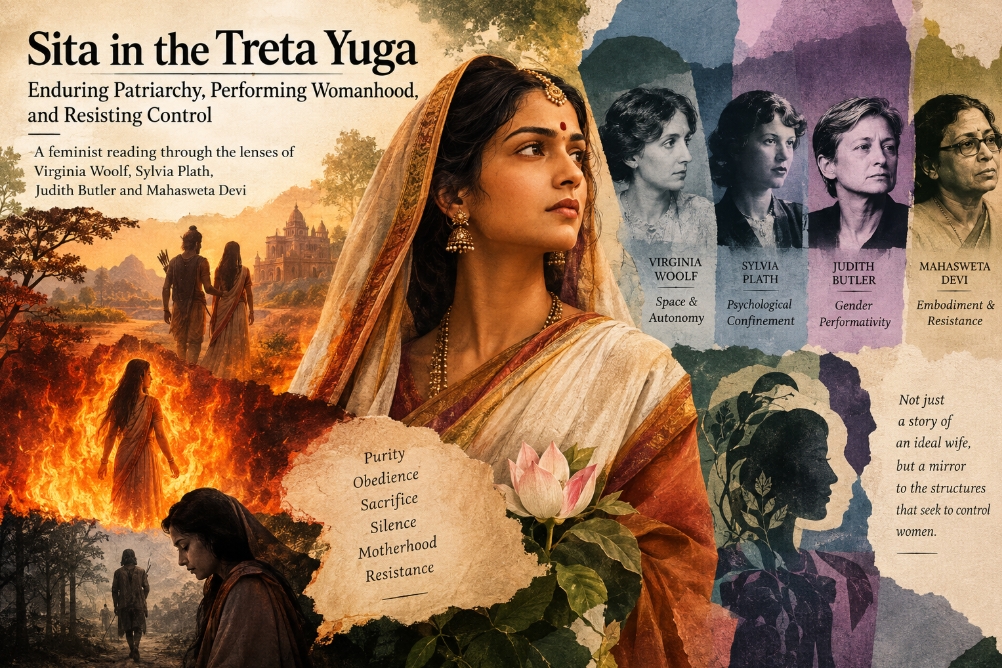
Sita Enduring Patriarchy
The Ramayana not only presents Sita as the ultimate devoted wife but also reveals a complex encounter between female agency and patriarchal authority. Although feminist scholars and thinkers such as Virginia Woolf, Sylvia Plath, Judith Butler, Mahasweta Devi and several others have discovered different intellectual lenses and lexicon from the imagined social world of Treta Yuga, these authors have exposed various mechanisms through which women are silenced and disciplined. Yet revisiting Sita’s experience through feminist lenses can be extremely helpful in understanding how the epic Ramayana has entrenched patriarchal norms in the psyche and imagination of people.
The central question this article delves into understanding is not if Sita was feminist in the modern sense. This article seeks to decipher: what happens when we read her story through feminist theories of identity, gender, space, psychological confinement, performance and resistance?
Reading Sita Beyond the Ideal Wife
Sita occupies the most enduring position not only in the Hindu mythology but also in the cultural imagination of South Asia. She has been celebrated as the embodiment of fidelity, chastity, sacrifice, patience, and devotion. Yet her story poses some of the most intriguing and unsettling questions concerning women’s position in epic literature. Epic literature has continued to capture imagination and it is ingrained in the psyche of common people. But it embeds some serious questions about selective morality, application of different standards of morality for men and women. Why must Sita prove her chastity after surviving abduction? Why does her suffering become a subject of public morality? Why does even a queen like Sita remain vulnerable to moral codes of a patriarchal community? And what is the significance of her finding ultimate refuge in mother earth?
These questions become even more unsettling and compelling when they are analysed through lenses of modern feminist theory. At the same time, this article makes an important clarification that social structures of the epic world such as Ramayana and modern evolving social orders are markedly different, and contemporary feminist theories cannot be uncritically applied upon ancient text. Yet revisiting the epic literature through the lens of feminist theorists such as Virginia Woolf, Sylvia Plath, Mahasweta Devi and Judith Butler can help decoding the very foundation of patriarchy.
Virginia Woolf: When a Woman Has No Space of Her Own
In her book, ‘A Room of One’s Own’, Woolf connects women’s subordination to material and intellectual conditions. Her argument is founded on the assumption that historically women have been denied privacy, economic independence, education and institutional authority and these precarious factors adversely affect their autonomous intellectual life. Woolf therefore argues that women need money and room of her own to seek freedom from structures and female subjectivity that define women through others. Reflecting upon women’s condition historically, Woolf maintains that ‘women have served all these centuries a looking glass … reflecting the figure of man at twice his natural size’ (Woolf, 1929).
Sita’s life closely and productively reflects this patriarchal space, as Rama’s valour, his childhood, his exile, his rule and his unflinching commitment for Dharma acquire central position in the epic. Sita becomes almost invisible. After returning to Ayodhya, she is sent to the forest. In the forest, she raises her children as a single mother. Yet her story fails to capture the imagination of the patriarchal project, Ramyana. Interestingly, Sita is princess of Mithila and later she becomes queen of Ayodhya. Yet her position remains precarious. Her chastity becomes an important subject of public morality.
Woolf’s concept of ‘A Room of One’s Own’ describes Sita’s subordination in terms of material and intellectual conditions. Despite her status as princesses of Mithila and queen of Ayodhya, she never gets ‘A Room of One’s Own’. Forest becomes the only place where she gets autonomy and ‘A Room of One’s Own’. Importantly, patriarchal expectations throughout the epic Ramayana subordinate Sita’s right to determine where and how she belongs. Therefore, according to Woolf, Sita’s problem can be understood as the problem of female access to autonomous space.
Sylvia Plath: The Psychological Cost of the “Ideal Woman”
Through her seminal book ‘The Bell Jar’, Sylvia Plath offers an interesting perspective about the conflict between women’s ambition and gender roles. The psychological consequence of social expectations imposed upon women of stature like Sita is obvious. After returning from the captivity of Ravana in Lanka, she undergoes Agni-Pariksha (Trial By Fire) to prove her chastity, but she refuses to undergo another Agni-Pariksha, when Rama enforced it as a precondition of returning her as queen of Ayodhya along with Luv and Kush, rather she decided to take final refuge with earth.
The biggest irony is that society expects Sita to embody an almost impossible set of feminine ideals: a faithful wife, devoted companion, dignified queen, morally pure women, obedient daughter and a self-sacrificing mother. The epic Ramayana has historically played an important role in nurturing the patriarchal psyche through enforcement of these feminine ideals, and embodiment of these ideals itself becomes a mechanism of discipline. Society wants a woman to continually demonstrate these ideals.
Plath’s The Bell Jar helps us understand how social expectations act as internal pressures of conformance. This gives rise to the conflict between social expectations demanding multiplicity of lives and a women independent imagined life. Plath argues that there is inherent tension between female identity and socially imposed gender roles. The issue is not Sita gives Agni-Pariksha, but the deeper issue is that her identity becomes contingent on external judgment of her sexual and moral purity.
Plath’s The Bell Jar helps us understand how social expectations acts as internal pressures. Esther Greenwood experiences the conflict between the woman society expects her to become and the multiplicity of lives she imagines for herself. Scholarship on Plath similarly emphasizes the tension between female identity and socially imposed gender roles.
Sita’s predicament is different, but the structural question is comparable: What happens to a woman when society gives her only one acceptable version of womanhood?
For Sita, the answer is endurance. She must continually negotiate between being herself and being the woman that Ayodhya expects her to be.
Judith Butler: Sita and the Performance of Ideal Womanhood
By invoking gender performativity, Judith Butler compellingly defines Sita’s gendered identity. She argues that gender cannot be simply perceived as inner essence that is expressed outwardly. Rather, it is constituted through repeated acts and norms that appear natural.
Strikingly
Sita’s self-chosen Vanvas (exile) appears normal but Rama’s exile extraordinary to patriarchal society.
Sita’s Agni-Pariksha appears natural to patriarchal society.
Abandonment into the forest appears natural to patriarchal society.
Raising her children as single mother in forest appears normal to patriarchal society
Butler maintains that these gendered performances occur within social and regulatory structures that punish deviation and reward conformity.
A central question arises: what does it mean to repeat gendered performance? The answer lies in Sita’s Agni-Pariksha. She was asked to perform this when she returned from the captivity of Ravana. She was again asked to repeat this when she wanted to return from the forest to Ayodhya. Besides, Sita conforms to the culturally engrained performances, including obedience, fidelity (ultimate devotion to Rama), modesty, endurance and sacrifice. These gendered acts not only express her identity but also create a social category of ‘ideal wife’.
Butler’s gender performativity posits that women are never completely secure, as every repetition of gendered performance accompanies the possibility of variation, disruption or refusal
Sita’s resistance consequently appears not only in moments when she openly challenges patriarchal authority but also in the moments when she refuses to allow others to define the meaning of her suffering.
Her voice matters.
Her refusal matters.
Her final withdrawal matters.
The woman who was repeatedly asked by patriarchal society to prove herself ultimately refuses another public performance of purity.
This is particularly significant in the Uttara Kanda tradition, where Sita’s final act can be interpreted as a refusal to remain permanently available for social verification. Rather than endlessly submitting her body and character to public judgment, she asserts the authority of her own truth.
From a Butlerian perspective, this can be read as a disruption of the gendered script.
- Mahasweta Devi: From the Silenced Woman to the Resistant Body
Mahasweta Devi’s Draupadi particularly brings an important Indian and postcolonial dimension to this discussion. In Draupadi, the main protagonist is Dopdi Mejhen, a Santhal tribal woman and a Naxal guerrilla fighter. The army under the leadership of decorated officer Senanayak launches a hunt for Dopdi and with the help of informants, she is captured. She is interrogated and subsequently she is gang-raped by the soldiers throughout the night. From the perspective of the soldiers, her gang-rape stands a deliberate act of punishment and humiliation. Next morning, when she is asked to put on her clothes and appear before officer Senanayak.
But she refuses. Tear her clothes. Appears before Senanayak completely naked, unashamed and defiant.
Dopdi challenges Senanayak to look at what state power has produced. She asserts a terrifying agency. Although the story of Draupadi is completely different from Sita, the comparison is illuminating. While Dopdi transforms her body from an object of patriarchal violence into a site of resistance, Sita destroys her body and refuses an endless cycle of public validation.
Yet through Draupadi, Mahasweta Devi offers a productive lens of rethinking Sita. Sita’s is repeatedly treated by the patriarchal society as a site upon which social morality can be inscribed.
Why does her sexuality become a public concern?
Why does her chastity become a political concern?
Why is pregnancy connected to the question of legitimacy?
Her pregnancy becomes connected to questions of legitimacy.
Why her motherhood became part of royal responsibility.
Her body therefore becomes a political body.
This is precisely where Mahasweta Devi’s feminist imagination becomes relevant.
Mahasweta Devi argues that women do not necessarily resist oppression through conventional political power. Their resistance can emerge through the body itself—through refusal, silence, exposure, speech, or the rejection of shame. Dopdi’s refusal to submit to shame can be seen as an embodied challenge to patriarchal and state authority.
But Sita’s resistance is quieter
She walks into the fire.
She enters exile.
She raises her children outside the royal authority and structure
And finally, she refuses to undergo an endless cycle of public validation.
Her body, which patriarchy attempts to regulate, becomes the very medium through which she expresses autonomy.
The Agni-Pariksha: A Test of Sita or a Test of Patriarchal Authority?
The Agni-pariksha becomes particularly complex when read through these four feminist thinkers.
Through Woolf, we see the absence of autonomous female space.
Through Plath, we see the psychological burden of conforming with the idealized feminine roles.
Through Butler, we see how repeated performances of chastity, devoted wife and obedience, produce the category of the “ideal woman.”
Through Mahasweta Devi, we see how the female body itself can become a contested political territory—and ultimately a site of resistance.
Together, these perspectives shift the question. “Was Sita pure?”
But together, these feminist thinkers ask one pertinent question:
“Why was Sita’s purity made a matter for public verification in the first place?”
That is a fundamentally different question.
The first question places Sita on trial.
The second places the social system on trial.
Sita as a Woman Caught Between Dharma and Selfhood
The deepest complexity of Sita’s character emerges from the conflict between dharma and her autonomy. She is deeply embedded in both Dharma and social order.
She is the daughter of Mithila.
She is wife of Rama
She is queen of Ayodhya
She is the mother of Lava and Kusha.
Each identity carries a set of obligations.
But each identity also places her under surveillance.
Her tragedy is therefore not simply that patriarchy oppresses her. It is that patriarchy makes her virtues the instruments through which she is controlled.
Her fidelity becomes an obligation.
Her patience becomes an expectation.
Her purity becomes a public possession.
Her motherhood becomes a political responsibility.
Her sacrifice becomes normalized.
This is why Sita’s endurance should not be romanticized.
To call her merely “the ideal woman” risks reproducing the very patriarchal structure that the story can also be read as exposing.
From Endurance to Resistance
A feminist interpretation does not require us to transform Sita into a twenty-first-century activist.
That would be another form of appropriation.
Instead, we can recognize the forms of agency available within her historical-literary world.
Sita’s resistance lies in her ability to retain an inner sense of dignity even when external institutions attempt to define her.
Woolf helps us see her struggle for autonomous space.
Plath helps us see the psychological weight of prescribed femininity.
Butler helps us understand the repeated performance of ideal womanhood and the possibility of disrupting that performance.
Mahasweta Devi helps us recognize the female body as a site where domination and resistance meet.
Together, these thinkers allow us to see Sita not simply as the woman who endured the fire, but as a woman whose story exposes the social structures that demanded the fire.
Sita Beyond the Ideal Woman
Sita’s significance in the Treta Yuga lies precisely in this contradiction.
She is celebrated because she conforms to the ideals of womanhood, yet her story simultaneously reveals the violence of those ideals.
She is praised for her patience, yet repeatedly placed in situations requiring extraordinary patience.
She is revered for her purity, yet repeatedly required to demonstrate it.
She is remembered as obedient, yet her final acts can be interpreted as a refusal to submit indefinitely to patriarchal judgment.
Thus, a feminist reading does not have to ask whether Sita was “weak” or “strong.”
The more productive question is: What kinds of strength are possible for a woman living inside a patriarchal order?
Woolf, Plath, Butler, and Devi provide four different answers.
Strength may be the creation of inner space.
It may be the struggle to preserve an authentic self.
It may be the disruption of socially prescribed gender performances.
Or it may be the transformation of the oppressed body into a site of resistance.
Read through these perspectives, Sita becomes more than the archetype of the obedient wife.
She becomes a figure through whom the contradictions of patriarchy become visible: a woman praised for enduring the system, yet whose final refusal forces us to question the system itself.
And perhaps that is the most radical way to read the Agni-pariksha—not as proof of Sita’s purity, but as a moment that exposes how desperately patriarchal society seeks to control the meaning of a woman’s body, sexuality, and dignity.
Author: Chandra, D.
References
National Museum, New Delhi [online] https://artsandculture.google.com/story/GgWxERU0uwd8lw
Hazarika, Munmi. “Gender Roles and Representation of Feminine Identity in Ramayana: A Critical Study.”International Journal of English Language, Literature and Humanities, Vol. II, 2014, pp. 295-301.
Goldman, J., 2007. The feminist criticism of Virginia Woolf. A history of feminist literary criticism, pp.66-84.
Kishwar, Madhu. 2001. “Yes to Sita, No to Ram: The Continuing Hold of Sita on Popular
Imagination in India.” In Questioning Ramayanas: A South Asian Tradition, edited
by Paula Richman, 285–308. Berkeley: University of California Press.
Luthra, R. 2014. Clearing Sacred Ground: Women-Centered Interpretations
of the Indian Epics, Feminist Formations, Vol. 26 No. 2.
Saklani, D.P. 2018. Valmiki Ramayana and the Case of Sita in Historical Context, Spring Magazine on English Literature, Vol. IV, No. 1,
Sengupta, R. 1972. “Ravana Carrying Away Sita, Terracota From Koushambi.” Journal of the Andhra Historical Research Society, Vol- XXXII.
Variyar, S. 2018. Saving Sita: The Ramayana and Gender Narratives in Postcolonial Hindu Nationalism.


