

Ecofeminism: The Earth and Women Are Not Resources
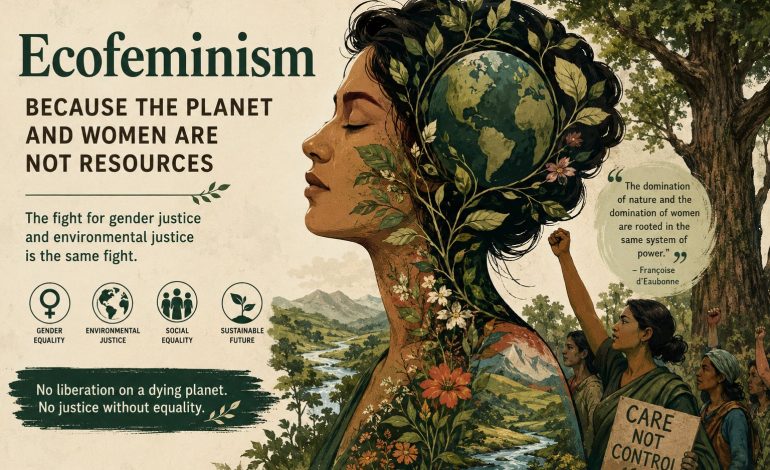

“The domination of nature and the domination of women are not separate stories. They are chapters of the same book.” Ecofeminism is grounded in central agument: The Earth and Women Are Not Resources
The Earth and Women Are Not Resources:
Imagine a forest being cleared for profit. The trees disappear first. Then the streams begin to dry. The soil loses its fertility. Crops fail. Water becomes scarce. But the consequences do not fall equally.
In many parts of the world, it is women who walk farther for water, who struggle to feed families when harvests decline, who absorb the hidden costs of environmental destruction. While corporations record profits and governments celebrate “development,” women often bear the burden of ecological collapse. This is not an accident.
According to ecofeminism, the same worldview that treats forests as commodities treats women as resources. The same logic that legitimizes the extraction of natural wealth often legitimizes the control of women’s bodies, labor, and lives.
Ecofeminism begins with a radical claim:The environmental crisis and gender oppression are not separate problems. They emerge from the same structures of domination. And until we confront those structures, neither women nor the planet can truly be free.

The Birth of a Revolutionary Idea
The term ecofeminism was coined in 1974 by French feminist Françoise d’Eaubonne in her groundbreaking book Le Féminisme ou la Mort (Feminism or Death). Her argument was startlingly direct: patriarchal systems were driving both ecological destruction and the oppression of women. If humanity continued along this path, the consequences would be catastrophic—not only for women, but for life itself.
Over the following decades, ecofeminism evolved into a powerful intellectual and activist movement. Thinkers such as Vandana Shiva, Val Plumwood, Carol Christ, and Starhawk expanded the framework, connecting feminism with environmental justice, anti-colonial struggles, indigenous knowledge systems, and critiques of capitalism. What emerged was not merely an environmental theory. It was a profound challenge to the foundations of modern Western thought.
The Hidden Architecture of Domination
At the heart of ecofeminist theory lies a critique of what philosophers call dualistic thinking. For centuries, dominant Western traditions have organized reality into opposing pairs:
- Man / Woman
- Culture / Nature
- Reason / Emotion
- Mind / Body
- Human / Animal
- Civilized / Primitive
These divisions are not neutral. The first term is usually associated with power, authority, and superiority. The second is associated with weakness, dependence, and inferiority. Ecofeminists argue that these binaries create a hierarchy in which certain groups gain legitimacy by dominating others.
Men dominate women.
Humans dominate nature.
Colonizers dominate indigenous peoples.
The wealthy dominate the poor.
The result is a culture that normalizes exploitation while disguising it as progress. Australian philosopher Val Plumwood argued that these dualisms are among the most dangerous intellectual habits in human history because they justify systems of control by portraying domination as natural.
The question ecofeminism asks is deceptively simple: What if the problem is not merely how we treat women or how we treat nature, but the very mindset that requires something to be dominated in the first place?
Feminism Meets Environmentalism
Traditional environmentalism often focuses on conservation, pollution, and climate policy. Traditional feminism often focuses on gender equality, reproductive rights, labor, and political representation. Ecofeminism refuses to separate these struggles by placing its central argument: The Earth and Women Are Not Resources
It insists that environmental degradation cannot be fully understood without examining gendered power relations. Likewise, gender justice cannot be achieved on a planet suffering ecological collapse. This insight becomes especially visible in communities facing environmental crises. When forests disappear, women lose access to firewood and medicinal plants. When water sources become contaminated, women often spend additional hours securing clean water.
When climate disasters strike, women and girls are frequently among the most vulnerable populations due to existing social inequalities. In other words, environmental destruction is never just environmental.
It is social.
Political.
Gendered.
And deeply unequal.
Why Are Women Often at the Frontlines?
One of ecofeminism’s most debated ideas concerns the relationship between women and nature. Some ecofeminists argue that women possess a unique connection to the natural world because of biological experiences such as pregnancy, childbirth, and menstruation. Others reject this explanation.
Materialist and postcolonial ecofeminists argue that women’s connection to nature is primarily social and historical rather than biological. Across many societies, women have traditionally been responsible for agriculture, water collection, caregiving, and food production. These roles place them in direct contact with environmental changes.
The distinction matters. If women are “naturally” closer to nature, feminism risks reinforcing old stereotypes. If women are positioned closer to environmental realities because of social structures, then their experiences become powerful sources of political knowledge rather than biological destiny. Contemporary ecofeminism increasingly embraces the second perspective. Women are not environmental guardians by nature. They become environmental witnesses because of where power places them.
The Women Who Hugged Trees
Few movements symbolize ecofeminism more vividly than India’s Chipko Movement. In the 1970s, rural women in the Himalayan region faced extensive commercial logging that threatened forests essential to their survival. Their response was extraordinary. They wrapped their arms around trees. By physically embracing the trees, they prevented loggers from cutting them down. The image became iconic: women placing their bodies between profit and destruction. Yet Chipko was never simply about trees. It was about livelihoods, water, food security, community survival, and resistance to systems that treated both women and nature as expendable.
The movement revealed a central ecofeminist truth: Environmental protection is often a struggle for social justice.
Capitalism, Colonialism, and the Extraction Machine
Modern ecofeminism extends beyond patriarchy alone. Many scholars argue that environmental destruction is sustained through interconnected systems of power, including capitalism, colonialism, racism, and class exploitation. This perspective is especially prominent in the work of Vandana Shiva, who has critiqued industrial agriculture, corporate control of seeds, and development models imposed on the Global South.
From this viewpoint, ecofeminism is not merely about women and nature. It is about understanding how multiple forms of domination reinforce one another. The same logic that extracts oil from the earth can exploit labor. The same mentality that clears forests can displace indigenous communities. The same structures that undervalue caregiving often undervalue ecological sustainability. Domination rarely travels alone.
The Critiques Ecofeminism Must Confront
Like all influential theories, ecofeminism has faced substantial criticism.
- Essentialism
Critics argue that linking women with nature can reinforce stereotypes that feminism has long struggled to dismantle. If women are portrayed as naturally nurturing, emotional, or environmentally conscious, does this not trap them within traditional gender roles? This remains one of the movement’s most significant debates.
- Romanticizing the Past
Some ecofeminist narratives idealize indigenous or pre-industrial societies without fully acknowledging their complexities and internal inequalities.Critics caution against replacing one myth with another.
- Lack of Analytical Precision
Certain spiritual branches of ecofeminism emphasize ritual, goddess traditions, and earth-centered spirituality. While meaningful to many activists, critics argue that these approaches sometimes lack philosophical rigor.
- Limited Diversity
Early ecofeminist scholarship was often criticized for centering white Western women’s experiences while overlooking race, colonialism, and global inequalities.Contemporary ecofeminism has responded by becoming more intersectional and globally inclusive.
Why Ecofeminism Matters More Than Ever
We live in an age defined by climate emergencies. Wildfires intensify. Water scarcity expands. Extreme weather displaces millions. At the same time, gender inequality remains deeply embedded in political, economic, and social institutions. Ecofeminism offers a framework capable of connecting these crises. It helps explain why women are disproportionately affected by climate change.
Why environmental harm often follows racial and colonial lines? Why extractive industries frequently target vulnerable communities? Why sustainability cannot be reduced to technology alone?
Most importantly, ecofeminism challenges a civilization built on domination. Instead of control, it proposes care. Instead of hierarchy, interdependence. Instead of extraction, reciprocity.
The Future Depends on Rethinking Power
Ecofeminism is not simply an academic theory. It is a challenge to the way modern societies imagine progress. For centuries, success has been measured through growth, conquest, and extraction. Forests become timber. Rivers become resources. Labor becomes productivity. Women become unpaid caregivers. Everything acquires value only when it can be used.
Ecofeminism asks a different question: What if genuine progress begins when we stop treating life as something to dominate?
The environmental crisis is not merely a technological failure. It is a philosophical one. And perhaps that is ecofeminism’s most important lesson. The fate of women and the fate of the Earth were never separate stories. They have always been the same story—written in different forms, by the same structures of power. The future depends on whether we choose to keep writing it that way.






2 Comments
[…] Source: The Earth Is Not a Resource. Women Are Not a Resource. Ecofeminism Exposes the Logic Behind Both. […]
[…] became a powerful social, political, and literary practice aimed at exposing and dismantling patriarchal structures embedded within traditional […]