

The Things AI Cannot Solve: Ancient Heroes and the Limits of Human Existence
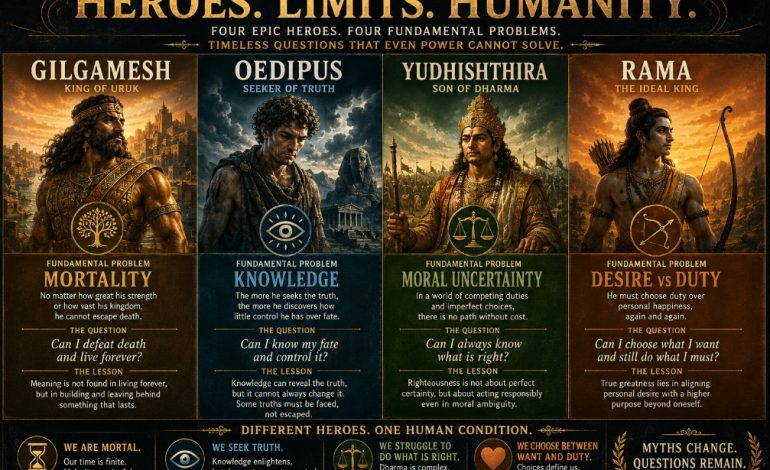

Can AI answer Limits of Human Existence? Imagine placing four ancient heroes in a room with an artificial intelligence system.
Gilgamesh asks: “Can you make me immortal?”
Oedipus asks: “Can you tell me my future?”
Yudhishthira asks: “Can you tell me what is right?”
Rama asks: “Can you tell me what I should choose?”
AI has immense capabilities to answer each question with astonishing sophistication. It can calculate probabilities, analyse vast archives, predict patterns, simulate consequences and produce apparently authoritative advice. Yet none of these capacities resolves the underlying problems that continues to limit human existence.
Gilgamesh will still die.
Oedipus will still have to confront the consequences of knowledge.
Yudhishthira will still have to act under conditions of moral dilemma.
Rama will still have to negotiate the painful dissonance between personal desire and duty.
The very purpose of this imagined encounter is to bring moral dilemma of our ancient heroes, from Rama to Gilgamesh, and reflect upon the defining questions that limits human existence; What happens when technological power expands faster than our ability to resolve the fundamental problems of being human?
The comparison is not intended to suggest that ancient epic anticipated artificial intelligence. Rather, it reveals something far more interesting. The technological questions that dominate contemporary culture: Can we extend life? Can we predict the future? Can algorithms make better decisions? Can technology optimise human choice? The questions have continued to invite human anxieties.
Perhaps ancient epic understood that the most consequential limits of human existence are not necessarily technical problems. They are existential ones.
Gilgamesh and the impossibility of defeating death
The Epic of Gilgamesh provides perhaps the most direct literary encounter with the limits of human existence.
Gilgamesh begins as a powerful king with exceptional strength which places him close to the divine. Yet the death of Enkidu, his closet companion, transforms his relationship with mortality. Gilgamesh’s experience and understanding of human grief aligns with the contemporary understandings of human emotions and its complexities. Immediately after being cognizant about Enikdu’s death, Gilgamesh finds himself trapped in a complex web of emotions; “began to rage like a lion, like a lioness robbed of her whelps.
For the first time, death is no longer an abstract fact affecting other people. It becomes an intolerable possibility for Gilgamesh himself.
Therefore, His subsequent journey can therefore be understood as a quest against the fundamental condition of human existence.
Gilgamesh begins his journey in search of Utnapishtim, the survivor of the Flood who has received immortality, hoping that the secret of eternal life can be acquired. His extraordinary quest of mortality ultimately results in a disaster. Even after discovering the possibility of rejuvenation, he loses the plant that might restore his youth.
The narrative suggests that even heroic exceptionalism cannot find cure of mortality. Consequently, Gilgamesh’s transformation depends not upon acquiring immortality but upon recognizing the value of the finite world. He returns to Uruk, where the city itself becomes part of the answer to his quest. Human beings cannot possess infinite life, but they can create, remember, build and participate in forms of cultural continuity that exceed an individual lifespan.
This is remarkably relevant to contemporary technological culture. Artificial intelligence, biotechnology and longevity research increasingly encourage speculation about extending human capacities and perhaps even overcoming biological limitations. Yet journey of Gilgamesh reminds us that the desire to defeat death is not merely a technological ambition; it is an ancient psychological condition.
The important question is therefore not only whether technology can extend life, but what kind of meaning we attach to a finite life.
Oedipus and the limits of prediction
If Gilgamesh represents humanity’s struggle against death, Oedipus represents the struggle against uncertainty and ignorance.
The tragedy of Oedipus is especially relevant in an age increasingly fascinated by predictive technologies. Modern systems can forecast consumer behaviour, financial trends, disease risks, political outcomes and countless other patterns. The contemporary imagination often treats more information as equivalent to greater control.
Oedipus exposes the underlying danger in that assumption.
He is an exceptionally intelligent man. His ability to solve the Sphinx’s riddle establishes his intellectual authority. He is intelligent, successful and decisive. He is ruler of Thebes. He is highly ambitious. Yet every effort to master his life brings him closer to prophecy that he will kill his father and marry his mother. Oedipus embodies the human condition that is most ambitious, at the same time constrained.
Oedipus acts with apparent freedom. He leaves Corinth to avoid prophecy; he pursues the truth about Laius’s murder to save Thebes; he insists on full knowledge even when warned. Each choice he makes is rational within the information available to him, yet the sum of those choices eventually leads to the fulfilment of prophecy. The limit here is structural: human deliberation occurs inside a causal and prophetic order that exceeds individual foresight. Oedipus is neither a puppet nor a purely autonomous agent; he is a finite being whose horizon of knowledge is always incomplete. The story of Oedipus insinuates that existence is lived under constraints, which are biological, historical, divine, or simply contingent—that no amount of cleverness and intelligence can permanently dissolve the ultimate fate. Upon discovering that he has killed his father and married his mother unknowingly he blinds himself.
The tragedy therefore raises a question that remains relevant in the age of predictive algorithms: Does knowing more necessarily mean having more control? Oedipus suggests that it does not.
Knowledge can illuminate reality without giving us the power to alter it. A prediction may tell us what is likely to happen, but it does not mechanically suggest how we ought to respond. Even perfect information cannot eliminate the human experience of uncertainty, responsibility and consequence.
In this respect, Oedipus is an important counterpoint to technological optimism. The problem of human existence has never simply been a shortage of information.
Sometimes the problem is what we do with knowledge once we possess it.
Yudhishthira and the problem of moral algorithms
The Mahabharata introduces a different limit: the ambiguity of determining what is right in a world where competing duties collide.
Yudhishthira is traditionally associated with the strongest proppant of dharma, truth and righteousness. Yet his story repeatedly places him in situations where moral principles collide with competing priorities, which cannot be addressed by machine such as AI.
The Mahabharata does not present simple ethical life with straightforward choices. Instead, it presents a world of competing obligations, tragic consequences and imperfect information. This makes Yudhishthira particularly significant for thinking about algorithmic decision-making.
Contemporary societies increasingly ask whether artificial intelligence can assist or even replace human judgement in areas such as medicine, governance, law, management, and warfare. Machine or AI often assume that ethical decisions can ultimately be converted into sufficiently sophisticated calculations. But the case of Yudhishthira complicates this assumption as a moral decision is not simply a problem of calculating outcomes. It involves responsibility, context, competing values and the recognition that every choice may produce suffering. The challenge is not merely to identify the optimal action but to take responsibility for acting when no option is morally perfect.
Yudhishthira’s significance lies precisely in this uncertainty. His story suggests that ethical maturity may not consist in possessing an algorithm capable of eliminating ambiguity. It may consist in developing the wisdom to act responsibly despite ambiguity.
In other words, a machine may calculate consequences, but calculation alone does not constitute moral responsibility.
Rama and the conflict between desire and duty
Rama introduces another dimension of human limitation: the conflict between what we desire and what we believe we ought to do.
The Ramayana places Rama within a framework of dharma, kingship, familial obligation and social responsibility. His decisions cannot be understood exclusively through the lens of personal preference because his position gives those decisions consequences for an entire social order.
This produces a recurring tension between private happiness and public duty.
Rama’s significance principally lies not in possessing unlimited freedom but in confronting the constraints attached to responsibility. His story asks a compelling question: whether a meaningful life can be constructed when our choices affect people beyond ourselves?
This question is particularly relevant to contemporary technology dominated culture, where optimisation has become a powerful metaphor for human decision-making. We are encouraged to optimise careers, relationships, health, productivity and even happiness.
But Rama’s story suggests that the best personal outcome is not always the most meaningful ethical choice.
Human beings inhabit both relationships and institutions. We inherit obligations. We make promises. We carry responsibilities that cannot always be reduced to individual preference.
The human problem is therefore not simply choosing between alternatives. It is all about determining which values should govern our choices.
Four ancient questions in a technological age
The four figures can consequently be read as four encounters with fundamental limits:
| Hero | Fundamental problem | Contemporary technological question |
| Gilgamesh | Mortality | Can technology defeat death and make human immortal? |
| Oedipus | Uncertainty and destiny | Can superior prediction give us better control? |
| Yudhishthira | Moral ambiguity | Can algorithms precisely determine what is ethically right? |
| Rama | Desire and duty | Can technology optimise human choice? |
What makes these comparisons compelling is that none of these heroes is ordinary.
Gilgamesh is extraordinarily powerful.
Oedipus is extraordinarily intelligent.
Yudhishthira is extraordinarily committed to righteousness.
Rama is extraordinarily associated with virtue and duty.
Yet life journey of these epic heroes insinuate that exceptional abilities do not dissolve existential limitations.
This is perhaps the most important lesson that ancient epic can offer to contemporary technological discourse. Human beings have always imagined forms of exceptional power, whether expressed through heroic strength, divine weapons, supernatural knowledge or moral perfection. Modern technology represents a new form of that aspiration.
But the underlying structure remains familiar.
We want power without vulnerability.
Knowledge without uncertainty.
Choice without responsibility.
Life without death.
The epics repeatedly demonstrate that these desires cannot be completely fulfilled.
What happens when the machine enters the epic?
Returning to our imagined encounter with AI, the machine might give Gilgamesh a longevity, Oedipus a probability distribution, Yudhishthira an ethical decision matrix and Rama a decision tree.
All four answers might be extraordinarily sophisticated.
And all four would still be incomplete.
Because the central questions are not merely technical.
Gilgamesh does not simply need information about biological longevity; he must confront the meaning of mortality.
Oedipus does not merely need a prediction; he must confront what knowledge does to a human being.
Yudhishthira does not merely need a recommendation; he must assume responsibility for an ethically difficult action.
Rama does not merely need optimisation; he must determine which obligations deserve priority.
This distinction is crucial. Information can expand the field of human possibility without eliminating the conditions of human existence.
Indeed, greater technological power may intensify rather than diminish these questions. The more capable our systems become, the more important it may be to distinguish between what can be calculated and what must still be judged.
The ancient future
Ancient epic is sometimes treated as a cultural inheritance belonging to a distant past. Yet its continued relevance lies precisely in its ability to articulate problems that technological progress cannot simply make obsolete.
The tools change.
The questions persist.
Gilgamesh’s longing for immortality can be heard in contemporary ambitions to radically extend human lifespan. Oedipus’s desire for knowledge resonates with our fascination with prediction and surveillance. Yudhishthira’s moral dilemmas anticipate contemporary debates about automated decision-making. Rama’s conflict between personal desire and duty speaks to an age increasingly organised around individual choice.
The point is not that ancient heroes provide simple answers to modern technological dilemmas. They do something more valuable: they complicate the questions.
Perhaps the greatest danger of technological culture is not that machines will become too intelligent. It is that human beings may begin to confuse intelligence with wisdom, prediction with understanding, calculation with judgement, and extended existence with meaningful existence.
The ancient epics resist that confusion.
They remind us that the defining boundaries of human life are not necessarily problems waiting for technological solutions. Some are conditions through which human meaning is created.
Gilgamesh teaches us that mortality gives urgency to existence.
Oedipus teaches us that knowledge does not guarantee control.
Yudhishthira teaches us that moral life cannot always be reduced to certainty.
Rama teaches us that freedom exists within relationships, obligations and competing values.
And so the question we might finally ask of our hypothetical AI is not, “Can you solve these problems?”
It is:
“Can you tell us what it means to live with them?”
That question may remain stubbornly, irreducibly human.
SChandra Literature Team, 2026
References
Abusch, T. 2015. 6. The Development and Meaning of the Epic of Gilgamesh: An Interpretive Essay. Male and Female in the Epic of Gilgamesh: Encounters, Literary History, and Interpretation. University Park, USA: Penn State University Press, pp. 127-143. https://doi.org/10.1515/9781575067186-009
Agard, Walter R. “Fate and Freedom in Greek Tragedy.” The Classical Journal, vol. 29, no. 2, 1933, pp. 117–26. JSTOR, http://www.jstor.org/stable/3290417. Accessed 20 Oct. 2023.
George, Andrew, et al. The Epic of Gilgamesh. Translated by Andrew George, Penguin Classics, 2003.



1 Comment
[…] है जहाँ प्राचीन महाकाव्य और आधुनिक Artificial Intelligence एक दिलचस्प संवाद शुरू करते […]