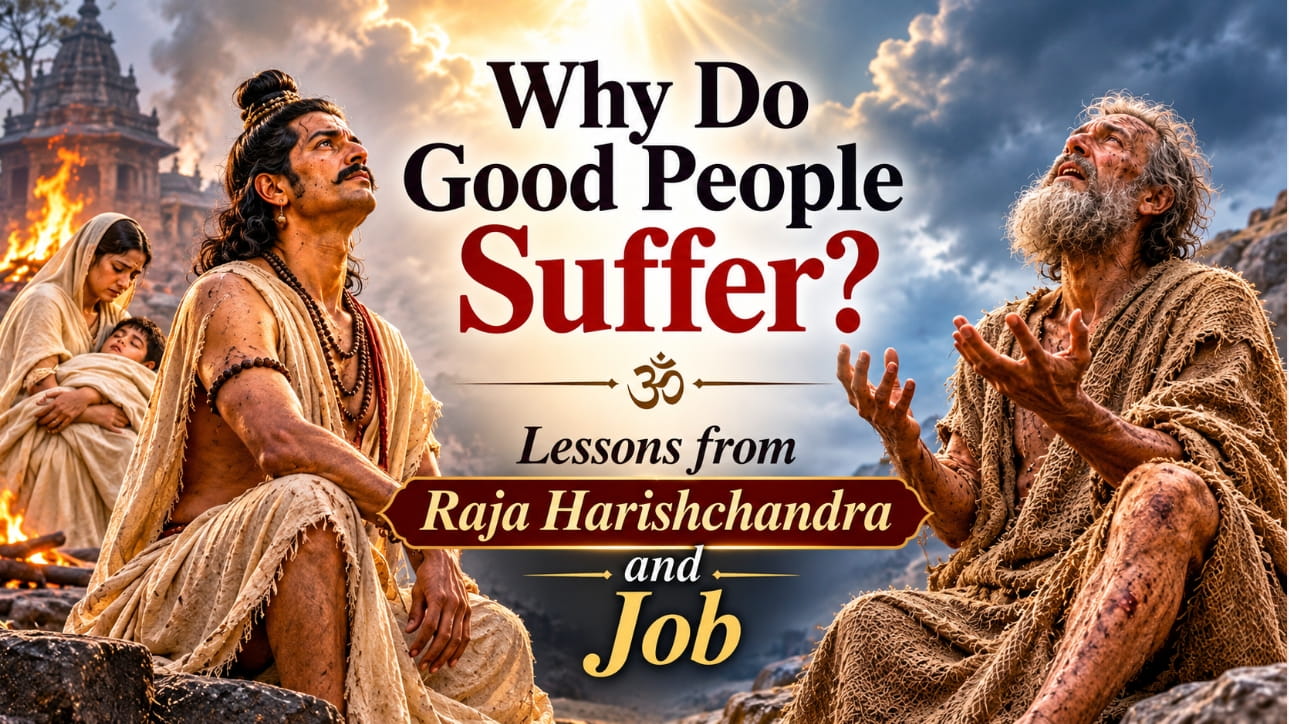

Why Do Good People Suffer? Lessons from Raja Harishchandra and Job

Why Do Good People Suffer?
Imagine two men separated by continents, cultures and centuries.
One sits on an ash heap, covered in painful sores, stripped of his wealth, family and social standing. He has lost almost everything that once gave meaning to his existence. Yet he refuses to accept the explanations offered by those around him. Instead, he demands an answer from God.
The other stands in a cremation ground, having lost his kingdom, possessions, wife and son. Reduced from a powerful monarch to a servant, he continues to uphold the one principle that defines his existence: truth.
The first is Job, the central figure of the biblical Book of Job. The second is Raja Harishchandra, the legendary Hindu king celebrated for his uncompromising commitment to satya (truth) and dharma (righteous duty).
Their stories emerge from profoundly different religious and literary traditions. Yet they confront humanity with remarkably similar questions.
Why do good people suffer?
Does righteousness guarantee happiness?
Should faith require unquestioning obedience, or does it allow us to challenge divine justice?
And perhaps the most difficult question of all: What remains of a person’s moral identity when everything else has been taken away?
The stories of Job and Harishchandra do not offer an easy answer. Instead, they take us into one of the oldest and most enduring debates in theology, philosophy and human existence: the relationship between virtue, suffering and divine justice.
- The Price of Truth: When Righteousness Becomes a Burden
Almost every religious and philosophical tradition places considerable importance on moral conduct.
Speak the truth. Do good. Honour your obligations. Live righteously. Respect the divine order.
These principles are often accompanied by an implicit promise: a virtuous life should, in some meaningful sense, produce a good life.
This belief provides psychological and moral reassurance. It encourages people to behave ethically because they expect the universe to possess some underlying structure of justice.
However, the problem emerges when reality refuses to cooperate.
Good people become victims of injustice. Honest individuals are exploited. Compassionate people experience extraordinary loss. Meanwhile, those who act selfishly sometimes prosper.
The stories of Job and Harishchandra confront precisely this contradiction.
They challenge what philosophers and theologians describe as the problem of theodicy: how can suffering, injustice and evil exist in a universe governed by an all-powerful, all-knowing and perfectly good God?
The question is particularly disturbing when the sufferer is not morally responsible for the misfortune.
If wrongdoing produces suffering, why does the righteous person suffer?
If virtue deserves reward, why does the virtuous person experience devastation?
Both narratives expose the limitations of treating morality as a transaction between human beings and the divine.
Righteousness, they suggest, cannot always be understood through the immediate rewards and punishments of worldly existence.
- Raja Harishchandra: The King Who Refused to Abandon Truth
Raja Harishchandra occupies a distinctive position in Hindu religious and cultural imagination.
He is not primarily remembered for conquering territories, expanding an empire or accumulating wealth. His legacy rests on his extraordinary commitment to truth.
In the narrative preserved in the Markandeya Purana, the sage Vishwamitra subjects the king to an increasingly devastating series of demands and trials.
Harishchandra loses his kingdom.
He gives away his possessions.
Unable to meet the demands placed upon him, he sells his wife and son into servitude and ultimately sells himself.
The former king becomes a servant working in a cremation ground, collecting the prescribed funeral fees from those who arrive to perform the last rites of their relatives.
Then comes the most devastating moment.
His son dies after being bitten by a snake.
His wife, Shaivya, carries the child’s lifeless body to the cremation ground. She is unable to pay the required funeral fee.
The man responsible for collecting it is her own husband.
Harishchandra now confronts an almost impossible moral dilemma.
Should he waive the fee because the grieving woman is his wife?
Should he abandon the rules of his responsibility because the dead child is his own son?
Or should he continue to uphold the principle of truth and duty, even when doing so appears to violate the most fundamental human instincts of love and compassion?
He remains committed to his obligation.
Eventually, divine intervention reveals the larger purpose of his trials. The child is restored to life, and Harishchandra’s righteousness is recognised.
But the philosophical significance of the story extends far beyond its miraculous conclusion.
Harishchandra’s greatness lies in the idea that truth should not become negotiable merely because circumstances become difficult.
His story elevates satya from an ordinary moral preference into a fundamental principle of existence.
In Hindu philosophical traditions, truth is not merely about avoiding lies. It is connected to dharma, the wider moral and cosmic order that sustains individual and collective life.
Yet Harishchandra’s narrative also raises an uncomfortable question: Can adherence to duty become so absolute that it risks overshadowing compassion?
This is an important tension within the story.
It invites readers to consider whether righteousness is simply the mechanical application of rules or whether it requires a deeper understanding of competing moral obligations.
That question remains relevant in contemporary ethical debates.
- Job: The Man Who Dared to Question God
The Book of Job, part of the Hebrew Bible and the Christian Old Testament, begins with a similarly extraordinary figure.
Job is wealthy, respected and deeply righteous.
He possesses considerable material prosperity, a large family and an established social position.
The biblical narrative describes him as a man of exceptional integrity.
Then his life collapses.
He loses his possessions.
His children die.
His health deteriorates.
His body becomes covered with painful sores, and he eventually finds himself sitting among ashes.
Unlike Harishchandra, Job does not initially understand the circumstances behind his suffering.
The reader, however, is given access to a heavenly scene in which an accuser challenges the sincerity of Job’s righteousness.
The central question is unsettling: Is Job genuinely faithful, or does he worship God simply because his life is prosperous?
In other words, would his faith survive if all the material rewards disappeared?
Job’s suffering becomes a test of the relationship between faith and self-interest.
Initially, Job responds with remarkable restraint. But as his suffering continues, he begins to question the justice of his situation.
His friends arrive and offer familiar explanations.
They insist that suffering must be connected to wrongdoing. If Job is experiencing such terrible misfortune, he must have committed some sin, perhaps even one of which he is unaware.
Their reasoning reflects a conventional system of retributive morality: good behaviour produces prosperity, while wrongdoing produces suffering.
Job refuses to accept this explanation.
He knows that he has not committed the crimes of which he is effectively being accused.
Consequently, he demands an opportunity to present his case before God.
This is what makes Job such an extraordinary theological figure.
He does not abandon his relationship with God, but neither does he surrender his intellectual and moral integrity.
He questions. He protests. He laments. He demands justice.
Job’s faith is not the absence of doubt. It is the courage to continue addressing God even when the world appears to have become morally incomprehensible.
Eventually, God responds from a whirlwind.
Yet the response does not provide Job with a straightforward explanation for his suffering. Instead, God draws attention to the vastness and complexity of creation, confronting Job with the limitations of human understanding.
Significantly, God also rebukes Job’s friends for failing to speak rightly about Him.
The ending therefore complicates the assumption that religious faith requires accepting every conventional explanation of suffering.
Sometimes, the person who questions may possess greater moral honesty than those who defend an apparently comfortable religious doctrine.
- Two Men, Two Philosophies: Dharma and Faith
At first glance, Harishchandra and Job appear to be variations of the same religious archetype: the righteous individual subjected to extraordinary suffering.
But their responses reveal two distinct dimensions of spiritual life.
Harishchandra represents the determination to uphold truth regardless of personal consequences.
Job represents the determination to seek justice and understanding even when divine silence becomes unbearable.
Their philosophical orientations can be understood through three interconnected ideas.
First, the ethics of duty.
Harishchandra’s story is closely connected to dharma. His identity is inseparable from his commitment to moral obligation.
His circumstances change, his social position collapses and his material possessions disappear, but he continues to define himself through truth.
Second, the ethics of protest.
Job refuses to accept the proposition that his suffering must be deserved.
His arguments expose the danger of simplistic religious explanations that turn every tragedy into evidence of personal wrongdoing.
Third, the ethics of integrity.
Both men refuse to allow external circumstances to determine their moral identity.
One refuses to abandon truth.
The other refuses to abandon the demand for justice.
In this sense, their stories complement each other.
Harishchandra reminds us that morality requires consistency.
Job reminds us that morality also requires the courage to question injustice.
One demonstrates the strength of conviction. The other demonstrates the importance of moral inquiry.
Together, they suggest that genuine spirituality requires both ethical commitment and intellectual honesty.
- The Problem of Theodicy: Why Does God Allow the Righteous to Suffer?
The suffering of Job and Harishchandra leads directly into one of theology’s most difficult intellectual problems.
If God is good, why does suffering exist?
If God is powerful, why does injustice continue?
And if the universe possesses a moral order, why does that order appear so frequently to contradict human experience?
In Christian theology, the problem is commonly discussed through the concept of theodicy.
The Book of Job is particularly important because it challenges the simplistic belief that suffering is always a consequence of sin.
Job’s friends defend a predictable moral universe. They believe that wrongdoing must explain misfortune.
But Job’s experience undermines their reasoning.
His suffering cannot be adequately explained through the assumption that he must have done something wrong.
This is a profound theological intervention.
It challenges religious communities to distinguish between the existence of suffering and the moral responsibility of the person experiencing it.
A similar complexity emerges in Hindu philosophical discussions of karma.
The doctrine of karma is frequently interpreted as a relationship between actions and consequences extending beyond a single lifetime.
However, karma should not be reduced to the crude assumption that every person experiencing hardship must somehow deserve it.
Hindu philosophical traditions contain diverse interpretations of karma, destiny, free will and divine grace. Their relationship is neither simple nor uniform.
Harishchandra’s narrative introduces another dimension: the importance of dharma and satya even when worldly circumstances become hostile.
His righteousness is not presented merely as a strategy for obtaining material rewards.
It is a commitment to a moral principle that possesses value beyond immediate success.
Here, the Hindu and biblical narratives meet at an important philosophical intersection.
Perhaps the value of righteousness cannot be measured exclusively through the rewards it produces.
This does not solve the problem of suffering. But it challenges the assumption that prosperity is the ultimate evidence of divine favour.
- Virtue Ethics: Who Are We When We Lose Everything?
The stories of Job and Harishchandra can also be examined through the framework of virtue ethics.
Associated particularly with Aristotle, virtue ethics places character at the centre of moral philosophy.
Instead of asking only whether an individual follows rules or produces desirable consequences, it asks a more fundamental question:
What kind of person should we become?
For Aristotle, virtues such as courage, justice, temperance and practical wisdom contribute to the development of a flourishing human life.
Harishchandra and Job can be read through this framework.
Their prosperity initially conceals the full extent of their moral character.
When they lose wealth, reputation, security and social position, their inner commitments become more visible.
Harishchandra’s defining virtue is truthfulness.
Job’s defining virtue is integrity, expressed through his refusal to accept accusations he believes to be false.
Yet there is an important distinction between enduring suffering and celebrating suffering.
Neither story should be interpreted as an instruction to seek hardship or tolerate injustice unnecessarily.
Human beings have moral obligations to prevent suffering, challenge oppression and protect the vulnerable.
The significance of these narratives is not that pain automatically makes people virtuous.
It is that suffering can expose the limitations of external measures of human worth.
A person’s dignity does not disappear with their wealth.
Their moral identity does not necessarily collapse with their social status.
And their worth cannot be established through the simplistic calculation of success and failure.
- Existentialism and the Search for Meaning in Suffering
There is another way to approach these narratives: through existential philosophy.
Existentialist thinkers have repeatedly examined the human struggle to find meaning in a world that does not always provide clear explanations.
The twentieth-century philosopher Viktor Frankl, drawing upon his experiences of extreme suffering, argued that human beings possess a capacity to search for meaning even under circumstances of extraordinary adversity.
His work, particularly Man’s Search for Meaning, offers a useful modern lens through which to interpret the stories of Job and Harishchandra.
Both men experience the collapse of the external structures that previously defined their lives.
Harishchandra loses his identity as a king.
Job loses his identity as a prosperous patriarch.
Yet neither is entirely reduced to his circumstances.
Their moral commitments continue to provide a framework through which they understand themselves.
This does not mean that suffering is inherently meaningful or that every tragedy has a hidden purpose.
Indeed, one of the dangers of religious and philosophical explanations is the tendency to impose meaning upon another person’s pain.
Sometimes suffering is simply devastating.
Sometimes it is unjust.
Sometimes no explanation is sufficient.
Job’s protest is important precisely because it refuses to make suffering intellectually comfortable.
His story reminds us that lament, anger and questioning can be legitimate dimensions of religious experience.
Harishchandra, meanwhile, represents the possibility of maintaining moral consistency when life becomes unrecognisable.
Together, the two narratives suggest that meaning is not always discovered through an explanation of suffering. It may also emerge through the way individuals respond to circumstances they cannot control.
- The Mahabharata and the Paradox of Righteousness
The same philosophical dilemma appears throughout the Mahabharata, one of the most significant literary and philosophical works of Hindu civilisation.
Consider Yudhishthira, the eldest of the Pandavas.
He is frequently associated with truth, justice and righteousness.
Yet his life is marked by extraordinary adversity.
He loses his kingdom in a game of dice.
He witnesses the humiliation of Draupadi.
He spends years in exile.
He eventually participates in a devastating war that results in the deaths of relatives, teachers, friends and countless others.
His experience challenges the simplistic assumption that moral conduct guarantees worldly happiness.
The Mahabharata repeatedly explores the complexity of dharma.
What happens when different duties conflict?
Can an individual remain righteous in a morally compromised world?
Is following the letter of a moral principle always equivalent to following its spirit?
These questions are particularly relevant when comparing Yudhishthira with Harishchandra.
Harishchandra represents an unwavering commitment to truth, while Yudhishthira’s journey reveals the difficulties of navigating competing obligations.
The Mahabharata does not present dharma as an easy formula.
It is often contextual, contested and difficult to interpret.
This complexity adds another dimension to our understanding of Job and Harishchandra.
Righteousness is not necessarily a guarantee of a comfortable life. Nor is it always a straightforward exercise in following established rules.
It may require difficult decisions, moral reflection and the willingness to confront uncomfortable truths.
- The Universal Theology of Suffering: Beyond Religious Boundaries
What makes the stories of Job and Harishchandra particularly remarkable is their capacity to speak across religious boundaries.
Their traditions are different, their theological assumptions are not identical, and their conclusions cannot simply be merged into one universal doctrine.
Nevertheless, they illuminate several shared dimensions of human spirituality.
Truth is valuable beyond material reward.
Harishchandra’s story suggests that integrity should not depend entirely upon personal advantage.
Faith does not eliminate the right to question.
Job demonstrates that protest and lament can coexist with a continuing relationship with the divine.
Suffering does not automatically indicate moral failure.
The accusations made against Job by his friends expose the cruelty of assuming that victims must somehow deserve their circumstances.
Human dignity exceeds social status.
A king can become a servant without losing his moral worth. A wealthy man can become destitute without losing his integrity.
The divine cannot always be understood through human expectations of justice.
Both narratives challenge the assumption that the universe must deliver immediate and visible rewards for virtuous conduct.
These are not identical theological teachings. They emerge from different religious understandings of God, karma, dharma and moral order.
But they create a meaningful space for interfaith reflection.
They suggest that the search for truth, the struggle against injustice and the desire to preserve human dignity are not confined to one religious tradition.
They belong to the wider human experience.
- The Modern Obsession with Success: When Wealth Becomes a Measure of Worth
Perhaps these ancient narratives are particularly relevant in contemporary society because modern culture has developed its own version of the prosperity principle.
We measure success through income, professional achievement, property, social recognition and public visibility.
A successful person is often assumed to be intelligent, disciplined and deserving.
A struggling individual, conversely, may be judged as irresponsible, incompetent or morally deficient.
This way of thinking creates a dangerous illusion: that external circumstances accurately reflect internal character.
The stories of Job and Harishchandra reject this assumption.
Job is righteous before he becomes prosperous, and his suffering does not prove that he has become wicked.
Harishchandra remains committed to truth even after losing the privileges of kingship.
Their stories challenge the tendency to confuse material success with moral superiority.
They also encourage compassion towards those experiencing misfortune.
Rather than asking what a suffering person must have done to deserve their condition, perhaps society should ask what responsibilities it has towards them.
This is an important ethical lesson.
The friends of Job make the mistake of defending an abstract theory of justice at the expense of the suffering individual standing before them.
Their failure is not simply theological. It is also human.
They explain when they should listen.
They accuse when they should comfort.
They defend their understanding of divine justice rather than recognising the pain of another person.
In this sense, the Book of Job offers a powerful lesson in the ethics of compassion.
Sometimes the most meaningful religious response to suffering is not an explanation.
It is solidarity.
- What Remains When Everything Is Lost?
Ultimately, the stories of Job and Raja Harishchandra return us to a fundamental question.
What remains when everything else disappears?
For Harishchandra, the answer is satya.
For Job, it is integrity, accompanied by an unrelenting demand for justice and an enduring, complicated relationship with God.
But perhaps their greatest contribution lies not in the different answers they provide, but in the questions they leave behind.
Is truth worth defending when it costs everything?
Can faith survive when the divine appears silent?
Can a person remain morally whole when the structures of ordinary life collapse?
And can human beings accept the limits of their understanding without surrendering their responsibility to question injustice?
These are not merely religious questions.
They are existential questions that confront every generation.
Most heroic stories celebrate individuals who conquer enemies, establish kingdoms or acquire extraordinary power.
The stories of Job and Harishchandra are different.
Their central struggle is not against an external enemy alone. It is against despair, moral compromise and the temptation to abandon the principles that give their lives meaning.
One refuses to surrender truth.
The other refuses to surrender the search for justice.
One reminds us that faithfulness can survive the collapse of worldly prosperity.
The other reminds us that faith need not silence the human conscience.
Perhaps the deepest lesson is that the worth of a human being cannot be measured by what fortune gives or takes away. It must also be understood through the principles that person chooses to uphold.
And perhaps there is another lesson, equally important.
We should be careful about calling another person’s suffering a divine test. We do not possess the knowledge to explain every tragedy, and we should not turn the pain of others into a convenient theological argument.
The stories of Job and Harishchandra do not give us permission to romanticise suffering.
They invite us to examine our understanding of truth, justice, faith and compassion.
For ultimately, the question is not simply why good people suffer.
It is also what kind of human beings we become when confronted with suffering, both our own and that of others.
That may be the most universal theological lesson of all.