
After the Death of God: Faith, Doubt, and Nihilism in Niels Lyhne
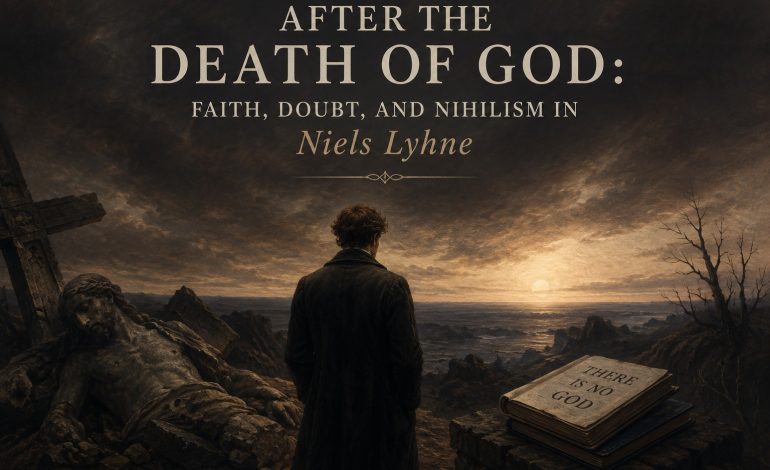

Jens Peter Jacobsen’s Niels Lyhne is premised upon a fundamental rejection of God, Death of God—or, more precisely, a rejection of everything that Christianity is understood to represent. Jacobsen’s work frequently spills over into what Bernard Schweizer terms misotheism, a concept that may be translated as a form of hatred or opposition towards God. In Niels Lyhne, Jacobsen attempts to capture the peculiar dynamic that an atheist necessarily forms with the very idea of God. The novel enters into a discourse wherein atheism itself appears less as a simple absence of belief and more as a form of belief—a negative belief, defined through its continual engagement with the divine it denies.
The novel assumes a remarkably complex philosophical, existential, and theosophical trajectory in its diagnosis of atheism and its engagement with modern nihilism as an emerging intellectual current. At its core, Niels Lyhne is a narrative circumscribed around the loss of faith, a phenomenon that became increasingly recognizable in the latter half of the nineteenth century. Similar concerns animate the writings of figures such as Edmund Gosse and Thomas Hardy, while later finding perhaps their most influential philosophical articulation in the works of Friedrich Nietzsche.
Nietzsche’s declaration of the “death of God”—his understanding of nihilism as the collapse of absolute and immutable truth, meaning, and purpose in the universe—holds immense significance in decoding the narratorial semiology of Jacobsen’s novel. Nietzsche’s call for a return to the tragic humanism of the pre-Socratic Greeks resonates strongly with Jacobsen’s concerns. In Niels Lyhne, nihilism emerges as the impossibility of re-establishing absolute values after the death of God and the futility of conformism in a world no longer sustained by transcendental guarantees.
While the nineteenth century often approached atheism through an increasingly positivist framework, Jacobsen probes far deeper into the contradictions and tensions that surround unbelief. In Niels Lyhne, he offers a vivid and often unsettling portrayal of atheism’s many nuances and paradoxes. As a young man, Niels Lyhne appears as a militant and uncompromising atheist—one who might seem strikingly familiar to contemporary readers accustomed to the rhetoric of the so-called “New Atheism.” Yet as the narrative progresses, he becomes increasingly disillusioned with his own convictions. Jacobsen’s central insight is that atheism cannot simply be equated with liberation. The removal of God does not eliminate the problems that belief was historically tasked with addressing. The fissures remain: metaphysical inquiries into the meaning of life, the inevitability of death, and the search for purpose continue to haunt human ontology even after God has been declared dead.
The narrative addresses these dilemmas with considerable force. Nearly every significant relationship in the novel ends either with the death of a disappointed rebel or with that rebel’s chastened return to the fold of normative society. Often, both outcomes occur simultaneously. The novel’s conclusion exemplifies this pattern. Niels eventually appears to find happiness with a young woman who shares his intellectual commitments. They marry, have a child, and together embrace a form of atheistic humanism. Earlier, Niels had proclaimed, “There is no God and the human being is His prophet,” encapsulating the secular faith that underpins his worldview.
Yet, as throughout the novel, the approach of premature and inexorable death destabilizes certainty. Doubt begins to compete with conviction. Different characters respond differently when confronted with mortality, but Niels remains steadfast to the end. He dies not reconciled to faith but faithful to what might be called an anti-ideal: the belief that there is no God, no transcendence, and no salvation. In this sense, Jacobsen transforms Niels into a lonely yet heroic figure of integrity—one who confronts death without metaphysical consolation and remains committed to the consequences of unbelief, even at the threshold of annihilation.