

When Identity Refuses to Stand Still: Virginia Woolf’s Orlando and the Philosophy of Becoming
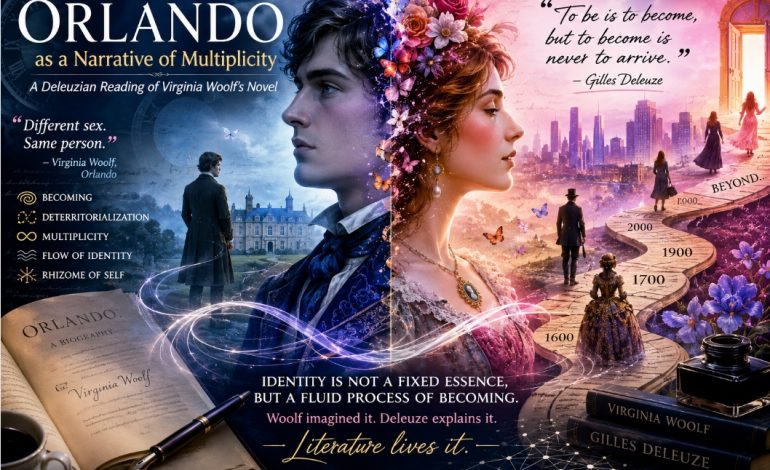

“Different sex. Same person.” Few sentences in twentieth-century literature carry as much philosophical weight as these four simple words from Virginia Woolf’s Orlando. Long before conversations about gender fluidity entered mainstream discourse, Woolf imagined a protagonist who effortlessly transcends centuries, genders, and fixed definitions of identity. Yet Orlando is much more than a whimsical fantasy about a man who awakens as a woman. It is an extraordinary meditation on one of humanity’s oldest questions: Who are we when everything about us changes?
Nearly a century after its publication, Orlando continues to surprise readers—not because of its magical transformation, but because it speaks uncannily to modern debates surrounding identity, gender, and selfhood. Through the lens of French philosopher Gilles Deleuze, Woolf’s masterpiece emerges as a revolutionary text that rejects permanence in favor of endless transformation.
The Illusion of Fixed Identity
Society has long preferred neat categories. We classify people as male or female, past or present, self or other. Identity, we assume, is something stable—a destination rather than a journey.
At the beginning of Orlando, Woolf deliberately reinforces these assumptions. Orlando is introduced with the emphatic declaration:
“He—for there could be no doubt of his sex.”
The certainty is almost theatrical. Orlando, as a young nobleman, believes deeply in conventional gender roles. Women, he assumes, are delicate, obedient, and emotionally fickle. His heartbreak after Sasha abandons him only strengthens these stereotypes, revealing how rigidly he understands the world.
This is precisely where Deleuze’s philosophy becomes illuminating. Deleuze criticizes what he calls fixed or “sedentary” ways of thinking—systems that divide reality into rigid oppositions. Identity becomes meaningful only by excluding its opposite: male against female, rational against irrational, self against other.
Woolf cleverly allows Orlando to inhabit this rigid worldview before dismantling it completely.
The Moment That Changes Everything
Then comes one of literature’s most astonishing scenes.
Orlando falls asleep.
He awakens.
Nothing dramatic seems to happen—except that Orlando is now biologically female.
Remarkably, Woolf refuses to treat this transformation as a tragedy or miracle. Instead, she calmly observes:
“Orlando had become a woman… But in every other respect Orlando remained precisely as he had been.”
The body changes.
The consciousness persists.
The identity expands.
Rather than presenting gender transformation as a rupture, Woolf portrays it as continuity. Orlando simply continues living.
This effortless transition embodies Deleuze’s idea of becoming. Becoming is not about abandoning one identity for another. It is the ongoing process of transformation that defines existence itself. We are never finished products. Every experience reshapes us.
Being, for Deleuze, is always becoming.
Woolf transforms this philosophical insight into unforgettable fiction.
Identity as Motion Rather Than Destination
Modern society often asks us to answer impossible questions:
Who are you?
What are you?
Where do you belong?
These questions assume that identity is something permanent. Orlando quietly refuses this assumption.
Its protagonist moves through four centuries without aging normally, changes gender without losing the self, inhabits different social classes, fashions, and political climates, and continuously reinvents personal identity.
The novel suggests that the self resembles a flowing river more than a sculpted monument.
Each experience adds another current.
Each encounter redirects the flow.
Identity never arrives because it is always in motion.
This fluidity resonates profoundly with Deleuze’s philosophy, where multiplicity replaces singularity and movement replaces permanence.
Beyond Gender: The Multiplicity of the Self
Although Orlando is celebrated as one of literature’s earliest explorations of gender fluidity, reducing it to that theme alone misses its larger achievement.
Woolf is ultimately interested in multiplicity.
Every individual contains contradictions.
We are courageous in one moment and fearful in another.
Traditional and rebellious.
Logical and emotional.
Confident and uncertain.
Rather than forcing these contradictions into harmony, Woolf embraces them.
Orlando becomes both man and woman, aristocrat and outsider, poet and observer—not sequentially, but simultaneously.
This multiplicity reflects Deleuze’s rejection of singular identity. Human beings are not unified wholes but dynamic constellations of experiences, desires, memories, and possibilities.
The self is not one voice.
It is a chorus.
Woolf Was Writing for the Twenty-First Century
Reading Virginia Woolf’s Orlando today can feel strangely contemporary.
Discussions surrounding gender identity, performativity, and fluid selfhood dominate cultural conversations. Judith Butler would later argue that gender is not something we are but something we continually perform through repeated acts.
Decades earlier, Woolf had already dramatized this insight.
Throughout the novel, clothing, behavior, and social expectations constantly reshape how Orlando is perceived. The body matters, but so do performance, context, and cultural norms.
Identity emerges not from biology alone but from an ongoing negotiation between self and society.
In this sense, Woolf was not merely ahead of her time.
She was writing beyond it.
Why Orlando Still Matters
What makes Orlando extraordinary is not simply its treatment of gender.
It is its radical optimism.
The novel refuses to imprison people inside fixed definitions. Instead, it imagines identity as creative possibility.
Every transformation becomes an opportunity rather than a loss.
Every contradiction becomes a source of richness.
Every becoming opens another future.
Deleuze believed philosophy should create concepts capable of transforming how we think.
Woolf achieved something equally remarkable through literature.
She created a character who transforms how we understand ourselves.
Final Thoughts
Perhaps the enduring brilliance of Virginia Woolf’s Orlando lies in its refusal to provide definitive answers.
Instead of asking readers to choose between male or female, stability or change, past or future, Woolf invites us to embrace the spaces in between.
Identity is not a destination waiting to be discovered.
It is a story continually being written.
And perhaps that is Woolf’s greatest lesson: the most authentic self is never fixed. It is always becoming.
Chandra, S. 2026
References
Butler, Judith. Gender Trouble. Routledge, 2006.
Kaivola, Karen. “Revisiting Woolf’s Representations of Androgyny: Gender, Race, Sexuality, and Nation”. Tulsa Studies in Women’s Literature, Vol. 18, No.2, 1999, pp. 235-261.
Rado, Lisa (2000). The Modern Androgyne Imagination: A Failed Sublime. Charlottesville: University Press of Virginia.
Ryan, Derek, and Laci Mattison. “Introduction: Deleuze, Virginia Woolf and Modernism.” Deleuze Studies, vol. 7, no. 4, 2013, pp. 421–26. JSTOR, http://www.jstor.org/stable/45331707. Accessed 10 Dec. 2024.
Deleuze, Gilles. Difference and Repetition. Trans. Peter Patton. US: Colombia University Press, 1994.
— What is Philosophy? Colombia University Press, 1994.
Woolf, Virginia (2003). Orlando. Hertfordshire: Wordsworth Classics.
Woolf, Virginia (1992). A Room and One’s Own and Three Guineas. Oxford University Press.


1 Comment
[…] जैसे शब्द प्रचलित थे, न ही पहचान (Identity) पर इतनी खुली बहस होती थी। फिर भी […]