

The Decay of Urdu in Custody: Language, Memory, and Cultural Loss in Anita Desai’s In Custody
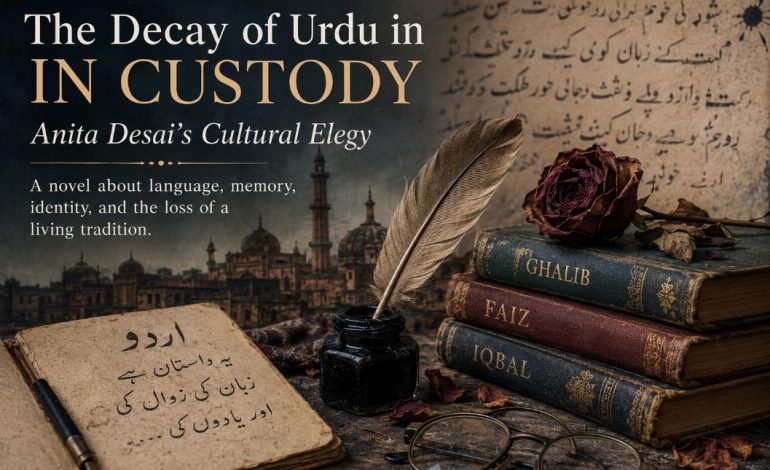

Language is more than a medium of communication—it is a repository of history, identity, memory, and cultural belonging. Anita Desai’s In Custody (1984) is one of the most compelling literary explorations of the gradual decline of Urdu in post-independence India. Through the tragicomic journey of its protagonist, Deven Sharma, Desai constructs an elegy for a language that once flourished under the patronage of Mughal courts but now survives only in fragments of memory, nostalgia, and fading literary traditions.
Rather than presenting the death of Urdu as a simple linguistic phenomenon, Desai transforms it into a metaphor for the erosion of an entire cultural world. In Custody becomes a meditation on the relationship between language, history, politics, and identity in modern India.
Deven: The Reluctant Custodian of a Dying Tradition
At the heart of the novel stands Deven Sharma, a modest Hindi lecturer in the provincial town of Mirpore. Ironically, although he earns his livelihood by teaching Hindi, his emotional and intellectual allegiance belongs to Urdu poetry. His attachment is deeply personal, rooted in childhood memories of Lucknow and Delhi, where Urdu represented refinement, beauty, and artistic excellence.
Deven’s predicament symbolizes the contradiction of postcolonial India. Hindi provides economic survival, but Urdu nourishes the imagination. As Deven himself suggests, teaching Hindi supports his family, while serving Urdu fulfills his soul. This division between material necessity and cultural desire defines his existence throughout the novel.
When his childhood friend Murad invites him to interview the celebrated Urdu poet Nur Shahjahanabadi for the literary journal Awaz, Deven imagines the journey as an opportunity to reconnect with the glorious literary world he has long admired. Yet the interview gradually becomes an encounter not with literary greatness but with decay, disillusionment, and failure.
Mirpore: A Geography of Cultural Decline
Desai’s fictional town of Mirpore is much more than a physical setting; it is a symbolic landscape reflecting the condition of Urdu itself.
The narrator traces the town’s history to a Muslim nawab who fled Delhi after the Revolt of 1857 and built a mosque in gratitude for his survival. Once constructed from marble and pink sandstone, the mosque now stands neglected, surrounded by dust, filth, and urban decay. The image mirrors the condition of Urdu—a magnificent cultural inheritance reduced to ruins.
By contrast, the Hindu temples of Mirpore are described as timeless structures whose origins have disappeared into antiquity. They seem perpetually rebuilt, retaining their essential identity across generations.
This contrast is particularly significant. Without necessarily endorsing communal ideology, Desai inadvertently reproduces a historical narrative in which Hindu culture appears eternal while Muslim culture seems historically contingent and fragile. Such a representation echoes what Edward Said describes as “structures of attitude and reference”—the subtle ideological assumptions embedded within literary representations of culture and history.
Thus, Mirpore itself becomes an ideological map where language, religion, and historical memory intersect.
Urdu, Hindi, and the Politics of Language
The decline of Urdu in In Custody cannot be separated from the politics of post-independence India.
Following Partition, Hindi increasingly became the official language of administration, education, and national identity in North India, while Urdu gradually lost institutional support. The novel reflects this shift through Deven’s own career. He teaches Hindi because it offers employment, yet he remains spiritually devoted to Urdu.
Desai does not portray Hindi as inherently oppressive. Instead, she reveals how state institutions and market forces privilege one language over another, reducing Urdu to the margins of public life.
The symbolic divide between Hindi and Urdu is reinforced through Mirpore’s communal geography. Hindu and Muslim neighborhoods remain physically and psychologically separated. During the festivals of Holi and Muharram, communal tensions erupt into violence despite police intervention. Particularly striking is Desai’s reference to Hindi and Urdu newspapers, each shaping public opinion through competing narratives that intensify social divisions.
Language thus becomes inseparable from political identity.
Murad and the Illusion of Cultural Revival
Murad initially appears as the energetic catalyst who reconnects Deven with Urdu literature. Yet his enthusiasm gradually reveals itself as self-interest.
Unlike Deven, whose attachment to Urdu is sincere, Murad commodifies literary culture. His journal Awaz survives more through opportunism than genuine commitment to literary preservation.
Their contrasting personalities represent two responses to cultural decline. Murad embodies the pragmatic modern city, exploiting nostalgia for personal gain. Deven, by contrast, becomes the passive victim of his own idealism, repeatedly betrayed by those around him.
His pilgrimage to Delhi therefore becomes less a journey toward cultural restoration than an education in irreversible loss.
Nur Shahjahanabadi: The Fallen Monument
The legendary poet Nur Shahjahanabadi is introduced as the last surviving giant of classical Urdu poetry. Deven imagines him as the living embodiment of an extraordinary literary tradition.
Reality proves devastating.
Instead of a dignified sage, Deven encounters an aging alcoholic surrounded by sycophants, domestic chaos, financial exploitation, and personal decline. Nur’s physical deterioration mirrors the condition of Urdu itself.
The poet survives, but only as a shadow of his former greatness.
His inability to preserve either his own dignity or his literary legacy demonstrates that cultural traditions cannot survive through nostalgia alone.
The Silencing of Women’s Voices
One of the novel’s most revealing moments concerns Nur’s second wife, Imtiaz Begum.
She passionately challenges Deven’s assumptions about literary authority, accusing him of dismissing her poetry solely because she is a woman. She reminds him that, unlike both Nur and Deven, she received no formal education and had to educate herself through determination and personal struggle.
Her accusation exposes the patriarchal foundations of literary tradition. She asks whether Deven abandoned her poetry reading because he feared that a woman’s verse might rival—or even surpass—that of the celebrated male poets he reveres.
Her challenge is powerful.
Yet Deven ultimately tears apart her manuscript and rejects her appeal.
This symbolic act extends the novel’s central tragedy. Not only is Urdu disappearing as a language, but it also proves incapable of accommodating new voices that might revitalize it. Female creativity remains excluded from the tradition Deven seeks to preserve.
The destruction of Imtiaz Begum’s manuscript becomes an act of cultural self-destruction.
Nostalgia and the Limits of Cultural Memory
Desai’s portrayal of Urdu is deeply nostalgic.
Nearly every major character—Deven, Murad, and Nur—looks backward toward an idealized literary past rather than imagining new futures for the language.
This nostalgia gives the novel much of its emotional power, yet it also limits its vision.
The distinguished Urdu novelist Intizar Husain argued that Urdu has never belonged exclusively to one city, region, or ruling class. Its strength lies precisely in its hybridity and ability to adapt across changing historical circumstances.
Desai’s vision differs considerably.
Her Urdu appears frozen within memories of Delhi, Lucknow, Mughal refinement, and aristocratic culture. It struggles to imagine contemporary transformations or evolving literary possibilities.
Consequently, Urdu becomes an object of mourning rather than renewal.
From English Narrative to Urdu Reclamation
An intriguing afterlife of In Custody emerged through Ismail Merchant’s film adaptation released nine years after the novel. The screenplay was rewritten in Urdu by Shahrukh Husain in collaboration with Anita Desai.
This adaptation subtly transforms the novel’s ideological position.
While Desai narrates the story of Urdu from the perspective of English fiction, Merchant symbolically returns the narrative to Urdu itself. More significantly, Merchant rejected the idea that Urdu was dying. His adaptation suggests that languages survive not merely through institutional patronage but through continual reinvention, performance, and cultural resilience.
The shift from English narration to Urdu dialogue represents a symbolic reclaiming of linguistic agency.
Conclusion: Elegy or Warning?
In Custody remains one of the finest literary explorations of linguistic decline in postcolonial India. Yet the novel is about far more than the fate of a language.
It interrogates the relationship between memory and modernity, literature and politics, nostalgia and history. Through Deven’s failed quest to preserve Urdu, Desai reveals the impossibility of safeguarding cultural traditions by merely worshipping their past. Languages remain alive only when they continue to evolve, absorb new voices, and engage with changing historical realities.
Ultimately, Deven fails not because he lacks devotion, but because devotion alone cannot rescue a tradition that has ceased to reinvent itself. His repeated journeys between Mirpore and Delhi become symbolic crossings through a metaphorical desert—a landscape separating memory from modernity, preservation from transformation.
The novel closes on a haunting irony. Although characters repeatedly declare that “Urdu is supposed to have died,” the very existence of In Custody ensures that the language continues to provoke conversation, scholarship, and cultural reflection. Desai’s novel is therefore not simply an elegy for Urdu. It is also a profound warning against allowing any cultural tradition to become imprisoned within nostalgia instead of enabling it to flourish in the present.
Chandra, S. 2026
Citations
Works Cited
Ahmad, A. Theory: Classes, Nations, Literatures London and New York:Verso.——.
Lineages of the Present: Political Essays
New Delhi: Tulika. Ali, Agha Shahid, ed.
Ravishing Disunities: Real Ghazals in English
Middleton, Conn.: Wesleyan University Press. Anderson, B.
Imagined Communities: Reflections on the Origin and Spread of Nationalism
. Rev. ed. London: Verso.Benjamin, W.
On Some Motifs in Baudelaire.” In his
Illuminations edited and with an introduction by Hannah Arendt, translated by Harry Zohn. New York: Schocken.
Bhabha, H.K., ed.
Nation and Narration
. London: Routledge.Bose, S., and A. Jal
Modern South Asia: History, Culture, Political Econ- omy
. London: Routledge.Brass, P.
Language, Religion and Politics in North India
. Cambridge: Cam-bridge University Press.Certeau, M. de.
In Culture in the Plural
, edited and with an introductionby Luce Giard; translated and with an afterword by Tom Conley. Min-neapolis: University of Minnesota Press.Coppola, C.
. Urdu Poetry: The Progressive Episode. Ph.D. diss., University of Chicago.Costa, M.
“Interview With Anita Desai.” <http://www.umiacs.umd.edu/users/sawweb/sawnet/books/desai_interview.html>.Desai, A.
Clear Light of Day
. London: Penguin Books.——.
In Custody
. London: Penguin Books.Dryland, E
Faiz Ahmad Faiz
: Urdu Poet of Social Realism
.Lahore: Vanguard Books.Eagleton, T.
The Idea of Culture
. Oxford: Blackwell.
Pakist≥nµ Kal±ar aur Qaumµ TashakhkhuΩ kµ Tal≥sh
(Paki-stani Culture and the Search for National Character). Lahore: Ferozsons.Farouqui, Athar.
. “Urdu Education in India: Four Representative States.”
Economic and Political Weekly
.Gupta, J.D.
Language Conflict and National Development: Group Politics and National Language Policy in India
. Berkeley and London: University of California Press.Hasan, K
The Unicorn and the Dancing Girl: Poems of Faiz Ahmad Faiz
. Translated by Daud Kamal. London: Independent.Hasan, Z.
Quest for Power: Oppositional Movements and Post-Congress Poli- tics in Uttar Pradesh
. Delhi: Oxford University Press.Husain, I.
Urd∑ k≥ Tehÿµbµ Miz≥j
” (The Cultural Disposition of Urdu).
The Annual of Urdu Studies
. Jaffrelot, C.
. “The Sangh Parivar Between Sanskritization and Social Engi-neering.” In
The BJP and the Compulsions of Politics in India
. Edited by Thomas Blom Hansen & Christophe Jaffrelot. Delhi: Oxford University Press.Kiernan, V., ed. and trans.
Poems by Faiz
. Lahore: Vanguard Books.Khilnani, S.
The Idea of India
. London: Penguin Books.King, C.
One Language, Two Scripts: The Hindi Movement in Nineteenth Century North India
. Delhi: Oxford University Press.Latifi, D.
. “Urdu in UP.”
Nation and the World
. “‘Hit It With a Stick and It Won’t Die’: Urdu Language andMuslim Identity and Poetry in Varanasi, India.”
The Annual Of Urdu Studies


1 Comment
[…] Source: The Decay of Urdu in Custody: Language, Memory, and Cultural Loss in Anita Desai’s In Custody […]