

The Invisible Empire: How Surveillance Capitalism Is Rewriting Our Lives
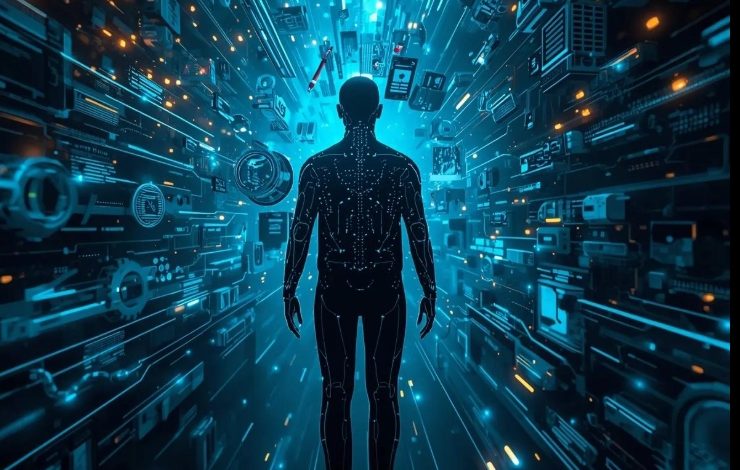

Every Click Tells a Story—But Whose Story Is It? Imagine waking up in the morning and opening your favourite music app. A playlist appears, seemingly crafted just for you. You scroll through social media, browse a few products online, and search for a restaurant nearby. These actions feel personal, private, and entirely under your control. But what if they aren’t? What if they are just mechanisms of entrenching Surveillance Capitalism
What if every search, every click, every pause, and every swipe is quietly feeding an economic machine that knows more about you than you know about yourself?
This is the unsettling reality explored by Harvard scholar Shoshana Zuboff in her groundbreaking theory of surveillance capitalism—a system in which human experience itself has become the raw material for profit.
The question is no longer whether we are being watched. The question is: what happens when our behaviour becomes the most valuable commodity in the world?
The Birth of a New Economic Order
For centuries, capitalism depended on tangible resources—land, labour, capital, and enterprise. Factories extracted value from workers, industries transformed raw materials into products, and markets determined winners and losers.
Today, however, a new resource has emerged: human behaviour.
Zuboff argues that companies such as Google, Facebook, Amazon, and Apple have pioneered a form of capitalism that thrives not on manufacturing goods but on collecting, analysing, and predicting human actions. Our personal experiences—once considered private and insignificant—have become data points in a vast commercial ecosystem.
The warning signs appeared early.
In a widely discussed 2009 interview, former Google Chairman Eric Schmidt suggested that individuals concerned about privacy might simply have something to hide. The statement revealed a growing assumption within the technology industry: collecting and storing personal information had become normal, even inevitable.
What followed was the rise of a business model built on the belief that every aspect of human life could be transformed into data and monetised.
From Digital Footprints to Digital Profits
Most people think they use technology for free.
The reality is more complicated.
Every online interaction leaves behind what researchers call a digital exhaust—search histories, purchases, messages, locations, preferences, and social interactions. Surveillance capitalists capture this information, refine it into behavioural data, and sell predictive insights to advertisers and other organisations.
The result is an unprecedented marketplace where future behaviour is bought and sold.
Zuboff refers to this as a behavioural futures market.
Companies no longer simply want to know what you did yesterday. They want to predict what you will do tomorrow—and, increasingly, influence what you do next.
This shift marks a profound transformation in the relationship between corporations and consumers. We are no longer merely customers. We are sources of behavioural surplus.
The Cambridge Analytica Wake-Up Call
For years, much of this data collection occurred beyond public scrutiny.
Then came the Cambridge Analytica scandal.
The controversy exposed how personal information harvested from millions of Facebook users could be used to create detailed psychological profiles and influence political behaviour. What many dismissed as targeted advertising suddenly appeared as something far more powerful: behavioural manipulation on a massive scale.
The scandal lifted the curtain on a system that had already become deeply embedded in everyday life.
What made the revelation so alarming was not simply the collection of information—it was the ability to shape decisions, emotions, and perceptions without individuals fully realising it.
Who Knows? Who Decides? Who Controls the Future?
At the heart of Zuboff’s argument lie three deceptively simple questions:
Who Knows?
Technology companies possess unprecedented knowledge about billions of individuals. They know what we buy, what we fear, what we search for, and often what we are likely to do next.
Who Decides?
Algorithms increasingly determine what information reaches us, what products we see, what content appears in our feeds, and even what opportunities are presented to us.
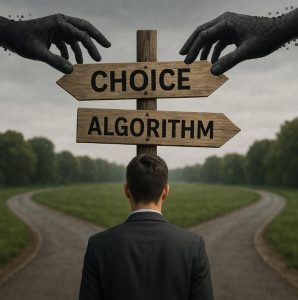
Who Decides Who Decides?
Perhaps the most important question of all.
The mechanisms governing these decisions are often proprietary and opaque. Consumers rarely understand what data is collected, how it is analysed, or who profits from it.
This creates what Zuboff describes as a profound division of learning—a world where a small number of corporations know everything about us while we know almost nothing about them.
The Illusion of Choice
Consider Spotify.
The platform is frequently celebrated as a triumph of artificial intelligence and personalised customer experience. Every playlist appears tailored to individual tastes, moods, and listening habits.
But there is another perspective.
Spotify’s recommendations are built upon extensive data collection and predictive algorithms. The platform learns from previous behaviours, identifies patterns, and subtly shapes future listening decisions.
Users often feel empowered because they are offered personalised options. Yet those options have already been curated by systems designed to influence behaviour.
The same logic extends across digital life—from online shopping and social media feeds to streaming platforms and targeted advertising.
The choice feels ours.
The architecture behind the choice often is not.
When Marketing Becomes Behavioural Engineering
Traditional marketing sought to persuade consumers.
Modern digital marketing seeks to predict and influence them.
Through big data analytics, machine learning, and algorithmic decision-making, companies continuously monitor consumer behaviour in real time. Every interaction becomes feedback. Every response improves the system’s ability to anticipate future actions.
The result is a recursive cycle:
- Data is collected.
- Behaviour is analysed.
- Predictions are generated.
- Environments are adjusted to encourage desired outcomes.
- New behaviour produces more data.
The cycle never ends.
In this environment, marketing evolves from communication into behavioural engineering.

The Rise of the “Big Others”
Zuboff introduces the concept of the “Big Other”—a new form of power exercised through digital infrastructures.
Unlike traditional institutions, the Big Other does not govern through visible authority. Instead, it operates through continuous observation, data extraction, and behavioural prediction.
Social media platforms exemplify this phenomenon.
Their power stems not from physical assets but from informational dominance. The more they know about human behaviour, the more valuable they become.
This explains why technology companies have accumulated extraordinary economic and social influence within a remarkably short period.
Information has become the new capital.
Knowledge has become the new currency.
Prediction has become the new source of power.
The New Inequality: A Division of Learning
Industrial capitalism was built on a division of labour.
Surveillance capitalism thrives on a division of learning.
A small group of individuals and organisations possess advanced capabilities in data analytics, machine learning, artificial intelligence, and behavioural prediction. These capabilities generate immense wealth and influence.
The disparity is striking.
Technology executives command fortunes measured in billions of dollars because they control systems that extract value from behavioural information. Meanwhile, millions of workers participate in the same digital economy without access to the knowledge structures that generate such power.
This is not merely an economic divide.
It is a knowledge divide.
And knowledge, as history repeatedly demonstrates, is inseparable from power.
Fiction Predicted Reality
David Eggers’ novel The Circle imagined a world dominated by a single technology company possessing the combined influence of Google, Facebook, Apple, and Amazon.
The story follows Mae, an employee who gradually ascends through the organisation while witnessing its expansion into every aspect of public and private life.
What once seemed like dystopian fiction now feels increasingly familiar.
The concentration of informational power among a handful of corporations raises questions that extend far beyond markets and technology. It forces society to reconsider the boundaries between convenience and control, innovation and manipulation, connection and surveillance.
The Fight for Our Future
Perhaps the most powerful aspect of Zuboff’s work is her warning that surveillance capitalism threatens what she calls our “right to the future tense.”
This is our ability to imagine, choose, and create our own futures.
When algorithms increasingly predict and influence behaviour, individual autonomy becomes vulnerable. The risk is not simply that companies know too much about us.
The risk is that they become capable of shaping who we become.
The challenge facing modern societies is therefore not technological but fundamentally human.
Can innovation coexist with privacy?
Can data-driven systems serve people without controlling them?
Can individuals reclaim ownership over their digital lives?
Conclusion: The Cost of Convenience
Surveillance capitalism has transformed private experiences into economic assets. It has created extraordinary technological innovation while simultaneously raising profound concerns about privacy, autonomy, and democracy.
The conveniences of the digital age come with hidden costs.
Every recommendation, personalised advertisement, and algorithmic suggestion is part of a larger system built upon behavioural data. While these technologies promise empowerment, they also concentrate knowledge and power in unprecedented ways.
Zuboff’s warning remains deeply relevant: the greatest threat may not be that surveillance capitalists know everything about us, but that they increasingly influence how we think, choose, and imagine our future.
The battle over data is no longer simply about privacy.
It is about human freedom itself.
References
Darmody and Zwick, 2020. Manipulate to empower: Hyper-relevance and the contradictions of marketing in the age of surveillance capitalism, Big Data & Society, pp. 1–12. DOI: 10.1177/2053951720904112.
Day, M. 2022. Amazon CEO Andy Jassy’s Pay Package Was $212 Million, Bloomberg [online] https://www.bloomberg.com/news/articles/2022-04-01/amazon-ceo-andy-jassy-s-pay-package-was-212-million-in-2021
Forbes, 2022. Mark Zuckerberg [online] https://www.forbes.com/profile/mark-zuckerberg/
Gray, C. H. (2019). The threat of surveillance capitalism. Teknokultura. Revista de CulturaDigital y Movimientos Sociales, 16(2), 265-276.
indeed, 2022. Delivery Driver hourly salaries in the United States at Amazon.com [online] https://www.indeed.com/cmp/Amazon.com/salaries/Delivery-Driver#:~:text=How%20much%20does%20a%20Delivery,9%25%20above%20the%20national%20average.
Kendell, D., 2020. Age of Surveillance Capitalism–The Fight for a Human Future at the New Frontier of Power. Brock Education Journal, 29(2), pp.52-52.
Power, M., 2022. Theorizing the economy of traces: From audit society to surveillance capitalism. Organization Theory, 3(4-6).
Zuboff, S., 2019, January. Surveillance capitalism and the challenge of collective action. In New labor forum (Vol. 28, No. 1, pp. 10-29). Sage CA: Los Angeles, CA: SAGE Publications.
Zuboff, S., 2015. Big other: surveillance capitalism and the prospects of an information civilization. Journal of information technology, 30(1), pp.75-89.
Jansen, S.C. and Pooley, J., 2021. Blurring genres and violating guild norms: A review of reviews of The Age of Surveillance Capitalism.
Evangelista, R., 2019. Review of Zuboff’s The age of surveillance capitalism. surveillance & society, 17(1/2), pp.246-251. s2




1 Comment
[…] Source: The Invisible Empire: How Surveillance Capitalism Is Rewriting Our Lives […]