

Living Inside the Doll’s House: How Henrik Ibsen Turned Architecture into a Critique of Modern Society
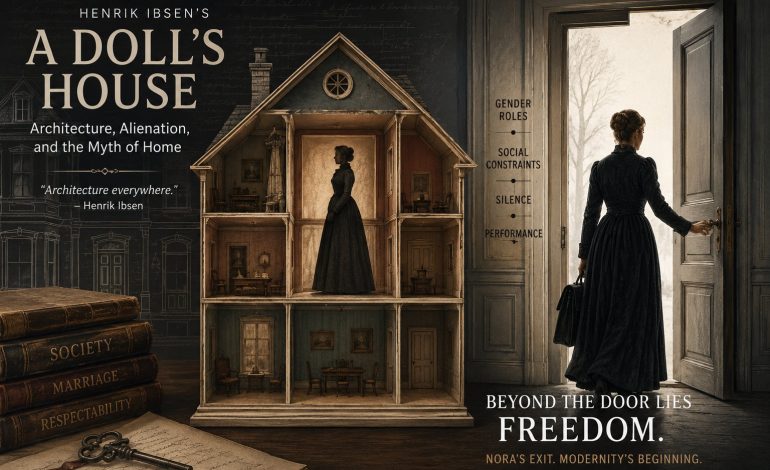

“Architecture everywhere.” — Henrik Ibsen (A Doll’s House)
What if a house could lie?
Not merely conceal secrets within its walls, but actively participate in the deception of those who inhabit it. What if the architecture of a home could become a stage upon which identities are manufactured, desires suppressed, and freedom quietly sacrificed?
These questions stand at the heart of Henrik Ibsen’s A Doll’s House (1879), one of the most revolutionary dramas of modern literature. More than a story about a troubled marriage, the play is an architectural meditation on modern existence. Through the seemingly ordinary domestic space of the Helmer household, Ibsen exposes the hidden structures that govern society itself. The house becomes much more than a setting; it becomes a metaphor, a prison, a performance space, and ultimately a symbol of modern alienation.
To understand the radical nature of Ibsen’s achievement, it is useful to recall Walter Benjamin’s observation that architecture bears witness to a society’s hidden mythology. If mythology consists of the stories, symbols, and beliefs through which a culture explains itself, then architecture functions as its most enduring material expression. Buildings preserve social values in stone, wood, and brick long after the ideas that produced them have faded from conscious awareness.
Seen through this lens, A Doll’s House emerges as a dramatic excavation of nineteenth-century European mythology. The play dismantles the cherished ideal of the bourgeois home and reveals the anxieties concealed beneath its polished surfaces.
The House as a Myth of Stability
For nineteenth-century Europe, the family home represented security, morality, and social order. It was imagined as a sanctuary insulated from the uncertainties of the modern world. Within its walls, clearly defined gender roles supposedly guaranteed harmony: the husband governed, the wife nurtured, and the children completed the picture of domestic happiness.
The Helmer residence initially appears to embody this ideal.
The stage directions emphasize comfort, warmth, and tasteful prosperity. Everything seems perfectly arranged. Yet from the opening moments of the play, subtle cracks begin to appear. Conversations reveal hidden debts, unspoken resentments, and unequal power relations. The house that appears secure from the outside gradually reveals itself as structurally unstable.
Ibsen’s genius lies in demonstrating that the problem is not simply the people inhabiting the house. The architecture itself embodies the ideological assumptions that constrain them. Every room reinforces social expectations; every doorway marks a boundary between permitted and forbidden behavior. The home becomes a spatial expression of patriarchal authority.
What appears as protection is, in reality, confinement.
Nora as the Occupant of a Designed Identity
No character experiences this confinement more intensely than Nora Helmer.
Her famous description as a “doll” is not merely psychological but architectural. She inhabits a carefully designed environment in which her role has already been predetermined. Like an ornament placed within a display cabinet, Nora is expected to decorate the household rather than actively shape it.
Her husband Torvald constantly employs diminutive language—”little skylark,” “little squirrel”—that reduces her individuality. These affectionate labels function like architectural constraints. They define the boundaries of her existence and dictate how she must perform femininity.
The house itself becomes an extension of this process.
Nora moves through rooms that appear comfortable yet operate according to invisible rules. She may occupy the space, but she does not possess it. Her presence is permitted only insofar as she fulfils the role assigned to her. The architecture of the home mirrors the architecture of patriarchal power.
In this sense, Nora’s struggle is not merely against Torvald. It is against an entire system of spatial, social, and symbolic organization.
Modernity and the Crisis of Home
Ibsen wrote during a period of profound transformation. Industrialization, urbanization, secularization, and emerging feminist movements were reshaping European society. Traditional sources of identity and meaning were beginning to weaken.
Philosophers would later describe this condition as a form of “homelessness”—not necessarily the absence of shelter, but the absence of existential belonging. Individuals increasingly found themselves detached from stable traditions and inherited certainties.
A Doll’s House captures this condition with remarkable precision.
Ironically, Nora’s sense of homelessness emerges within the very space designed to provide a home. Surrounded by comfort and security, she experiences profound estrangement. The domestic interior no longer functions as a site of belonging but as a mechanism of exclusion.
This paradox is deeply modern.
The house promises identity while simultaneously preventing its realization. It offers shelter while denying freedom. It creates the appearance of intimacy while fostering emotional isolation.
The result is a distinctly modern form of alienation: being trapped inside a structure that claims to represent one’s true self.
Architecture as Theatre, Theatre as Architecture
Drama has always possessed an architectural dimension. Characters move through designed spaces, interact with objects, and inhabit built environments. Yet Ibsen pushes this relationship further than most playwrights.
The architecture of A Doll’s House is not passive scenery. It actively generates meaning.
Doors, in particular, acquire extraordinary significance throughout the play. They regulate access, separate private from public life, and symbolize the barriers imposed upon personal freedom. Every entrance and exit becomes charged with emotional and ideological significance.
The famous closing scene culminates in one of the most celebrated architectural gestures in literary history: Nora’s departure.
The sound of the slammed door reverberates far beyond the stage. It is not merely a character leaving a house. It is the symbolic rejection of an entire social order. The architectural boundary that once confined her becomes the threshold through which she claims autonomy.
That door slam announces the arrival of modern consciousness.
The Dismantled Self and the Dismantled House
One of Ibsen’s most radical insights is that psychological identity and architectural space are deeply interconnected.
As Nora begins to question her marriage, she simultaneously begins to question the meanings embedded within her surroundings. The house gradually loses its authority as a source of stability. What once seemed natural appears artificial. What once seemed permanent appears fragile.
This transformation mirrors the fragmentation of the modern self.
The nineteenth century inherited grand narratives about religion, family, nation, and morality. Modernity increasingly subjected these narratives to scrutiny. Individuals found themselves compelled to construct meaning independently rather than receive it from tradition.
Nora’s awakening exemplifies this process.
Her departure is therefore not a simple act of rebellion. It is a recognition that authentic selfhood cannot emerge within a structure designed to suppress individuality. To become herself, she must abandon the architecture that has defined her existence.
Society as a Doll’s House
Perhaps the most unsettling implication of Ibsen’s drama is that the Helmer household serves as a model for society itself.
The title does not merely refer to Nora’s domestic circumstances. It suggests that modern social institutions often function as elaborate dollhouses: carefully arranged systems that demand performance rather than authenticity. Individuals become occupants of predefined roles, expected to enact identities constructed by cultural expectations.
Marriage becomes a dollhouse.
Gender becomes a dollhouse.
Respectability becomes a dollhouse.
Even society itself becomes a dollhouse.
The architecture of these institutions appears solid and natural, yet Ibsen reveals their fragility. Once subjected to critical examination, their foundations begin to crumble.
Why Ibsen Still Matters
More than a century after its publication, A Doll’s House remains astonishingly relevant. Contemporary debates surrounding gender, personal autonomy, identity, and institutional power continue to echo the concerns that animate the play.
Its enduring significance lies in Ibsen’s recognition that oppression is not always visible. It can be embedded within everyday spaces, habitual practices, and seemingly benign forms of social organization. Architecture, in this sense, becomes a repository of ideology.
By transforming the bourgeois home into a site of critique, Ibsen fundamentally altered the relationship between literature and architecture. He demonstrated that buildings are never merely physical structures; they are expressions of cultural values, instruments of power, and stages upon which social myths are performed.
The house in A Doll’s House stands as one of modernity’s most potent metaphors: a structure that promises belonging while producing alienation, offering security while restricting freedom.
And when Nora walks out of that house, she does more than leave a marriage.
She steps beyond the walls of an entire mythology.
Chandra S. 2026
References
Ibsen, Henrik, and Nicholas Rudall. A Doll’s House. I. R. Dee, 1999.
Spurr, David. Architecture and Modern Literature. University of Michigan Press, 2012. JSTOR, https://doi.org/10.2307/j.ctt1qv5nb5. Accessed 13 Feb. 2023.