

Deconstructing the Centre: Derrida, Play, and the Endless Possibility of Meaning
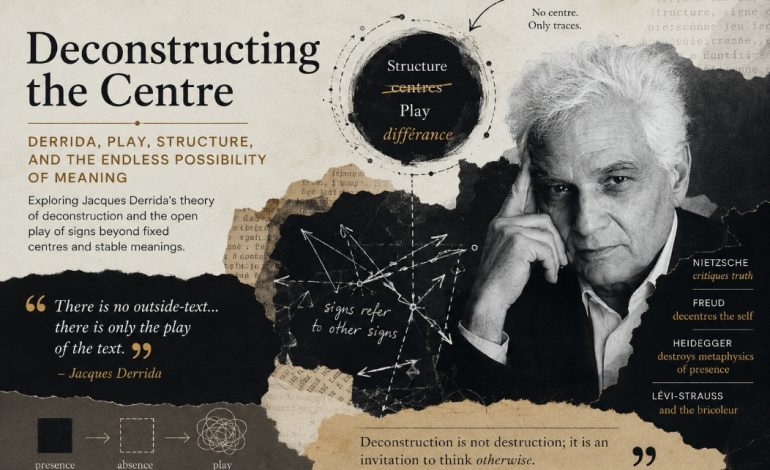

For centuries, Western philosophy has sought certainty. It has searched for origins, fixed meanings, stable truths, and unquestionable centres from which knowledge could be organized. Yet what happens when the very idea of a centre begins to unravel? What if meaning itself is never complete but constantly deferred, negotiated, and reinvented? It is precisely this philosophical disruption that Jacques Derrida introduces through his theory of deconstruction.
Rather than positioning post-structuralism as a simple rejection of structuralism, Derrida reveals its intimate dependence on the very structures it interrogates. Structuralism, inspired by linguistic models, assumes that every system possesses an organizing principle—a centre—that regulates meaning and establishes coherence. This centre appears to stabilize the structure by limiting interpretive possibilities. However, Derrida’s radical insight lies in exposing the paradox embedded within this assumption: the centre belongs to the structure while simultaneously escaping its structural logic.
In his landmark essay Structure, Sign and Play in the Discourse of the Human Sciences, Derrida argues that the concept of structure has always relied upon an unquestioned centre. The centre organizes, balances, and legitimizes the structure, but it also restricts the “play” of its elements. Play, for Derrida, is not merely movement or freedom; it is the dynamic process through which meaning emerges from relationships among signs rather than from any fixed origin. Every centre, therefore, performs a dual function—it guarantees order while suppressing the limitless possibilities of interpretation.
This insight transforms our understanding of meaning itself. If every sign derives significance only through its difference from other signs, then no sign can function as an ultimate foundation. Derrida famously identifies the centre as a “transcendental signifier,” a privileged point believed to anchor all other meanings. Yet this transcendental signifier cannot justify itself independently. It too requires other signs for its intelligibility. Consequently, the dream of an absolute foundation collapses, leaving us with discourse rather than certainty.
The historical significance of Derrida’s intervention lies not in abolishing structures but in revealing their instability. Throughout intellectual history, centres have continually replaced one another—God gives way to Reason, Reason to Consciousness, Consciousness to Language, and so forth. Each substitution preserves the structural desire for certainty while merely changing its privileged location. Derrida names the moment when this confidence in stable centres begins to fracture as the event of “rupture.” Rupture does not destroy structure; rather, it exposes the endless movement concealed beneath its apparent stability.
The philosophical genealogy of this rupture extends beyond Derrida himself. The critique of metaphysics undertaken by Friedrich Nietzsche challenges the universal validity of truth; Sigmund Freud destabilizes the sovereign, self-present subject through the unconscious; Martin Heidegger questions the metaphysical determination of Being as presence. Derrida inherits these critiques while pushing them further. Instead of replacing one philosophical centre with another, he interrogates the very desire for centredness.
Perhaps one of Derrida’s most misunderstood claims is that deconstruction seeks to dismantle structures entirely. On the contrary, deconstruction depends upon structures. A structure must exist before it can be questioned, displaced, or reread. Deconstruction therefore operates from within, revealing internal tensions, contradictions, and exclusions that every seemingly coherent system attempts to conceal. The objective is not destruction but critical openness.
This methodological openness finds expression in Derrida’s appropriation of Claude Lévi-Strauss’s notion of the bricoleur. Unlike the engineer, who supposedly designs systems according to universal principles, the bricoleur works creatively with whatever materials are available. Lévi-Strauss initially presents these figures as opposites. Derrida, however, deconstructs the opposition itself. Even the engineer, he argues, is inevitably a bricoleur because no thinker ever begins from an uncontaminated origin. Every concept is borrowed from previous discourses, every language already inhabited by inherited assumptions. There is no pure starting point outside history or language.
The implications of this argument extend far beyond literary criticism. Deconstruction invites us to rethink political institutions, philosophical traditions, cultural identities, legal systems, and academic disciplines. Every structure that presents itself as natural, universal, or self-evident becomes open to critical scrutiny. Rather than searching for definitive meanings, deconstruction encourages attentiveness to silences, marginal voices, internal contradictions, and possibilities that dominant interpretations suppress.
At the heart of Derrida’s project lies the concept of différance—a term that simultaneously signifies difference and deferral. Meaning is never fully present; it is endlessly postponed through an infinite chain of signification. This does not imply that meaning disappears altogether. Instead, meaning becomes an event of continuous negotiation, always provisional, always relational, and always open to reinterpretation.
The enduring originality of Derrida’s intervention lies in this profound shift of philosophical orientation. He replaces the search for immutable truth with an ethics of interpretation. He transforms certainty into inquiry, stability into movement, and closure into openness. Deconstruction is therefore less a method of dismantling texts than a disciplined practice of reading against the grain, revealing how every claim to universality depends upon exclusions that can never be completely erased.
In an intellectual climate increasingly marked by competing truths, polarized identities, and rigid ideological certainties, Derrida’s insistence on the necessity of play remains remarkably relevant. His work reminds us that critical thinking flourishes not by escaping structures but by inhabiting them differently—questioning their assumptions, unsettling their hierarchies, and remaining receptive to meanings that have yet to emerge.
Ultimately, deconstruction is neither philosophical skepticism nor interpretive chaos. It is an invitation to acknowledge that meaning lives not in fixed centres but in the restless movement between signs. The absence of a final origin is not a crisis to be overcome; it is the very condition that makes thought, language, and interpretation endlessly possible.
Chandra, S. 2006




2 Comments
[…] by arguing that language is far more unstable than we imagine. Interestingly, long before Derrida’s theories of deconstruction, the Romantic poets had already sensed this instability. Their poetry can be read as an artistic […]
[…] paradox finds a remarkable philosophical companion in the work of French philosopher Jacques Derrida. In his influential essay Faith and Knowledge, Derrida challenges the conventional assumption that […]