

The Hidden Climate Bill of AI: Every Prompt Has a Planetary Price
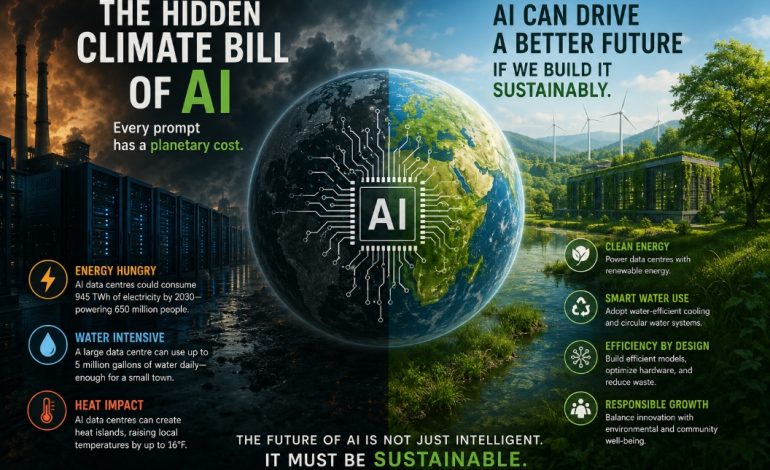

AI is changing the world. But who is paying the environmental bill? What is the Hidden Climate Bill of AI?
Artificial Intelligence has become the defining technology of our era. It writes code, creates art, diagnoses diseases, predicts market trends, and automates work that once required hours of human effort. For businesses, AI represents speed, efficiency, and competitive advantage. For society, it promises breakthroughs in healthcare, education, climate science, and scientific discovery.
Yet beneath every seemingly effortless AI-generated response lies an invisible physical infrastructure—one that consumes staggering amounts of electricity, water, and land. AI is often perceived as a “cloud-based” digital innovation, but the cloud is not weightless. It is made up of massive data centres, cooling systems, power grids, and servers operating around the clock. In reality, AI is not just a software revolution—it is a material revolution with measurable environmental consequences.
The AI Revolution Has the Hidden Climate Bill of AI
Businesses are embracing AI at an unprecedented pace. From customer service chatbots and automated financial analysis to predictive maintenance and personalized marketing, organizations increasingly rely on AI to improve productivity and decision-making.
But as companies race to become “AI-first,” another race is unfolding quietly—the race to build more data centres.
Unlike conventional software, modern Generative AI models require enormous computing power for both training and daily use. Every interaction, whether generating an email, creating an image, or answering a question, requires energy-intensive computation running in specialised data centres.
Studies suggest that an AI query can consume significantly more energy than a traditional internet search. Individually, the difference appears trivial. Collectively, billions of AI interactions each day create a rapidly expanding energy demand that is reshaping national electricity systems.
By 2030, global AI infrastructure could consume nearly 945 terawatt-hours of electricity annually—roughly equivalent to the electricity consumption of hundreds of millions of people.
The irony is striking: the technology designed to make human life more efficient may simultaneously make achieving global climate goals significantly more difficult.
Every AI Response Drinks Water
Electricity is only part of AI’s environmental footprint.
The servers powering AI generate enormous amounts of heat. To prevent overheating, data centres require continuous cooling, much of which depends on vast quantities of freshwater.
A medium-sized data centre may consume approximately 300,000 gallons of water every day, while the largest facilities can require up to five million gallons daily—enough to meet the needs of an entire small town.
This water often comes from regions already experiencing increasing water stress.
The environmental equation therefore becomes more complex than simply counting carbon emissions. Every unit of electricity consumed by AI carries a hidden water footprint. Every AI-generated paragraph, image, or recommendation is supported by a physical cooling system somewhere on the planet.
In an era where water scarcity is becoming one of humanity’s greatest challenges, this raises difficult questions about how societies should allocate increasingly limited resources.
Why Communities Are Pushing Back
Around the world, resistance to new AI data centres is growing.
Contrary to popular perception, local communities are rarely opposing technology itself. Instead, they are responding to its environmental consequences.
Residents increasingly report concerns about:
- Rising noise pollution from cooling infrastructure.
- Pressure on already stressed electricity grids.
- Growing competition for freshwater resources.
- Loss of agricultural or community land.
- Reduced local control over infrastructure development.
Recent research has also identified another unexpected consequence: AI data centres can create localized “heat islands,” increasing surrounding temperatures by as much as 16°F (approximately 9°C). These temperature increases can worsen urban heat stress and affect hundreds of millions of people living nearby.
The digital economy, it appears, is creating very physical environmental impacts.
The Cost Nobody Sees on Their Screen
One of AI’s greatest strengths is that it feels frictionless.
A user types a prompt.
Within seconds, an answer appears.
The environmental costs remain invisible.
Consumers rarely consider where the computation occurred, how much electricity powered the servers, or how much water cooled the equipment. Unlike driving a car or flying on an airplane, AI’s environmental impacts are hidden behind clean interfaces and seamless user experiences.
This invisibility creates a dangerous illusion that digital technologies have no material footprint.
They do.
They simply outsource it.
The AI Sustainability Paradox
Ironically, AI is also becoming one of humanity’s most powerful tools for environmental protection.
Researchers are using AI to:
- Improve renewable energy forecasting.
- Detect deforestation from satellite imagery.
- Monitor biodiversity.
- Predict floods and wildfires.
- Reduce industrial emissions.
- Optimize transportation networks.
- Improve energy efficiency in buildings.
In other words, AI is simultaneously contributing to environmental pressures while helping solve them.
This is the central paradox of the AI age.
The challenge is no longer whether AI should be used.
The challenge is ensuring that AI creates more environmental value than environmental damage.
Growth Without Green Is Not Progress
Economic growth and sustainability should not be treated as competing objectives.
Businesses increasingly recognise that environmental performance is becoming a competitive advantage rather than merely a regulatory obligation.
The future of responsible AI therefore extends beyond developing smarter algorithms. It also requires building smarter infrastructure.
This includes investing in renewable-powered data centres, water-efficient cooling technologies, energy-efficient AI models, responsible hardware design, and transparent reporting of AI-related environmental impacts.
Innovation should no longer be measured solely by computational capability.
It should also be measured by environmental efficiency.
The Next Competitive Advantage: Sustainable AI
The next generation of business leaders will not simply ask:
“Can AI increase productivity?”
They will ask:
“Can AI create value without exhausting the planet’s resources?”
The organizations that answer both questions successfully will define the next era of innovation.
Artificial Intelligence undoubtedly represents one of humanity’s greatest technological achievements. But intelligence without environmental responsibility is incomplete.
The future does not belong to companies that build the biggest AI models.
It belongs to those that build the smartest—and the most sustainable—ones.
Because every AI prompt leaves an invisible footprint. The real question is whether we choose to ignore it—or innovate beyond it.
Chandra, D. 2026
References
Chouksey, A., Rajan, A.K., Gurjar, V., Tiwari, R. and Mishra, P.K., 2026. The green paradox: The climate, environmental, and sustainability implications of artificial intelligence. Global Environmental Change Advances, 6, p.100029.
Leman, M. 2026. The energy and environmental impact of AI and how it undermines democracy, Greenpeace [online] https://www.greenpeace.org/international/story/82486/ai-energy-environment-democracy/
JP MorganChase, (2026, 14 Apr). Understanding the use of AI among small businesses [online] https://www.jpmorganchase.com/institute/all-topics/business-growth-and-entrepreneurship/understanding-ai-use-by-small-businesses
Paddison, L. (2026, 31 March). Scientists have found an alarming environmental impact of vast data centers, CNN [online] https://edition.cnn.com/2026/03/30/climate/data-centers-are-having-an-underrported
UNU-INWEH, (2026, 03 June), Environmental Cost of Artificial Intelligence: Carbon, Water, and Land Footprints [online] https://unu.edu/inweh/collection/environmental-cost-of-AIs-Enrgy-Use-Carbon-water-and-land-footprints
Walker, C.D. and Goldsmith, (2026, 17 Feb). From Energy Use to Air Quality, the Many Ways Data Centers Affect US Communities, World Resources Institute [online] https://www.wri.org/insights/us-data-center-growth-impacts