
When Broken Bodies Speak: Reading Samuel Beckett Through Disability and Power

What if a character’s inability to walk, speak, or even remember properly isn’t merely a personal tragedy but a political declaration?
This question resides at the heart of Samuel Beckett’s fiction. Across his novels, readers encounter figures who crawl, limp, forget, stutter, and slowly disintegrate. They are old, sick, disabled, and often trapped within their own bodies. At first glance, these characters appear to represent human despair. Yet, a closer reading uncovers something far more unsettling: their broken bodies become maps of a world shaped by violence, power and control.
Beckett’s literary universe is populated by people who exist on the margins of physical and mental capability. Invalidism, paralysis, memory loss, frailty, and neurological difference are not incidental details in his works—they are the very forces that carry forward the narrative. In novels such as Molloy, Malone Dies, and The Unnamable, disability is not merely a medical condition. Rather it becomes a language through which Beckett questions society, authority, and even the very purpose and meaning of human existence.
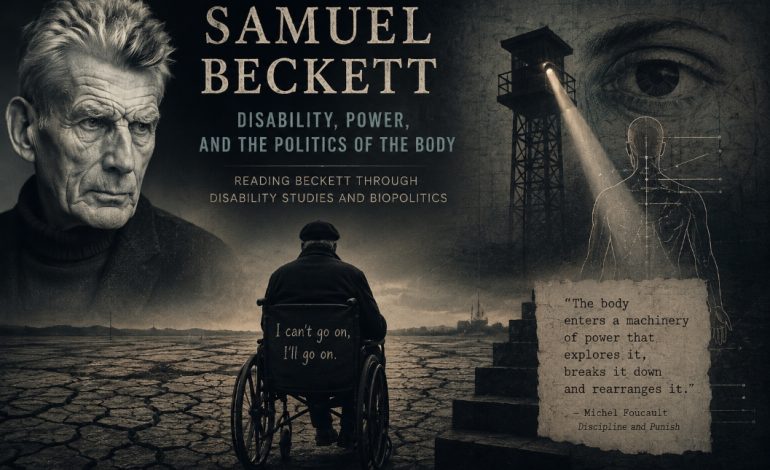
To understand this, the ideas of French philosopher Michel Foucault offer a powerful lens. In Discipline and Punish, Foucault argues that modern societies exercise control not only through institutions or laws but through the body itself. Human beings are trained, disciplined, monitored, and reshaped until their bodies become instruments of power. As Foucault famously describes, the body enters “a machinery of power” those studies, reorganizes, and disciplines it.
Seen through this perspective, Beckett’s disabled characters begin to look very different. Their physical decline is not merely biological; it reflects the invisible pressures of political systems, social expectations, and historical violence. Their bodies resist becoming efficient, productive, or “normal.” In doing so, they expose the very mechanisms that attempt to regulate human life.
Beckett wrote during a century scarred by world wars, ideological conflicts, and rapid social transformation. These historical realities profoundly influenced his imagination. His characters inhabit worlds where certainty has collapsed, identities are unstable, and the body itself can no longer be trusted. Disability, therefore, becomes more than a theme—it becomes a metaphor for the fractured condition of modern existence.
Consider the trilogy of Molloy, Malone Dies, and The Unnamable. Each novel progressively dismantles the human subject. Bodies weaken. Language fragments. Identity slips away. The characters are stripped of mobility, autonomy, and even coherent selfhood. This gradual disintegration reflects Beckett’s deep skepticism toward systems that promise order, progress, or completeness. Instead of presenting idealized human beings, he offers incomplete, vulnerable, and unfinished lives.
Interestingly, Beckett also shows a profound mistrust for reproduction and continuity. His works rarely celebrate growth or renewal. Rather, they dwell on decline, interruption, and incompleteness. In this sense, disability becomes an alternative way of imagining and understanding existence, challenging conventional ideas of perfection, productivity, and normalcy.
Reading Beckett through disability studies and biopolitics therefore opens new possibilities for understanding his fiction. Disability is not simply represented; it becomes a critical framework that exposes how societies define value, regulate bodies, and determine whose lives are considered meaningful. Beckett’s physically and neurologically impaired characters force readers to confront uncomfortable questions: Who decides what a “normal” body is? What happens when a body refuses or fails to meet those expectations? Can vulnerability itself become a form of resistance?
These questions remain strikingly relevant today. In an era shaped by surveillance technologies, biomedical interventions, and increasing debates about accessibility and inclusion, Beckett’s fiction speaks with renewed urgency. His novels remind us that the body is never merely biological—it is also political, cultural, and deeply contested.
Far from portraying disability as simple suffering, Beckett transforms it into a profound critique of modern civilization. His fragmented protagonists reveal the hidden structures of power that govern human life while simultaneously affirming the resilience of existence in its most fragile forms. Their brokenness is not a weakness to be overcome; it is a powerful way of exposing the limits of systems that seek to define, discipline, and control us.
In the end, Beckett’s greatest achievement may be this: he compels us to see that the most damaged bodies often tell the most revealing stories about the world that produced them.
Chandra, S. 2026
References
Beckett S. Complete Dramatic Works. London: Faber; 1989.
Foucault, Michel, 1926-1984. Discipline and Punish : the Birth of the Prison. New York :Pantheon Books, 1977.