

The Price of Patriarchy: Why India Cannot Become a Fully Developed Nation While Half Its Potential Is Constrained

At Pune’s recent “Chhatron Ki Goonj” interaction, Congress leader and Leader of the Opposition Rahul Gandhi asked young women to challenge what he described as a “Manusmriti mindset” and “smash patriarchy.” His central argument was larger than a partisan political critique: women cannot be treated as possessions of fathers, husbands or sons, because their identity and aspirations belong to them. He also described India’s women as one of the country’s greatest assets.
The political controversy surrounding those remarks should not obscure the larger question they raise:
What does patriarchy cost India?
The answer is not merely social or moral. It is economic, institutional, educational and demographic.
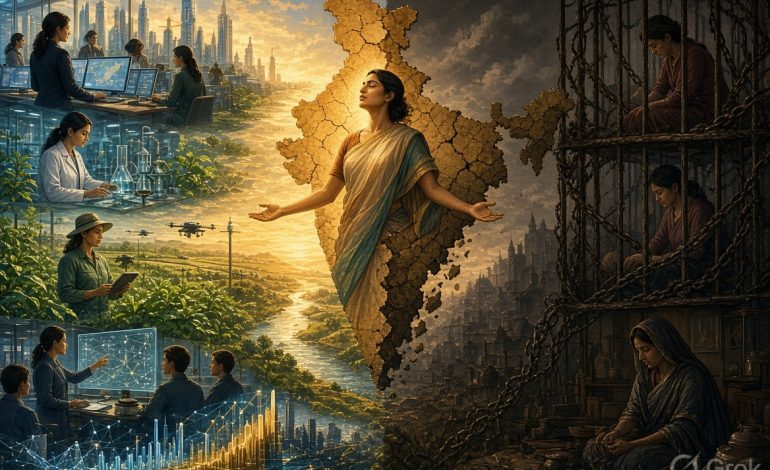
A nation that asks half its population to negotiate restrictions on where they can go, what they can study, whom they can marry, whether they can work, how late they can return home, how much they should earn, or whose ambitions should take priority is not simply limiting individual freedom. It is limiting its own productive capacity.
Patriarchy is more than individual prejudice
Patriarchy is often reduced to the image of a domineering father, an abusive husband or a sexist workplace. Feminist scholarship, however, understands it as something broader: a social system in which power, authority and resources are disproportionately organised around men and masculine norms.
Patriarchy in India manifests as social norms, family structures, legal/practical gaps, and institutional biases that limit women’s mobility, education returns, paid work, property control, and safety. These are not uniform—southern and northeastern states often show better outcomes than northern ones—but they are pervasive.
The feminist theorist Sylvia Walby, for example, conceptualised patriarchy through interconnected structures including household relations, employment, the state, sexuality and cultural institutions.
This matters because discrimination does not have to announce itself as discrimination.
A daughter may be encouraged to study—but told that an ambitious career is ultimately secondary to marriage.
A woman may be legally entitled to work—but expected to perform most unpaid domestic labour.
A professional may enter an office—but discover that leadership is still coded as masculine.
A young woman may technically have freedom of movement—but learn that safety, family honour and social reputation make that freedom conditional.
These restrictions can become so normalised that they cease to look like restrictions at all.
That is the power of patriarchy: it can turn inequality into common sense.
From Manusmriti to the modern household: tradition and interpretation
Gandhi’s invocation of the Manusmriti is particularly contentious because India’s intellectual and religious traditions are extraordinarily diverse, and no single ancient text can reasonably be treated as a complete representation of Indian civilisation.
The important question, therefore, is not whether every Indian tradition is inherently patriarchal. It plainly is not.
The more useful question is how particular patriarchal interpretations of tradition have historically been used—or continue to be used—to justify unequal authority.
At the Pune event, Gandhi criticised what he characterised as a Manusmriti-derived understanding of women as remaining under male authority at different stages of life.
The contemporary feminist response should not be a simplistic rejection of culture. It should be a demand to distinguish heritage from hierarchy.
A civilisation is not weakened when its younger generation questions inherited power structures. It becomes stronger when it has the confidence to examine its traditions critically and retain what advances human dignity while rejecting what denies it.
That intellectual project has deep roots in India itself.
From Savitribai Phule, who challenged restrictions on women’s education, to Pandita Ramabai, who confronted the social oppression of women, Indian women reformers repeatedly demonstrated that questioning patriarchal customs was not an assault on India—it was part of India’s own tradition of social reform.
Simone de Beauvoir and the making of inequality
The French feminist philosopher Simone de Beauvoir famously argued in The Second Sex that womanhood is not simply a biological destiny but something shaped by social expectations.
Her insight remains remarkably relevant.
A girl is born with potential. Society then begins assigning expectations.
Be modest.
Be careful.
Be accommodating.
Do not be too ambitious.
Do not be too outspoken.
Do not come home too late.
Choose a “suitable” career.
Remember your future family.
These instructions may appear individually harmless. Collectively, however, they can construct an invisible architecture around a person’s choices.
Boys, meanwhile, are frequently socialised toward independence, risk-taking, leadership and financial responsibility.
The result is a paradox.
India invests in educating girls and then, in countless ways, teaches them not to fully use that education.
bell hooks: patriarchy harms men too
The American feminist thinker bell hooks offered another crucial insight: feminism is not a war against men. It is a struggle against sexist systems that damage everyone.
Patriarchy tells men that masculinity means dominance, emotional suppression and economic authority.
It tells women that femininity means accommodation, care and obedience.
Both are restrictive.
A father who believes his worth depends entirely on earning may struggle to participate equally in childcare.
A boy taught that vulnerability is weakness may find emotional intimacy difficult.
A woman who is expected to become the family’s unpaid caregiver may have to sacrifice professional opportunities.
Patriarchy therefore does not merely create “women’s problems.” It creates a distorted society in which human beings are forced into narrow roles.
Smashing patriarchy, properly understood, should mean expanding freedom for everyone.
The economic argument is impossible to ignore
There is a particularly powerful reason India should treat gender equality as a national-development priority:
Growth needs talent.
India cannot afford to educate, train and inspire millions of women and then leave their abilities underused.
The World Bank reports that female labour-force participation in India rose from 22.9% in 2018 to 35.3% in 2025. It estimates that increasing women’s participation to 50% could raise India’s annual GDP growth rate by about one percentage point, helping the country move closer to the growth rate required to become a high-income economy by 2047.
The World Bank also identifies low female labour-force participation as one of India’s continuing development challenges and says raising female participation from roughly 35.6% to 50% by 2047 will be important to unlocking India’s demographic dividend.
These are not abstract feminist statistics.
They represent millions of unrealised careers, businesses, inventions, salaries, tax revenues, ideas and leadership opportunities.
When a qualified woman leaves the workforce because childcare is unavailable, society loses.
When a woman never applies for a job because travelling alone is considered unsafe, society loses.
When a girl abandons education because marriage is prioritised over professional development, society loses.
When women perform enormous quantities of unpaid care work without recognition or economic security, society loses.
Patriarchy is therefore not only an equality problem. It is an efficiency problem.
The unpaid economy: work that disappears because women do it
One of patriarchy’s most persistent mechanisms is the unequal distribution of care.
Cooking, cleaning, caring for children, looking after elderly relatives, managing household logistics and maintaining family relationships all require time and labour.
Yet much of this work remains invisible in conventional economic measurements.
This produces a peculiar contradiction: a woman can work an exhausting “second shift” at home while being described as economically inactive because her labour does not generate a conventional wage.
The feminist economist Nancy Folbre has spent decades drawing attention to the economic importance of care work and the way societies systematically undervalue it.
India’s growth story cannot be complete while the care economy remains overwhelmingly dependent on women’s invisible labour.
If India wants more women in formal employment, it needs more than motivational speeches.
It needs safe transport, affordable childcare, flexible work, dignified maternity and paternity policies, household technology, equal pay, workplace safety and a cultural redistribution of domestic responsibility.
In other words, women should not have to choose between being economically productive and fulfilling socially assigned caregiving roles.
Patriarchy also wastes India’s demographic dividend
India’s young population is frequently described as one of its greatest advantages.
But a demographic dividend does not automatically produce economic growth.
Young people must be educated, healthy, skilled and productively employed.
If young women remain excluded from meaningful economic participation, half of that demographic potential is compromised.
This is why gender equality should not be treated as a niche “women’s issue.”
It belongs in conversations about:
GDP.
Manufacturing.
Start-ups.
Education.
Innovation.
Tax revenue.
Household incomes.
Poverty reduction.
Human capital.
National competitiveness.
The World Bank notes that India’s development challenge includes both increasing female participation in employment and creating more and better jobs for women, particularly in labour-intensive sectors.
A country aspiring to compete with the world’s largest economies cannot afford a social system that systematically narrows the choices of a huge portion of its talent pool.
Feminism is not anti-family
One of the most persistent misunderstandings about feminism is that equality requires the destruction of family or tradition.
It does not.
A feminist society does not have to be a society without families.
It can instead be a society in which family is a partnership rather than a hierarchy.
A daughter can love her parents without being controlled by them.
A wife can love her husband without becoming economically dependent on him.
A mother can care for her children without being expected to surrender her identity.
A father can provide for his family without believing that domestic work is beneath him.
A son can care for ageing parents without assuming that his sister’s responsibility is automatically greater simply because she is a woman.
Equality does not abolish relationships.
It makes relationships more voluntary, reciprocal and dignified.
Amartya Sen and the freedom to choose
Indian economist and philosopher Amartya Sen’s capability approach offers an especially useful way to understand this question.
Development, in Sen’s framework, is not simply about increasing income. It is about expanding people’s substantive freedoms—their real ability to live the lives they have reason to value.
Apply that principle to gender.
A woman may have the formal right to attend university, but does she have the freedom to travel safely to campus?
She may have the legal right to work, but does she have access to childcare?
She may have the right to own property, but does she have genuine control over economic resources?
She may have the right to contest an election, but does her family and community permit her political participation?
Legal equality is essential. But genuine freedom requires the social and economic conditions that make legal rights usable.
This is where India’s gender conversation must move next—from rights on paper to capabilities in practice.
From “women’s empowerment” to women’s agency
There is another subtle distinction worth making.
Women do not need to be “empowered” in the sense of being granted permission by society to become capable.
They already possess agency.
The question is whether institutions allow that agency to flourish.
The language of empowerment can sometimes imply that someone else is handing women power.
The language of agency asks a more fundamental question:
Who gets to make decisions about a woman’s life?
Her education?
Her career?
Her marriage?
Her body?
Her mobility?
Her money?
Her political choices?
Her ambitions?
The feminist answer is straightforward:
She does.
That principle was at the heart of Gandhi’s Pune remarks when he argued that women should not be defined only through their relationships to fathers, husbands or mothers.
The Gen Z opportunity
Perhaps the most significant part of the Pune intervention was its appeal to young people.
Gen Z has grown up amid enormous contradictions.
It has seen women become CEOs, pilots, scientists, entrepreneurs, athletes, judges, soldiers and political leaders.
At the same time, it has inherited old expectations about gender, sexuality, marriage, family honour and domestic responsibility.
Young Indians therefore have a unique opportunity.
They can redefine masculinity.
They can normalise men doing housework.
They can make fathers equally responsible for childcare.
They can reject casual sexism in classrooms and workplaces.
They can challenge victim-blaming.
They can demand safer public spaces.
They can insist that women’s careers are not merely “optional income.”
And men can participate in this transformation—not as saviours of women, but as partners in dismantling a system that restricts everyone.
The goal should not be to replace male domination with female domination.
The goal is to replace hierarchy with equality.
India cannot become Viksit Bharat with half its talent constrained
India’s development ambitions are enormous.
It wants to become a high-income economy, a global manufacturing centre, a technological power and a major force in science and innovation.
But national development is ultimately about people.
A country becomes stronger when its citizens can convert education into opportunity, talent into productivity and ambition into achievement.
If social norms prevent millions of women from doing precisely that, the country is voluntarily leaving capacity unused.
The World Bank’s broader gender research similarly finds that women’s full participation can increase economic productivity, reduce poverty, strengthen social cohesion and improve wellbeing across generations.
So the argument against patriarchy need not begin with ideology.
It can begin with national interest.
India needs every scientist.
Every entrepreneur.
Every teacher.
Every doctor.
Every engineer.
Every artist.
Every administrator.
Every worker.
Every leader.
And if half the population continues to face disproportionate barriers to becoming those things, India’s development will remain incomplete.
The real revolution is ordinary
The end of patriarchy will not arrive through a single speech, law or election.
It will happen through millions of ordinary decisions.
A family that lets its daughter choose her career.
A father who teaches his son to cook.
A husband who treats his wife’s ambition as seriously as his own.
A workplace that promotes talent rather than conformity.
A school that teaches girls confidence and boys equality.
A government that makes public spaces safer.
An economy that recognises care work.
A young generation that refuses to inherit prejudice simply because it is old.
That is the deeper meaning behind the call to challenge patriarchy.
India does not have to choose between tradition and progress. It has to choose between hierarchy and human potential.
The question facing Gen Z is therefore not whether women deserve equality.
The more consequential question is:
Can India afford not to give it to them?
The evidence suggests the answer is no.
Because when women are restricted, India is restricted.
And when women are free to learn, work, create, lead and decide for themselves, India does not merely become fairer—it becomes stronger.
Team SChandra Literature



1 Comment
[…] Source: The Price of Patriarchy: Why India Cannot Become a Fully Developed Nation While Half Its Potential I… […]