

Status of Women in Ancient India: Between Reverence and Restriction
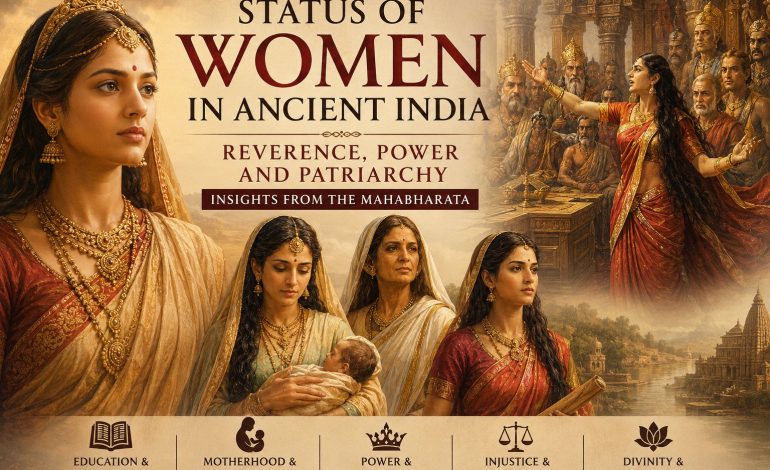

Ancient India presents one of history’s most fascinating paradoxes regarding womanhood. On one hand, women were revered as goddesses, embodiments of power, wisdom, fertility, and prosperity. On the other, historical and literary sources reveal social practices that curtailed women’s autonomy and often reduced them to subordinate positions within patriarchal structures. This duality is vividly reflected in Hindu traditions, particularly in the Mahabharata, one of the most influential epics of ancient India. The status of Women in Ancient India cannot be understood through a single lens. Religion, society, politics, economics, and cultural norms collectively shaped women’s lives. While sacred texts celebrated feminine divinity, social realities often placed women under male authority. The Mahabharata, with its complex characters and intricate narratives, provides a remarkable window into these contradictions.
Women in Ancient Indian Thought
The period commonly referred to as Ancient India spans a vast historical timeline, roughly from 2500 BCE to 1500 CE. Sources such as the Vedas, Upanishads, Ramayana, Mahabharata, and Puranas offer valuable insights into women’s roles and status. These texts not only document social customs but also construct idealized images of gender through mythological and cosmological narratives.
Ancient Indian literature often portrays women as indispensable to social and cosmic order. They are mothers, wives, queens, scholars, and spiritual figures. Yet these same texts frequently express anxiety about female sexuality and independence. As sociologist Kenneth Plummer argues, sexuality is not merely biological but socially constructed through cultural meanings. Ancient Indian texts reveal how womanhood was similarly constructed through competing ideals of purity, devotion, fertility, and obedience.
Women as Bearers of Lineage
One of the recurring themes in the Mahabharata is the role of women as producers and preservers of dynastic lineage. Female protagonists such as Satyavati, Kunti, Madri, and Gandhari occupy central positions in the continuation of royal bloodlines.
The epic seamlessly blends mythology and biology in its depiction of motherhood. Gandhari’s extraordinary birth narrative, in which she eventually becomes the mother of one hundred sons, illustrates how mythological imagination and social expectations intersect. Similarly, Kunti’s divine invocations that result in the birth of the Pandavas underscore the importance attached to women’s reproductive roles. Their worth is frequently linked to their ability to produce heirs and secure dynastic continuity.
It is eminent to understand that the societal and political set up in which Mahabharata sets in was largely patriarchal and male-centric in nature. The individuals were driven by social formulations which kept men at a superior position of authority and women were predominantly considered irrelevant and incapable of participating into the larger political and social arena. However, it is equally vital to understand the analogy of various powerful female-figures who have influenced the entire plot of “Jaya”[1]. Throughout the course of action, women have played a decisive role in keeping the movement alive. Many theologians, religion-enthusiasts and pandit-shastris have evidently considered that the cause of the war was a “woman”, however these more or less remain claims which largely pertains to the religious and mythical interpretation of the grand epic and haven’t registered themselves in the arguments of scholars and critical theorists.
Vyasa’s tale was called ‘Jaya’, meaning spiritual victory, a victory where no one loses. He mainly focused on the post-war portion of the story; hence the title Jaya has been given to the epic.
Property, Power, and Patriarchy
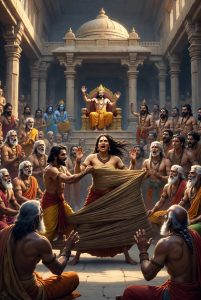
The Mahabharata and various Puranic texts reveal another troubling dimension of women’s status: their frequent association with property. The most striking example is the infamous dice game, where Yudhishthira gambles away his kingdom, his brothers, himself, and finally Draupadi. Draupadi, born from fire, she was intelligent, assertive, and questioned her husbands after being staked and lost in the dice game. She demanded justice in the Kuru court (a rare female voice amid powerful men) and vowed revenge, fuelling the Kurukshetra war.
This episode exposes the extent to which women could be treated as possessions within patriarchal structures. Draupadi’s public humiliation in the Kaurava court remains one of the most powerful critiques of gender injustice in ancient literature. Yet it is also within this scene that Draupadi emerges as a formidable intellectual force.
Her penetrating question—whether a man who has already lost himself has any right to stake his wife—challenges the moral and legal foundations of the assembly. Remarkably, the gathered elders struggle to answer her. Through reason, logic, and courage, Draupadi asserts her agency in a society that sought to deny it.
Figure 1: Women in Ancient India
Marriage and Family Structures
Ancient Indian society accommodated multiple forms of marriage. Polygamy was widely accepted among ruling elites, and the Mahabharata contains numerous examples of kings with multiple wives. However, the epic also presents the unusual case of polyandry through Draupadi, who becomes the wife of all five Pandava brothers.
This unique arrangement demonstrates that family structures in ancient India were more varied than often assumed. Nevertheless, such exceptions did not necessarily translate into greater freedom for women. Marriage remained a primary institution through which women’s lives were regulated and controlled.
Historical and literary sources also suggest the prevalence of practices such as purdah among elite women and instances of sati, particularly in later periods. These customs further indicate the growing restrictions imposed on women’s mobility and autonomy.
Education and Intellectual Contributions
The Vedic period offers evidence that some women participated in intellectual and spiritual life. Female scholars such as Lopamudra, Maitreyi, and Gargi are credited with composing hymns and engaging in philosophical debates. Their presence demonstrates that women were not entirely excluded from learning and scholarship.
However, such examples appear to be exceptions rather than the norm. While the Mahabharata provides detailed accounts of princes receiving military and formal education under renowned teachers, it offers little information about institutional education for women.
Yet educated women clearly existed. Draupadi’s eloquent arguments, Kunti’s political wisdom, and Gandhari’s moral counsel reveal a high degree of intellectual sophistication. Their voices suggest that women could exercise influence through knowledge, even when denied formal avenues of power.
The Contradictory Legacy of Ancient India
The status of women in ancient India was neither uniformly oppressive nor uniformly empowering. It was shaped by a complex interplay of reverence and restriction. Women were worshipped as goddesses and celebrated as mothers of dynasties, yet they could also be treated as property and subjected to patriarchal control.
The Mahabharata captures this contradiction with remarkable depth. Its women are not passive figures confined to the margins of history. They are thinkers, strategists, mothers, queens, and moral critics who shape the course of events. Characters such as Draupadi, Kunti, Gandhari, and Satyavati demonstrate that even within restrictive social structures, women exercised agency, challenged authority, and influenced political outcomes.
Understanding the status of women in ancient India therefore requires moving beyond simplistic narratives. The historical reality was characterized by both empowerment and subordination, reverence and discrimination. The Mahabharata remains an invaluable source for exploring these complexities, offering lessons that continue to resonate in contemporary debates about gender, power, and social justice.
Conclusion
The status of Women in Ancient India is ultimately a story of contradiction. While religious traditions elevated feminine power to divine status, social institutions often constrained women’s freedoms. The Mahabharata preserves this tension, presenting women as both symbols of honor and victims of injustice. Through figures like Draupadi, however, the epic also reveals the enduring strength of female intellect, resilience, and resistance—qualities that continue to inspire discussions about gender equality today.
Chandra, S. 2026
References
Rout, N. Role of Women in Ancient India, 2016, Odisha Review.
Witzel, Michael. 2009. Female Rishis and philosophers in the Veda? Journal of South Asia Women Studies 11(1).
[1] Vyasa’s tale was called ‘Jaya’, meaning spiritual victory, a victory where no one loses. He mainly focused on the post-war portion of the story, hence the title Jaya has been given to the epic.





4 Comments
[…] exposes how nationalist movements often celebrate women as cultural symbols while limiting their autonomy. This insight remains remarkably relevant in societies where debates about culture, tradition, and […]
[…] Source: Status of Women in Ancient India: Between Reverence and Restriction […]
[…] [1] Vyasa’s tale was called ‘Jaya’, meaning spiritual victory, a victory where no one loses. He mainly focused on the post-war portion of the story, hence the title Jaya has been given to the epic. […]
[…] the legitimacy of her being staked in the dice game. Drawing on Iravati Karve’s interpretation of Draupadi in Yuganta, the discussion explores her psychological complexity, desires, anger, relationships, […]