
One Night in Bhopal: When Corporate Pride Turned into a City’s Nightmare

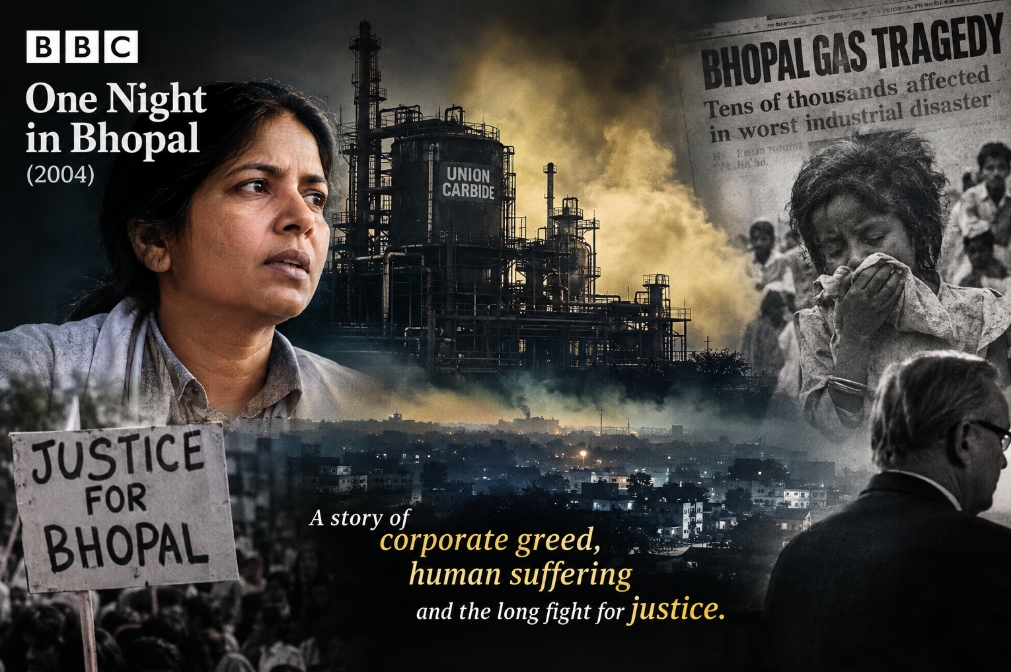
Review of the BBC documentary One Night in Bhopal (2004)
There is something deeply unsettling about watching Bhopal before the gas. The city shown in the BBC documentary One Night in Bhopal is not a city waiting for a disaster. It is alive, ordinary and hopeful. Families are building their lives. Workers are looking for better employment. And Union Carbide is not initially presented simply as the corporation that would become synonymous with one of the world’s most devastating industrial disasters. For many people, it represents something very different: a good job, better wages and a connection with the modern industrial world.
That is what makes the documentary so powerful. It does not begin with death. It begins with hope. And then it slowly shows how that hope became entangled with risk.
The Bhopal disaster occurred on the night of 2–3 December 1984, when deadly chemical fumes escaped from the Union Carbide India Limited pesticide plant. The Supreme Court of India has described the disaster as involving the escape of deadly chemical fumes from the Bhopal factory and has repeatedly addressed the enormous human suffering that followed.
More than four decades later, Bhopal remains a story about what can happen when technological power grows faster than systems of accountability.
The promise of the multinational corporation
One of the documentary’s most effective features is its portrayal of Union Carbide as an employer.
For people struggling to find secure and reasonably well-paid employment, a multinational company could represent an extraordinary opportunity. The documentary uses individuals such as Kumkum Saxena, a medical officer at the plant, and Mehboob Bi, whose husband worked as a maintenance employee, to illustrate this complicated relationship between ordinary people and a powerful corporation.
There is an important irony here.
The same factory that offered employment and economic opportunity was also storing and processing methyl isocyanate (MIC), an extremely toxic chemical used in pesticide production.
For an employee, the factory could mean prosperity.
For a neighbourhood, however, it could also mean exposure to a danger that most residents did not fully understand.
This is perhaps the documentary’s most disturbing theme: the people closest to the factory were not necessarily the people who understood its risks.
The information gap
A disaster does not begin when the gas escapes.
Sometimes, it begins much earlier—with information that is known by some people but unavailable to others.
One Night in Bhopal repeatedly draws attention to this divide between those inside the factory and those outside it. Plant personnel understood that MIC was extraordinarily dangerous. Ordinary residents knew Union Carbide primarily as a pesticide manufacturer.
That difference mattered.
The Supreme Court’s historical account records that the Union Carbide India plant was located in the northern part of Bhopal, with impoverished settlements adjacent to the factory.
The documentary therefore raises a fundamental question:
If a company operates with potentially catastrophic materials in an urban environment, how much does the surrounding population have a right to know?
Knowing that a factory produces pesticides is not the same as knowing what chemicals are stored there, how dangerous they are, what symptoms exposure can cause, where people should evacuate, or whom they should contact in an emergency.
That distinction between knowing that a factory exists and understanding the risk it creates becomes crucial on the night of the disaster.
Warnings that did not become action
The documentary’s accounts of earlier incidents are particularly unsettling because they make the catastrophe seem less like an unforeseeable bolt from the blue and more like the culmination of multiple vulnerabilities.
The precise chain of events surrounding the Bhopal release has been disputed in some respects, but contemporary technical investigations documented serious problems with safety systems and emergency preparedness.
A U.S. Environmental Protection Agency review conducted after Bhopal recorded that several safety controls at the Bhopal facility were not operational at the time of the disaster. It noted, among other things, that the refrigeration system for MIC storage had been non-operational since June 1984 and that the vent-gas scrubber was not in service.
Another EPA technical report recorded warning signs on the evening of 2 December, including rising pressure in the relevant storage tank, before the release occurred.
This transforms the central question.
It is not merely:
How did the accident happen?
It is also:
How many opportunities existed to prevent it?
That is a much more uncomfortable question.
Safety cannot depend on the balance sheet
The documentary repeatedly returns to the tension between safety and commercial pressure.
This is where One Night in Bhopal becomes more than a reconstruction of an industrial accident. It becomes an examination of corporate decision-making.
A company can proudly advertise sophisticated technology and rigorous safety standards. But the existence of safety rules on paper tells us little unless those rules are adequately funded, maintained and enforced.
The post-disaster investigations provide an important factual backdrop. The EPA recorded that Union Carbide’s U.S. MIC facility underwent extensive safety review after Bhopal, with changes involving monitoring, alarm systems, emission-control systems, leak detection and emergency-response planning.
The contrast is striking.
After Bhopal, safety systems were reconsidered and strengthened elsewhere.
The question raised by the documentary is whether comparable attention should have existed before catastrophe struck Bhopal.
That leads to one of the film’s most important questions:
Should the level of safety depend on the profitability of the operation?
The answer has consequences far beyond Bhopal.
The night the city woke up
Then comes the night of 2–3 December.
A sleeping city suddenly becomes a landscape of confusion.
The EPA’s contemporary description captures the scale of the event: poisonous gases spread across a heavily populated area, killing people in their homes and leaving thousands struggling with suffocation, blindness and other acute effects.
People ran without knowing where safety lay.
Families searched for missing relatives.
Hospitals confronted patients without adequate information about what they were treating.
The disaster exposed not only weaknesses inside the factory but also weaknesses outside it.
An industrial emergency requires more than machines and alarms. It requires hospitals that know what they are dealing with, emergency services that know how to respond, authorities who have access to information, and communities that have been told what to do.
Bhopal demonstrated what happens when these pieces are missing.
A disaster beyond the factory gates
Perhaps the most important lesson of Bhopal is that the factory did not exist in isolation.
Its consequences did not stop at the boundary wall.
The people who suffered included workers, families, children, residents of nearby settlements and people who had never entered the factory.
That is why the Bhopal tragedy cannot be understood purely as a workplace accident.
It was simultaneously an industrial, public-health, environmental, legal and social catastrophe.
And the questions of responsibility became correspondingly complicated.
Who was responsible for maintaining the plant?
Who was responsible for regulating it?
Who was responsible for informing nearby residents?
Who was responsible for emergency preparedness?
Who was responsible for compensating those who suffered?
And ultimately:
When responsibility is distributed among a corporation, a subsidiary, managers, regulators and governments, who answers to the victims?
Warren Anderson and the question of accountability
The documentary also brings Warren Anderson, then chairman of Union Carbide Corporation, into the story.
Anderson came to Bhopal shortly after the disaster and was arrested before being released on bail. The Supreme Court’s historical record confirms his arrest in Bhopal and subsequent release on bail.
The circumstances surrounding accountability subsequently became a source of intense controversy.
But one point is important: the history is more complicated than the simple claim that Anderson was “released because of American pressure.” That interpretation has been made in public debate, but establishing precisely what caused the decision requires distinguishing documented events from later allegations and interpretations.
What is undeniable is that the question of accountability never disappeared.
The man at the top of one of the corporations associated with the disaster became a symbol of a larger question:
Can corporate and political power create distance between decision-makers and the human consequences of industrial activity?
The price of justice
The legal aftermath of Bhopal is almost as complicated as the disaster itself.
In 1989, the Supreme Court recorded a settlement of US$470 million between Union Carbide Corporation and the Government of India. The settlement was intended to resolve claims arising from the disaster and was justified in part by the urgent need to provide relief to victims.
The Court later upheld the civil settlement while restoring criminal proceedings that had initially been quashed.
This history matters because the compensation question is often reduced to a single number.
But behind every compensation calculation are human beings.
A person who lost a parent cannot recover that relationship through a payment.
A person suffering long-term illness cannot necessarily return to the life they had before the disaster.
A family facing disability or chronic illness cannot treat compensation as equivalent to restoration.
Money can compensate for certain losses.
It cannot undo a catastrophe.
How many died?
Even the death toll has been contested and varies according to the period and methodology used.
Contemporary and later official figures differ, while broader estimates include people who died from longer-term consequences. The Madhya Pradesh government has been reported as confirming 3,787 deaths attributable to the gas release, while other estimates of the eventual death toll are considerably higher.
This disagreement itself is revealing.
The numbers matter because they measure the scale of the tragedy.
But they also risk hiding the individual stories behind the statistics.
Bhopal was not “3,787” or “8,000” or “25,000.”
It was Asharaf.
It was Chand Khan.
It was a child waking up unable to breathe.
It was a mother searching for her family.
It was a worker going to sleep near a factory whose dangers he or she might never have fully understood.
Every statistic was once a person.
The uncomfortable question of development
The documentary’s greatest strength is perhaps that it refuses to make the story simply about “good America” and “bad India,” or “evil corporation” and “helpless victim.”
The reality is more complicated.
India wanted industrial development.
Workers wanted employment.
The company wanted to manufacture pesticides.
The government wanted industrial investment.
Consumers needed agricultural products.
And yet these legitimate interests existed alongside the obligation to protect human life.
That is the contradiction at the heart of Bhopal:
Development can create prosperity while simultaneously creating new forms of vulnerability.
The lesson is not that developing countries should reject multinational corporations.
The lesson is that investment without transparency, regulation, emergency planning and meaningful accountability can impose enormous costs on the very communities that development is supposed to benefit.
What One Night in Bhopal leaves behind
More than anything, the documentary asks us to think about the meaning of responsibility.
Corporate documents can speak about safety.
Managers can speak about procedures.
Governments can speak about regulation.
Courts can speak about compensation.
But on the night of 2–3 December 1984, ordinary people did not experience Bhopal as a corporate-policy question or a legal dispute.
They experienced it as a desperate struggle to breathe.
That is why One Night in Bhopal remains so disturbing.
The documentary does not merely reconstruct how a chemical escaped from a factory. It shows how a catastrophe can emerge from the interaction of technology, corporate decisions, regulatory weaknesses, inadequate information and human vulnerability.
The gas eventually dissipated.
The questions did not.
Who knew?
Who should have known?
Who could have acted?
Who was responsible?
And perhaps the most important question of all:
How do we build a world in which the people living beside a dangerous factory are not the last people to learn how dangerous it is?
Bhopal’s tragedy belongs to 1984.
Its warning does not.
A note on the documentary and the historical record
One Night in Bhopal is valuable precisely because it combines personal testimony with a reconstruction of institutional failure. But a documentary is not itself the final authority on every historical or legal claim. Some assertions in accounts of Bhopal—particularly concerning precise death figures, individual responsibility, the circumstances of Warren Anderson’s release, and compensation received by particular victims—remain subjects of dispute or require careful qualification.
The historical record is substantial. The Supreme Court of India has published extensive judgments concerning the disaster and its aftermath, while U.S. government records document the safety and emergency-response issues examined after Bhopal.
The enduring value of the BBC documentary is therefore not that it supplies the last word.
It is that it makes us ask the questions that numbers, court orders and corporate statements can sometimes obscure:
What is the value of a life when profit, regulation and human safety collide?
And who bears the cost when they do?