
Orwellian doublethink in the Modi era: The Republic of Two Truths

In the vast, chaotic democracy of India, one man ascended to the position of Prime Minister in 2014. Initially, he presents himself as the biggest institutional reformer in the history of India. When Narendra Modi won election in 2014, he vowed to work for 1.25bn of his fellow Indians. After winning election Modi, 63, told the ecstatic crowd of Vadodara, “Brothers, sisters, you have faith in me and I have faith in you“. Rightly, Narendra Modi’s tenure as Prime Minister of India since 2014 has witnessed transformative impact in both India’s political and cultural landscape. His leadership has altered the relationship between political leaders, political parties and major institutions – from parliament to media to federal decision making. Supporters argue that this transformation signifies a stronger and more decisive government. Beneath Modi’s decisive government, there lies something far more interesting and startling– the vocabulary used by the Prime Minister and his supporters, which is patently similar to ‘Orwellian Doublethink’. It is not an ordinary contradiction that can be understood in terms of change in political regime. It is something stranger foregrounded in the method that helps the supreme leader to hold two incompatible positions simultaneously, making the contradiction disappear through language.
What is ‘Orwellian Doublethink’
The term comes from George Orwell’s ‘Novel Nineteen Eighty-Four’, first published in 1949. In the novel, it has been used as an important psychological tool by the totalitarian party that rules a fictional country Oceania. The term ‘Doublethink’ acquires significance in the novel as it allows people, particularly party members to accept official lies, rewrite history and remain loyal to the party. According to Orwell, Doublethink means the power of holding two contradictory beliefs in one’s mind concomitantly, and accepting both of them. In the novel, it allows party members to rewrite history and tell lies while genuinely believing in them. It becomes a means of denying objective realities and creating new realities to strengthen supreme belief in the party.
Using ‘Doublethink’ Party members must accept and spread blatant lies and rewritten history to create unflinching conviction that the party is always right, and failure of believing in Doublethink results in ‘thought crime’ which inevitably results in the evaporation of the individual who commits thought crime.
The main protagonist of the novel, Winston Smith struggles to have faith in doublethink, leading to uncover how a dystopian regime unleashes brutalities to control the mind and thought of its citizens. Even in the Modi era ‘Doublethink’ represents the republic of two truths simultaneously. For instance, war becomes peace, dissent becomes disorder, centralisation becomes federalism, and ….so on.
Examples of doublethink in the Modi era.
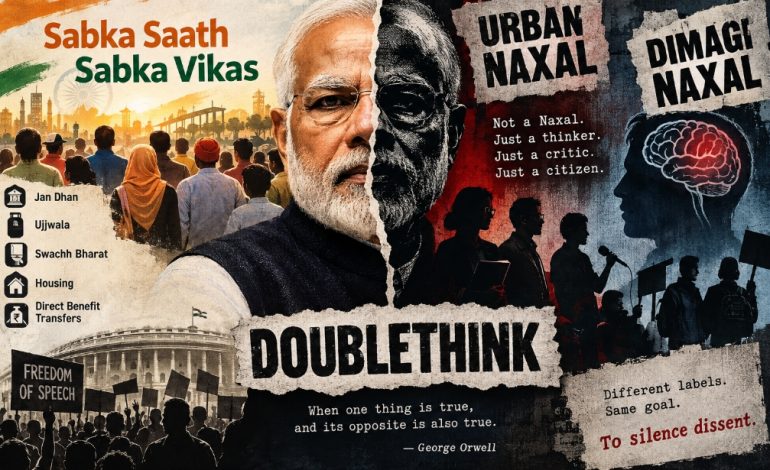
Sabka Saath, Sabka Vikas (Everyone Together, Everyone Developed)
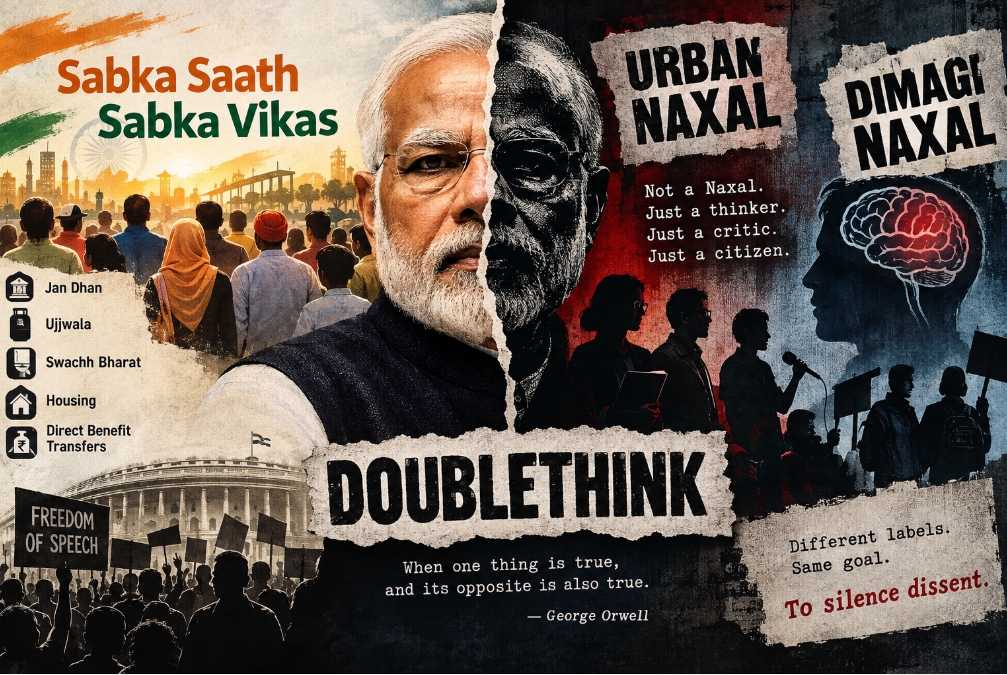
The pithy slogan, ‘Sabka Saath, Sabka Viaks’ was coined by Modi himself during the general election 2014. In the Modi era, few political slogans have been crafted more meticulously than this. The phrase echoes the constitutional spirit of India: Everyone Together, Development of Everyone. The Modi government has made an attempt to justify this slogan through various welfare schemes, including Jan Dhan Yojna, Ujjwala, direct transfer benefits and several others. However, beneath this slogan hides religious discrimination, hate speeches, marginalisation of religious minorities such as Muslim and citizenship policy. Human Rights Watch and other rights organisations have documented growing violence, hatred and intolerance against Muslim community in the Modi era.
The slogan ‘Sabka Saath, Sabka Vikas’ has been used as rhetoric, rather than its literal meaning. Beneath this slogan hides discrimination, hate mongering and politics of religion. Just like proles in the novel, the party methodologically engages with hate politics with Muslim community, but the party claims it has popular support of all communities. Even many members of BJP may not agree how discrimination leads to ‘Sabka Saath, Sabka Viaks’, but they still believe in both or are just made to believe.
Love Jihad (“Romeo Jihad”)
Love Jihad is a classic Orwellian Doublethink. There is ambiguity surrounding the origin of the term. But this term was propelled into the public discourse with unprecedented velocity, particularly by Godi media News channels after Narendra Modi became the Prime Minister in 2014. According to the theory of Love Jihad, the Muslim men systematically and purposely seduce, deceive and coerce Hindu women, sometimes Christian women as well. As a part of an organised both demographic and religious conquest, they marry Hindu and Christian women to convert them to Islam. The term not only denies female agency but also reframes consensual adult relationships as existential warfare. The very absurdity lies in the fact that the same discourse often claims to protect dignity and autonomy of the Hindu women.
While the central government has replied in the parliament that there is dearth of evidence to insinuate the presence of an organised love jihad campaign or syndicate, several BJP ruled states have passed stringent anti-conversion legislation and stiffening the rule for inter-faith marriages. BJP has continued to use it as rhetoric to consolidate Hindu vote bank.
‘Love Jihad’ operates as a classic doublethink because it simultaneously operates a grand conspiracy and the very absence of any systemic evidence for it. Besides mainstream TV media and social media, films like Kerala Story have captured public imagination through anecdotal cases.
Narendra Modi and the party members (BJP) leave no opportunity to remind citizens of India how the emergency was a direct assault on freedom of expression, civil liberties and institutional freedom. The Modi government celebrates the anniversary of the emergency every year. Emergency was imposed by then Prime Minister, Indira Gandhi, in 1975. On countless occasions Modi and his party members have described ‘the emergency’ as the darkest chapter in Indian democracy.
But there is a growing intolerance towards dissenting voices in India in the Modi era. The incumbent Modi government has continued to suppress dissenting voices whether journalists, protests or even social media posts with full force, which raises concern about the health of world’s largest democracy. India’s constitutional framework protects freedom of expression. But the Modi government has relentlessly and sternly used criminal law, administrative measures and blocking orders to curb freedom of expression.
During farmers’ protests in 2021, the government not only arrested more than 100 protesters, but also slapped draconian law, UAPA, and initiated withdrawal of passports against them (ALJAZEERA, 2021). In another incident, A 22-year-old climate activist, Disha Ravi, was arrested merely for sharing a social media post in support of farmers’ protest against agricultural laws. She was charged for criminal conspiracy and spreading disharmony on religious, social and cultural grounds (BBC, 2021).
Professor Ali Khan Mahmudabad, an associate professor at Ashoka University qualifies as a classic case exposing how the incumbent government deals dissenting voice with iron rod. He was arrested for his social media post that exposed the government’s covert effort of propagating hate mongering in the country. For his social media post, he was charged for endangering national sovereignty and promoting hatred between groups. In his social media post, prof Mahmudabad says, “I am very happy to see so many right-wing commentators applauding Colonel Sofiya Qureshi,” he wrote, but “they should also demand that the victims of mob lynching, arbitrary demolitions [of houses], others who are victims of the BJP’s hate mongering be protected as Indian citizens” (Yadav, 2025).
The case of Pawan Jaiswal, a reporter with a Hindi daily, exposes how information becomes misinformation and freedom of expression is treated as disorder. The reporter was charged with cheating and criminal conspiracy just because he had reported inferior quality of meal being served at a primary School in the Uttar Pradesh (Rashid, 2019).
The government’s totalitarian approach becomes obvious when its official circulates stringent warning to university against showing a BBC’s documentary that navigates Narendra Modi’s highhandedness in handling religious riot in Gujarat, 2002 (Basu, and Sen, 2024).
Consider this classic example: Natasa Narwal and Devangana Kalita, two female activists were arrested by Delhi Police during the CAA movement in 2020. They were charged for promoting terrorism. The two judge Delhi High Court Bench strongly criticised the government for linking citizens’ legitimate right to protest with terrorist activity. The high court eventually granted bail to female activists. Here, consistent with the ‘Doublethink’ philosophy, dissent becomes crime. Besides, many intellectuals, human right activists, journalists, university teachers and students have been booked under the sedition law.
The incumbent government is not only restricting citizens’ fundamental right of freedom of expression and opinion but also undermining democratic values through prolonged incarceration of activists, journalists and writers (The Hindu, 2024).
Urban Naxal and Dimagi Naxal
Terms such as Urban Naxal and more recent Dimagi Naxal are strong candidates of Orwellian Doublethink. BJP and the right-wing ecosystem have coined the term ‘Urban Naxal’ over a decade ago. Subsequently, the right-wing film maker, Vivek Agnihotri wrote a book titled ‘Urban Naxal: The Making of Buddha in a Traffic Jam’, in 2016. The book deals with how university students are brainwashed in a prestigious university like Jawahar Lal University (JNU). The term is used as a label predominantly by the right-wing group for urban intellectuals, activists, lawyers and academics who allegedly provide ideological, financial, legal and propagandist support to rural Naxalite (Maoist) insurgency.
The term Dimagi Naxal was first used by Prime Minister Modi in his 2026 Independence Day speech, later promoted by his council of ministers and the BJP ecosystem. The term shifts focus from geography to mindset.
Both Urban Naxal and Dimagi Naxal serve Orwellian double-think purposes: they allow simultaneous acceptance of security concerns and need for broader policing of dissent. At the same time, many party workers may not fully agree with their literal meanings. Interestingly, these terms are often used to undermine even genuine protests and dissent. The term ‘Urban Naxal’ was used by BJP’s ecosystem (leaders, spokesperson and Gogi Media) during the Farmer’s Protest to show it had support of anti-national elements. Professor, activist and historian, Romila Thapar, argues that the term ‘Urban Naxal’ is something of an oxymoron. Nevertheless, use of these doublethink terms helps right-wing ecosystems to instill doubt in the mind of majority religion that certain groups are always conspiring against the state.
Fact-checking
The government has instituted a fact-checking unit under the Press Information Bureau to keep check on misinformation in social media and digital media. 2023 amended IT rules confers power to the government to identify information as false or misleading. However, the Mumbai High Court struck the amendment in 2024. Despite that fact-checking unit has frequently directed social media platforms such as facebook and X to delete posts or suspend accounts.
Fact-checking strongly resonates to the Orwellian Double think as it simultaneously represents: ‘censorship and fact checking. Government narrative becomes fact and government criticism becomes misinformation. It therefore represents two realities simultaneously.
Conclusion
There are several other examples of the Orwellian Doublethink, including ‘demonetisation’, ‘Andolanjeevi’, National-Security, ‘Minimum Government -Maximum governance’ ‘One Nation-One election’ and ‘Bulldozer-Justice’ which have been promoted by the Prime Minister, BJP and the BJP ecosystem. The power of the Orwellian Doublethink politics does not solely rely on the ability of the government to tell people what is true but the vocabulary that diminishes people’s ability to question what is true.
By Chandra, D.
References
ALJAZEERA, 2021. BJP deploys its majoritarian tactics against India’s farmers [Online] https://www.aljazeera.com/opinions/2021/2/13/bjp-deploys-its-majoritarian-tactics-against-indias-farmers
Basu, S. and Sen, S., 2024. Silenced voices: Unravelling India’s dissent crisis through historical and contemporary analysis of free speech and suppression. Information & Communications Technology Law, 33(1), pp.42-65.
BBC, 2021. India activist Disha Ravi arrested over farmers’ protest ‘toolkit [online] https://www.bbc.com/news/world-asia-india-56060232
Drishti IAS, 2025. Reaffirming Free Speech in a Constitutional Democracy. [online] https://www.drishtiias.com/daily-updates/daily-news-editorials/reaffirming-free-speech-in-a-constitutional-democracy
Gupta, S. 2024. Silencing Voices: An In-Depth Analysis Of Freedom Of Speech And Expression On Social Media Platform In Context Of India’s IT Act, Indian Journal of Law and Legal Research
ISSN: 2582-8878 [online] https://www.ijllr.com/post/silencing-voices-an-in-depth-analysis-of-freedom-of-speech-and-expression-on-social-media-platform
Howie, E., 2018. Protecting the human right to freedom of expression in international law. International journal of speech-language pathology, 20(1), pp.12-15.
India Today, 2019. Use and misuse of Sedition law: Section 124A of IPC [online] https://www.indiatoday.in/education-today/gk-current-affairs/story/use-and-misuse-of-sedition-law-section-124a-of-ipc-divd-1607533-2019-10-09
NDTV, 2022. Journalist Who Exposed Roti-Salt Meal In UP School Dies Of Cancer [online] https://www.ndtv.com/india-news/pawan-jaiswal-journalist-who-exposed-roti-salt-meal-in-up-school-dies-of-cancer-2948360
NewsLaundry, 2018. NL Interviews: Abhinandan Sekhri in conversation with Vivek Agnihotri: https://www.newslaundry.com/2018/08/29/vivek-agnihotri-urban-naxal-nl-interviews-2
Pandey, G. and Day, A. 2026. No bail for Indian activists after five years in jail without trial, BBC [online] https://www.bbc.com/news/articles/cd0ye2z33x9o
Rashid, O. 2019. Journalist who exposed salt-roti meal in school booked by UP govt. The Hindu [online] https://www.thehindu.com/news/national/other-states/journalist-who-exposed-salt-roti-meal-in-school-booked-by-up-govt/article29320560.ece
Salam, Z.U. 2018. ‘Urban naxal is something of an oxymoron’, Frontline: https://frontline.thehindu.com/the-nation/urban-naxal-is-something-of-an-oxymoron/article25661715.ece
Siagian, R., Siahaan, L. and Hamzah, M.I., 2023. Human rights in the digital era: online privacy, freedom of speech, and personal data protection. Journal of Digital Learning and Distance Education, 2(4), pp.548-558.
Siddiqui, M.A.2024. Mapping Hindutva Discourse in India: Exploring ‘Love Jihad’ Narratives on X, Global Network: https://gnet-research.org/2024/01/03/mapping-hindutva-discourse-in-india-exploring-love-jihad-narratives-on-x-twitter/
Shukla, S. 2020. Freedom of speech and expression – Article 19(1)(a), Law Column [online] https://lawcolumn.in/freedom-of-speech-and-expression-article-191a/
The Guardian, 2023. India invokes emergency laws to ban BBC Modi documentary [online] https://www.theguardian.com/world/2023/jan/23/india-emergency-laws-to-ban-bbc-narendra-modi-documentary
The Hindu, 2024. ‘Writers, journalists, social activists being jailed for merely criticising Indian government’ [online] https://www.thehindu.com/news/national/writers-journalists-social-activists-being-jailed-for-merely-criticising-indian-government/article68007391.ece
https://cpj.org/2026/02/indian-journalist-ravi-nair-sentenced-to-1-year-in-adani-defamation-case/
Yadav, N. 2025. Bail for Indian professor arrested for comments on India-Pakistan conflict, BBC [online] https://www.bbc.com/news/articles/c93llyrrze7o
https://thewire.in/rights/india-134-free-speech-violations-2024-free-speech-collective
Singh, A. 2021. ‘Sabka Prayas’: Unpacking the Latest Addition to the PM’s Slogan, The Wire: https://livewire.thewire.in/livewire/sabka-prayas-unpacking-the-latest-addition-to-the-pms-slogan/
Telangana Today, 2026. Never forgive, never forget: PM Modi on emergency’s 51st anniversary: https://telanganatoday.com/never-forgive-never-forget-pm-modi-on-emergencys-51st-anniversary
https://www.theguardian.com/world/2014/may/16/narendra-modi-victory-congress-india-election
https://www.epw.in/journal/2018/36/editorials/what-makes-urban-naxal.html