
Siddhartha by Hermann Hesse: Spiritual Journey, Key Questions & Life Lessons
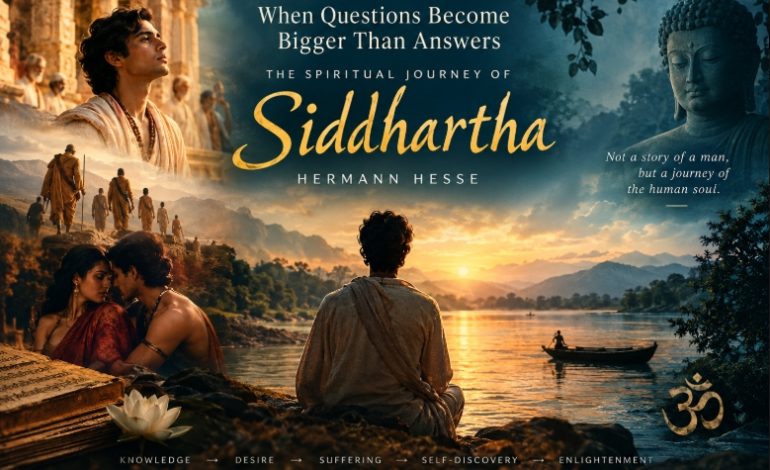

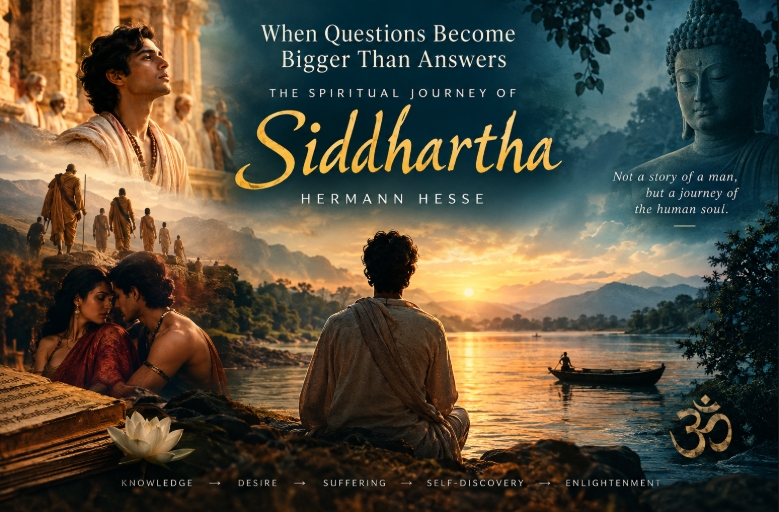
What if you have all the answers, but still feel empty? What if you know scriptures, rituals, mediation and have all privileges….and yet a question refuses to die somewhere deep inside: Is this really it? Hermann Hesse’s 1922 novel ‘Siddhartha‘ uncovers compellingly why a young Brahmin walks away from privilege, rituals, sacred text, companionship, and everything that he has been taught to revere. What follows in Siddhartha’s life is not a gentle pilgrimage, a journey of stripping away every illusion: from the ascetic extreme of sensual excess. Siddhartha by Hermann Hesse explores a journey through rebellion, spirituality, wealth, desire, love, sufferings, loss and silence. Yet Siddhartha refuses to remain merely a story of an ancient Indian seeker. It becomes the story of anyone who perceives: why it does not feel like enough?
The spiritual quest of Sidhartha for enlightenment begins during the time of Budha. This article navigates how a young Brahmin embarks upon his own path of self-discovery, encountering love, wealth, worldly pleasures, suffering and loss.
The Boy Who Knew Everything—Yet Knew Nothing
Born into a respected Brahmin family, Sidhartha grew up in an atmosphere of sacred knowledge, Vedic chants and rituals. He has a thorough understanding of religious teachings, including vedas, rituals and meditation. Everyone including his father believe Siddharta is destined for greatness and one day he will become the greatest spiritual leader.
But one night, Siddhartha discovers: something is missing
He has learned enough about the self, but he has not experienced the self. He has heard about Brahman from Vedas and Upanishads, but he is yet to realise what is Brahman?
He has learned about the Self, but he has not experienced the Self.
He has heard about Brahman, but he has not realized Brahman.
He has learnt Vedas and rituals, but these learnings have not transformed him.
And this distinction lies at the heart of the novel: Knowing about truth is not the same as knowing truth.
These contradictions invoke Sidhartha to reflect upon deepest question of Vedanta:
Who am I? What is my name? What is my profession? What does society think I am?
Sidhartha begins to ask an important existential question: Who am I beneath all these identities?
According to Vedanta, transcendence from surface level self to ultimate self is the beginning of spiritual enquiry, and Sidhartha senses this intuitively.
Scene One: The Decision to Walk Away
A young Brahim boy revered by both his family and community, stands before his father because he has already made a decision. He wants to leave his home, his family and his community. He wants to pursue a new life as a seeker. His father initially refuses but Sidhartha does not argue and remains steadfast with his decision, as he has already made a decision.
Hours pass but he remains standing firmly. Day becomes night and night becomes morning. Finally, his father realises that Siddhartha has already crossed the threshold and he cannot be kept.
This is Sidhartha’s first act of rebellion.
The Samanas: Can You Escape the Self by Destroying the Self?
And next morning, Sidhartha along with his friend Govinda walks quietly into the unknown with a heavy heart and strange feeling of freedom. He leaves everything behind. Far from the village… and far beyond the noise and restless clamor of civilization… Where the forest stands in peace, and the wind carries whispers of an ancient wisdom.
Siddhartha and Govinda arrive and before them stand Samanas. wandering ascetics who possess no clothes, no home, no desire and no hunger. But there is hunger in their eyes and this hunger is not bodily hunger but hunger for truth. They dwell in extreme self-denial. They fast, meditate and renounce all physical comfort.
Siddhartha and his friends join Samanas. After joining Samanas, Siddhartha renounces all physical comfort. He endures extreme physical discomfort through fasting, mediation and overcoming desire by weakening body. Siddhartha becomes exceptionally good at treading arduous paths of self-discovery charted by Samanas ascetics.
Surviving with Samanas proves radically new experience for Sidhartha, as he learns how to detach completely from the physical world. Yet Siddhartha realises something profound: he is only running away from the self, which is radically different from understanding the self. One can silence desire, suppress fear, deny pleasure or even reject the world completely. But these acts do not lead to understanding consciousness. Sidhrata reflects: am I destroying my own body or worldly desire? How suppressing desire can lead to freedom and consciousness? At this juncture the story takes a surprisingly modern turn.
Very next morning, Sidhartha leaves Samanas.
Then Siddhartha Meets the Buddha
And suddenly, Siddhartha encounters someone who appears to possess exactly what he has been searching for. Gautama Buddha. He finds peace in the presence of Buddha. Siddhartha’s friend, Govinda becomes a follower of Buddha, but Siddhartha again decides to move forward in search of enlightenment, and how to overcome discord between conflicting desires and internal-self. Although Siddhartha recognises the greatness of the Buddha, he does not want to borrow enlightenment from the Buddha. He wants to experience it through his own senses. After meeting Buddha, Siddhartha realises a teacher can only show path, but he cannot walk for Siddhartha. Only wisdom can be communicated but experience is idiosyncratic, something very personal. Siddhartha therefore renounces second-hand realisation of the self. Here, Siddhartha’s spiritual vision is radically different as he refuses to subscribe to simple religious obedience.
The Great Experiment: What If I Enter the World Instead?
After refusing to become a disciple of the Buddha, Siddhartha makes an unexpected choice. Overpowered by conflict between desire and self-enlightenment, Siddhartha decides to enter the world that he previously rejected. Siddhartha enters a city full of material life and pleasure. While walking through a beautiful grove, he encounters Kamla, a beautiful, wealthy and much celebrated courtesan. Siddhartha gets immediately struck by her radiant beauty, elegance and charm. Siddhartha approaches her with confidence and frankly tells her that he has come from the forest, and wishes to learn the art of love. Kamla is amused by his ascetic appearance and directness. She offers practical advice to Sidhartha that a person intending to learn the art of love must be rich. Kamla introduces him to a rich merchant, Kamaswami. She however gives him a brief and playful lesson of love, showing him how to kiss. But she also sends him away with the understanding that she will teach him remaining lessons when he will transform himself.
Siddhartha follows Kamala’s advice strictly and starts learning business from Kamaswami. Siddhartha intelligence and demeanour impress the merchant. Soon he becomes a highly successful businessman. After acquiring wealth, he returns to Kamala and she receives him as a lover. Kamla becomes both his beloved as well as teacher. She bestows both bodily pleasure and sensual enjoyment upon Siddhartha. He becomes completely immersed in Kamla’s love. At the time, her acquires formidable reputation as a merchant. Over the years their relationship evolves into a regular pattern of visit. Sidhartha regularly visits Kamla’s house and shares intimacy and cultivated pleasures. In the meanwhile, Kamala eventually becomes pregnant.
Figure: Siddhartha and Kamala

The Moment Everything Falls Apart
But wealth and romantic relationship with Kamala could not satisfy Siddhartha’s inner qualm. Cultivated pleasure could not satisfy deeper restlessness within him. Both pleasure and wealth gradually lose their relevance for Siddhartha. The old spiritual questions resurface with greater tenacity. The man who renounced both family and friends to seek liberation now becomes deeply attached to money and women’s bodies. Siddhartha once observed desire but now desire controls him. At this point, the concept of MAYA becomes illuminating for Siddhartha.
And Siddhartha abandons both his love and huge wealth forever. Overwhelmed by despair and meaninglessness of life, Sidhartha reaches the river. The old questions begin to haunt: Who am I? A spiritual seeker? An ascetic? A lover? A businessman? Or a failed man? All his previous identities started gravitating and collapsing. Suddenly, “Om” , a single sacred sound interrupts the darkness. In a state of utter despair, Siddhartha remembers something deeper. He falls into sleep, and when he wakes up, something has changed, because the old version of Siddhartha has begun to die.
The River Become His Greatest Teacher
This is where the novel transforms. Siddhartha meets Vasudeva, the ferryman. Vasudeva is not a teacher. He does not explain Siddhartha any philosophical lesson. But he teaches Siddhartha the most difficult lesson, how to listen to the flowing river, full of silence, suffering and life. The river becomes Siddhartha’s guru. The river relentlessly moves, there is birth, there is arrival, there is joy, there is death and there is sorrow. From the river, he comprehends that everything changes but everything belongs to one continuous whole. A river embodies countless movements but no wave exists in isolation. Yet every wave has its own momentary existence, just like a separate individual. This realisation invoked Siddhartha to reflect on all his spiritual learnings, and his hitherto journey of enlightenment. For a moment, it crossed his mind as if he had solved his own existential mystery.
A moment later, he encounters something unexpected. A grown-up lady was crying in pain. Siddhartha meets Kamala again. Kamala is on a pilgrimage, as she is travelling by the side of a river to meet the dying Buddha, but she is bitten by a poisonous snake. She has raised their son. In her final moments, she recognises Siddhartha and indicates towards their young son. There is a quiet but tender recognition between them. Siddhartha is deeply moved by this encounter, as the consequence of his past life continued to flow just like a river. Kamala dies and Siddhartha is left with the responsibility of the boy.
Siddhartha is again propelled in the world of Samsara- desire, possession and time. He takes responsibility for the boy. But the boy had been raised by Kamala in wealth and comfort. Suddenly, the boy feels trapped by the river, daily work of ferrying people and a modest hut. There are no luxuries, no servants, no comfort and nobody who could listen to him, as the father, Siddhartha, only speaks of patience. The boy mocks both Siddhartha and Vasudeva and refuses to participate in daily work. He always demands to return to the city and live a new life. One day he steals money that Siddhartha saves, and runs away towards the town. The boy wants freedom, comfort and the world of the city. The boy escapes to the city as he does not want to live a simple life, life of an ascetic. Sidhartha now starts pondering how he himself had once left his family and Brahmins to experience the world on his own terms.
The Final Lesson
For the first time, Siddhartha feels completely devastated. But he ponders how life has completed a perfect circle. When Sidhartha left his father, he was young, and wanted to experience his own life experience, not a borrowed experience. Like his father, Siddhartha wants his son to stay, but the son has different aspirations and desires. Like Siddhartha, his son also has his own idiosyncratic journey. Siddhartha now realises attachment huts because love always desires to possess what it loves. And Siddhartha now realises that there is a difference between loving someone and owning their life. At this juncture of his life, Siddhartha learns to let go. In doing so however his compassion deepens.
The entire life journey crossed in his mind just like a film. He studied religion, practiced austerity, explored worldly pleasure and accumulated wealth. He now realises nothing is permanent. Looking at the river, he starts pondering: yesterday’s water, today’s water and tomorrow’s water. But they are one continuous movement. Siddhartha now understands the flow of the river as a metaphor of life. He has discovered the unity of life: joy and sorrow are not enemies, failure and success are not permanent and love and loss are the part of the same human experience.
Something unexpected happens again: Siddhartha encounters Govinda again, the old friend who had taken a different path and became a disciple of the Buddha. Over the years, Govinda remained devoted to the Buddha and the path shown by him. But when Govinda meets Siddhartha, he discovers something familiar: a peace, a simple and a presence, that he once saw in the Buddha. Siddhartha does not give him any philosophical lesson, but invites him to experience.
Though Siddhartha cannot find an answer to the intellectual enquiry he wants to examine—what the true self (Atman) is and how one can realise it—he discovers something deeper: that life cannot be reduced to a single sentence.
Author: D.Chandra