
Bhishma’s Futile Life: A Vow, Patriarchy, and the Moral Failure of Mahabharata’s Greatest Warrior

Bhishma’s Futile Life
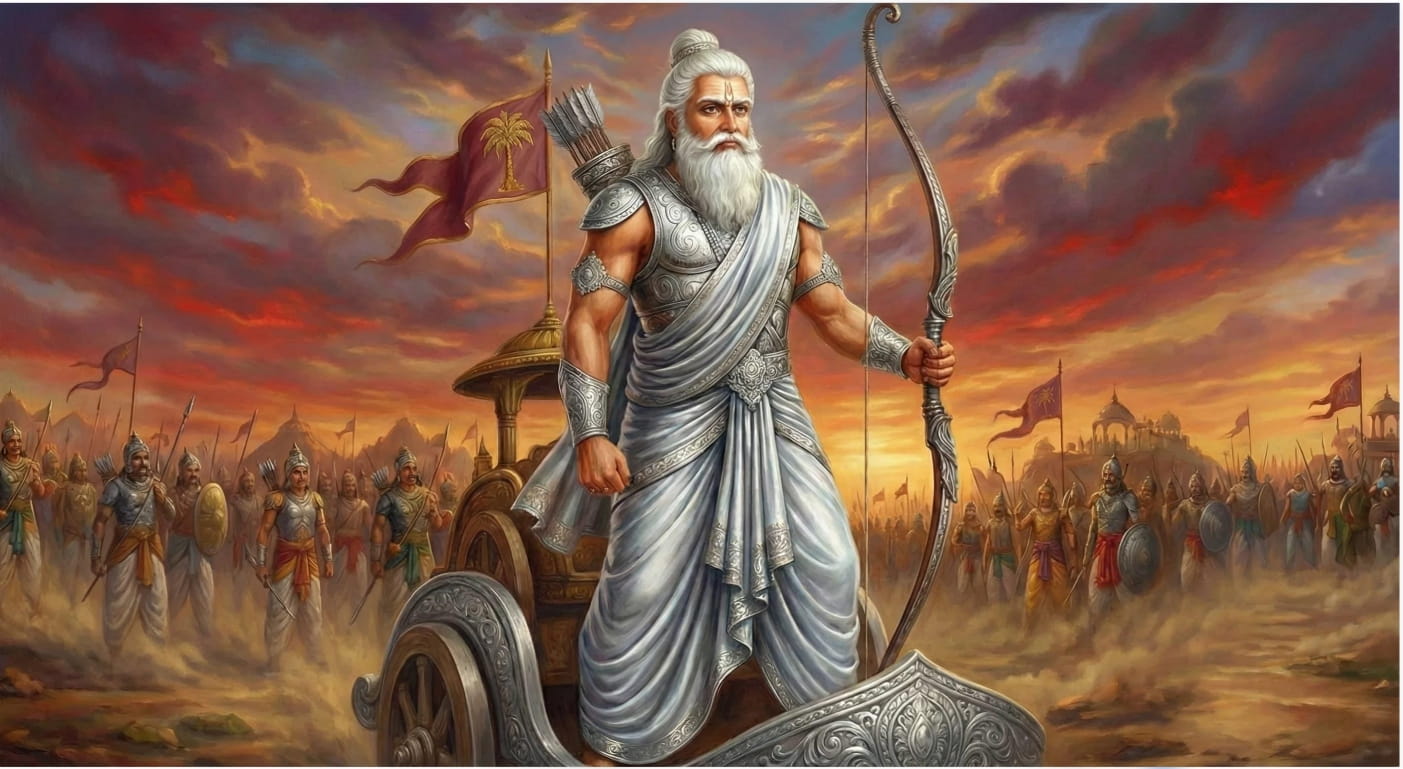
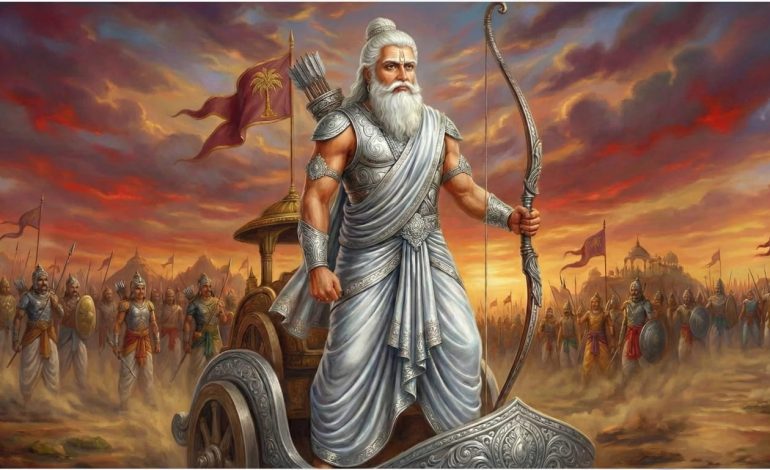
Bhishma Pitamah is one of the most revered characters in the Mahabharata. His extraordinary vow, renunciation, lifelong celibacy, and the boon of choosing the time of his death make him an exceptional figure. But an uncomfortable question remains: If his entire life was dedicated to protecting Dharma and Hastinapura, why did Hastinapura ultimately perish? If he was such a great knower of Dharma, how could he allow Draupadi’s humiliation, Amba’s suffering, and Duryodhana’s growing adharma to unfold before his eyes?
Bhishma’s tragedy was not merely that he lay wounded on a bed of arrows at Kurukshetra. His greatest tragedy was that the very kingdom, throne, and dynasty to which he had devoted his entire life could not be saved from destruction.
This is not an attempt to dismiss Bhishma’s sacrifices. It is an examination of the moral worth and consequences of his life. After all, a person’s greatness should not be measured merely by how much they sacrifice for themselves, but also by how much good their sacrifices bring to others.
- From Devavrata to Bhishma: A Vow That Changed the Purpose of His Life
Bhishma’s birth is associated with an extraordinary story.
According to the Adi Parva of the Mahabharata, the eight Vasus were cursed by Sage Vashishtha to be born as mortals because they had stolen his divine cow, Nandini. Dyau (also known as Prabhasa), who played the principal role in the theft, received the harshest punishment: unlike the other seven, he would have to live a long human life on earth.
Ganga married King Shantanu to fulfil this divine purpose. She gave birth to seven sons and immediately immersed them in the river, thereby liberating them from the curse. However, when she attempted to drown the eighth child, Shantanu intervened and stopped her.
That eighth child was Devavrata, who later became Bhishma.
There is an important philosophical question here.
Bhishma’s birth itself was connected to a divine purpose involving a temporary human existence. Yet, as his life unfolded, he became increasingly identified with the throne and the preservation of Hastinapura’s royal authority.
To facilitate his father Shantanu’s marriage to Satyavati, Devavrata renounced his claim to the throne and took an extraordinary vow of lifelong celibacy. This sacrifice was undoubtedly remarkable.
But the problem was not the vow itself. The problem was that he eventually placed his vow above changing circumstances, justice, and human suffering.
A vow that initially symbolised sacrifice gradually became a limitation on his moral judgement.
He gave up the throne, but never truly relinquished his influence over it. Although he was not king, he continued to play a decisive role in choosing kings, arranging royal marriages, and determining the political direction of the kingdom.
This is where the contradiction in Bhishma’s life begins.
- Was Bhishma the Protector of Hastinapura or the Guardian of Its Dynasty?
Bhishma’s greatest political failure was that he gradually stopped distinguishing between Hastinapura as a kingdom and its throne as an institution of royal power.
Hastinapura was a kingdom whose people, justice system, and moral foundations should have mattered more than any individual ruler or dynasty.
Yet the continuity of the royal lineage increasingly became his overriding priority.
After Vichitravirya died without an heir, Bhishma refused to marry or father children because of his vow. Consequently, Satyavati had to arrange for Vyasa to father children through the practice of Niyoga. This led to the births of Dhritarashtra, Pandu, and Vidura.
In the years that followed, Bhishma continued to struggle with the succession disputes between Dhritarashtra’s sons and Pandu’s sons, attempting to preserve the existing royal arrangement.
His loyalty increasingly appeared to be directed less towards individuals or justice and more towards the continuity of the Kuru dynasty.
Here is an important question:
When Dhritarashtra repeatedly failed to restrain his son Duryodhana’s misconduct, did Bhishma not have the moral authority and responsibility to intervene?
He was not merely an elderly royal adviser. He was the most senior member of the Kuru family, an influential guardian of the kingdom, and an accomplished authority on warfare and statecraft.
Yet his interventions often remained limited to advice.
When someone possesses the power to influence authority but fails to use that power to prevent injustice, their inaction also becomes part of history’s responsibility.
- Amba, Ambika, and Ambalika: The Women Who Paid the Price for Bhishma’s Vow
The Adi Parva describes how Bhishma abducted the three princesses of Kashi—Amba, Ambika, and Ambalika—from their swayamvara.
His intention was to arrange their marriages to his half-brother, Vichitravirya.
But this incident shaped the destinies of three women in very different ways.
Amba: She had already chosen King Shalva as her husband. After Bhishma abducted the princesses, he eventually allowed her to go to Shalva. However, Shalva refused to accept her because she had been carried away by another man.
Amba then approached Bhishma and asked him to marry her. But he refused, citing his lifelong vow of celibacy.
Amba’s life became trapped between the decisions of two men. One had abducted her, the other rejected her, and the first man refused to take responsibility for the consequences of his actions because of his personal vow.
Eventually, Amba vowed revenge. After years of penance, she was reborn as Shikhandi and became instrumental in Bhishma’s downfall at Kurukshetra.
Ambika and Ambalika: Both were married to Vichitravirya. After his death, they were also subjected to the Niyoga arrangement, through which Dhritarashtra and Pandu were born.
These events cannot simply be dismissed as arrangements necessary to preserve the royal dynasty. At their centre lies the question of women’s individual choices and consent.
Bhishma’s vow presents an interesting contradiction.
He renounced his own right to marriage and fatherhood, but did not hesitate to interfere in the marital choices and lives of others.
Was his sacrifice genuinely rooted in respect for women’s dignity and freedom?
Or was it primarily about preserving his own personal commitment?
The Adi Parva brings this contradiction into sharp focus.
- Gandhari’s Marriage: Royal Prestige Versus a Woman’s Choice
In the marriage episode of the Adi Parva, Bhishma learns about Gandhari and sends a proposal to King Subala of Gandhara for her marriage to Dhritarashtra.
Subala initially hesitates because Dhritarashtra is blind. However, considering the prestige and political importance of the Kuru dynasty, he eventually accepts the proposal.
When Gandhari learns that her parents have arranged her marriage to a blind prince, she chooses to blindfold herself.
An important factual distinction must be made here: the Mahabharata describes the consent of Gandhari’s parents and Gandhari’s own subsequent decision to blindfold herself. Therefore, it would be inaccurate to claim that Bhishma directly forced her into marriage.
However, it is still legitimate to ask how much consideration was given to Gandhari’s independent choice in the political arrangements surrounding the marriage.
Once again, Bhishma prioritised the interests of the royal dynasty. The marriage was treated as a political alliance between two royal families and as a matter of Kuru prestige.
Gandhari’s life was shaped less by her own independent choices and more by the expectations of the royal household.
This episode illustrates how, in ancient royal societies, women’s marriages were frequently treated as instruments of political arrangement. Bhishma was very much a part of this system.
- Draupadi’s Disrobing: When the Greatest Knower of Dharma Remained Silent
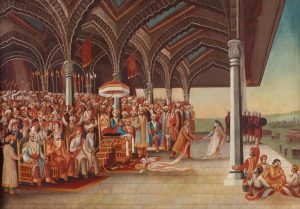
One of the most significant moral episodes in the Mahabharata is the dice game.
Yudhishthira successively lost his kingdom, wealth, brothers, and eventually himself. After losing his own freedom, he staked Draupadi as well.
Dushasana dragged Draupadi into the assembly by her hair.
Draupadi addressed Bhishma, the oldest and most respected authority on Dharma in the court, with a direct question:
If Yudhishthira had already lost himself and his freedom, how could he possibly retain the right to stake me?
This was not merely a question about the rules of gambling. It challenged the very idea that a woman could be treated as the property of a man.
Bhishma responded that Dharma was exceedingly subtle and that he could not arrive at a definitive answer.
But was the question really so complicated that he could not even take action to prevent the public humiliation of a helpless woman?
Vidura openly opposed the injustice. Vikarna also argued in Draupadi’s favour. Yet Bhishma, whose moral authority was arguably the greatest in that assembly, failed to intervene decisively.
This was one of the greatest moral failures of his life.
Knowledge of Dharma is meaningful only when it gives a person the courage to stand against injustice.
If the subtlety of Dharma becomes an excuse for failing to protect an innocent person’s dignity, what purpose does that knowledge serve?
Draupadi’s unanswered question exposed the limitations of a social order in which a woman’s independent identity was subordinated to the decisions of men.
Bhishma did not raise his weapons that day, but his silence allowed the injustice to proceed.
- Bhishma’s Treatment of Karna: Merit, Birth, and Social Prejudice
Karna is one of the most compelling characters in the Mahabharata. His talent and courage are beyond question. Yet his life was repeatedly marked by humiliation because of his birth and social identity.
There was also a deep personal and ideological conflict between Bhishma and Karna.
In Udyoga Parva, Chapter 165, Bhishma evaluates Karna as an Ardharathi, or a warrior of a relatively lower military classification. He refers to Karna’s fighting abilities, arrogance, Parashurama’s curse, and the loss of his divine armour and earrings. Drona supports this assessment.
Karna is deeply offended by the insult. He expresses his resentment towards Bhishma and declares that he will not fight as long as Bhishma remains commander of the Kaurava army.
It would be historically careless to describe this incident exclusively as proof of caste discrimination. Bhishma’s stated arguments concern Karna’s military abilities, conduct, and circumstances.
However, the larger social context of Karna’s identity as a Suta’s son and the prejudice he faced makes this disagreement especially significant.
There is another irony here.
Bhishma kept Karna away from the battlefield during his command, but once Karna entered the war, he remained fiercely loyal to Duryodhana and ultimately sacrificed his life for him.
The episode raises a larger question:
Did the warrior establishment of the Mahabharata genuinely reward merit, or did lineage, prestige, and social acceptance also determine a warrior’s standing?
Bhishma was among the most influential representatives of this establishment. His role therefore deserves critical examination.
- From the Lakshagriha Conspiracy to the Dice Hall: The Political Cost of Bhishma’s Inaction
The conspiracy against the Pandavas did not emerge suddenly.
Duryodhana’s jealousy, Dhritarashtra’s attachment to his son, and Shakuni’s political manoeuvres gradually pushed the Kuru dynasty towards destruction.
The plan to burn the Pandavas alive in the Lakshagriha was a decisive turning point in this conflict.
This raises questions about Bhishma’s role.
Was he unaware of the growing conspiracies within the royal family? Did he not possess the authority to intervene?
The Mahabharata makes it clear that Bhishma had affection for the Pandavas. Nor did he agree with every policy pursued by Duryodhana.
Yet his response often remained limited to expressing moral disagreement.
Here, the work of Iravati Karve, particularly her book Yuganta: The End of an Epoch, becomes especially relevant.
Karve does not portray Bhishma merely as an embodiment of sacrifice. She examines the political relationships and psychological contradictions hidden behind his idealised image.
In her analysis, Bhishma emerges as a man who remained at the centre of political power for decades without becoming king himself. He helped establish rulers, administered the kingdom, and maintained his enormous political influence.
Karve’s analysis invites an uncomfortable question: Was Bhishma’s commitment to the throne entirely selfless, or did he also derive satisfaction from exercising supreme political influence without actually occupying it?
This question alone is enough to encourage a fresh examination of Bhishma’s greatness.
- Could Bhishma Have Retired to the Forest Along with Satyavati?
This is one of the most important yet frequently overlooked aspects of Bhishma’s life.
After Pandu’s death, Satyavati became increasingly concerned about the future of the Kuru dynasty. Following Vyasa’s advice, she decided to leave the palace and retire to the forest along with her two daughters-in-law, Ambika and Ambalika.
Bhishma, however, remained in Hastinapura and this raises an important question. If the vow that Bhishma had taken had already required him to renounce his personal life, could he not also have withdrawn from the political centre of Hastinapura?
He could have chosen a life of retirement, at least allowing the next generation to assume responsibility for the kingdom. But he did not. He continued to serve as the guardian of the Kuru dynasty, even as its leadership increasingly fell into the hands of characters such as Dhritarashtra and Duryodhana. It is important to understand that Bhishma viewed his service to Hastinapura as a lifelong obligation. But that was precisely the problem.
Can the livelihood, privileges, and protection provided by a political establishment justify becoming complicit in its injustice?
Bhishma came to interpret Rajdharma as loyalty to the throne, whereas the true purpose of Rajdharma should have been the protection of justice and the welfare of the people.
His life became an example of how remaining attached to political authority in the name of duty can itself become a moral failure.
- The Boon of Choosing His Death: He Had the Power to Die, but Not the Courage to Change His Life
Bhishma had received the boon of Ichchha Mrityu from his father, Shantanu. He could choose the time of his death.
This extraordinary boon allowed him to remain alive even after being grievously wounded on the battlefield. He waited on his bed of arrows until the auspicious period of Uttarayana arrived.
But there is a deeper philosophical contradiction here. A man who possessed such control over his death seemed remarkably powerless when it came to determining the direction of his own life. He knew that Duryodhana was following the path of Adharma. He knew that the Pandavas had suffered injustice. He had witnessed Draupadi’s humiliation. He understood the devastating consequences of war. Yet he accepted the command of the Kaurava army.
He had refused to occupy the throne because of his vow, but when that very throne demanded military protection in an unjust war, he did not refuse to take up arms. This is perhaps the greatest contradiction in his life. He renounced the kingdom for his father’s happiness, but later went to war on behalf of Duryodhana. He sacrificed his personal ambitions but never truly abandoned his loyalty to the political establishment.
- Commanding the Kaurava Army: Should Bhishma Have Refused to Fight?
When the Kurukshetra war became inevitable, Duryodhana appointed Bhishma as the first commander of the Kaurava army.
Bhishma accepted the position.
This decision represents perhaps the greatest moral contradiction of his life.
He knew that the Pandavas were his own grandsons. He also knew that Duryodhana had committed grave injustices. Yet he agreed to lead the army fighting against them.
It is worth noting that Bhishma repeatedly advised Duryodhana to abandon the war, warning him that defeating the Pandavas would not be easy.
Iravati Karve, in Yuganta, draws attention to the fact that the first ten days of the war under Bhishma’s command were comparatively restrained in certain respects.
But was advising Duryodhana to stop the war enough?
Could Bhishma not have declared that he would refuse to lead an unjust war?
Could he not have rejected the position of commander?
He possessed the boon of choosing his death, enjoyed unparalleled military and social prestige, and Duryodhana depended heavily on his experience.
His leadership was important for the morale and military strength of the Kaurava army.
Therefore, accepting the position of commander was not a neutral decision. He chose to lead an army fighting against people he loved and had helped raise.
Karve’s analysis is particularly relevant here. Bhishma repeatedly attempted to persuade Duryodhana to end the war, but failed to stop the destruction that unfolded under his own command.
On the tenth day, Arjuna placed Shikhandi in front of him and struck him with a barrage of arrows, bringing Bhishma down onto a bed of arrows.
The man whose actions had contributed to Amba’s tragic fate was eventually brought down through the presence of Amba’s rebirth, Shikhandi.
This is one of the most meaningful symbolic elements of the Mahabharata: the fire of injustice from the past eventually returns to confront the person responsible for it.
- Bhishma’s Greatest Failure: He Could Neither Save Hastinapura Nor Protect Dharma
Bhishma’s entire life revolved around one extraordinary vow.
- He renounced marriage so that Satyavati’s sons could inherit the throne.
- He renounced fatherhood so that his descendants would never claim the kingdom.
- He dedicated his entire life to Hastinapura so that the Kuru dynasty could survive.
But what was the eventual outcome?
- The succession crisis did not end with Vichitravirya’s death.
- Dhritarashtra’s attachment to his son continued to grow.
- Duryodhana’s injustice went unchecked.
- The Pandavas repeatedly faced humiliation and conspiracies.
- Draupadi was publicly humiliated.
- Countless warriors perished in the Kurukshetra war.
- Ultimately, the Kuru dynasty was almost wiped out.
Bhishma’s vow may have helped resolve an immediate succession problem, but it failed to create a stable and just political order.
It would be an exaggeration to hold Bhishma solely responsible for the destruction of the Kuru dynasty. Dhritarashtra, Duryodhana, Shakuni, Karna, and even the decisions of the Pandavas played significant roles in this tragedy.
However, Bhishma’s responsibility was particularly serious because he possessed experience, prestige, authority, and numerous opportunities to intervene.
He may not have created Adharma, but at several decisive moments, he certainly became a silent guardian of injustice despite having the ability to oppose it.
- Bhishma Through Iravati Karve’s Lens: An Idealist Imprisoned by His Own Vow
Indian society often presents Bhishma as the ultimate symbol of sacrifice, celibacy, obedience, and commitment to one’s word.
However, anthropologist and author Iravati Karve, in her book Yuganta: The End of an Epoch, attempts to examine the characters of the Mahabharata beyond their idealised images.
Her analysis of Bhishma is particularly thought-provoking.
Karve raises questions about Bhishma’s lifelong search for suitable successors and the quality of the rulers he helped establish.
Although he never became king, he continued to play a central role in creating and maintaining the political order.
Even during the final stages of the war, he continued to hope for peace. But by then, circumstances had become almost impossible to reverse.
One of the important conclusions that emerges from Karve’s analysis is that Bhishma’s life cannot be reduced to a simple story of selfless sacrifice. It contains complex questions about power, prestige, duty, and personal contradictions.
Karve’s interpretation encourages us to see Bhishma as a man who became trapped in the very ideals that had once made him extraordinary.
A word of caution: A frequently circulated statement about Bhishma being a prisoner of his ideals, whose rigidity crushed human compassion, is often attributed to Karve. However, without verifying the exact passage in the original text, it should be treated as a summary of her interpretation rather than a direct quotation.
- Bhishma’s Life: The Greatness of Sacrifice or the Failure of Purpose?
The question is no longer whether Bhishma was a great warrior.
There is no doubt that he was extraordinary.
Nor can anyone deny that he sacrificed personal happiness, marriage, and fatherhood.
But sacrifice becomes meaningful only when it serves a larger human purpose.
Bhishma dedicated his entire life to Hastinapura, but failed to make it a just kingdom.
He did not desire the throne for himself, but continued to maintain his influence around it.
He practised lifelong celibacy, but failed to protect women’s freedom and consent.
He possessed immense knowledge of Dharma, but failed to defend it when Draupadi was humiliated.
He advised Duryodhana against wrongdoing, but eventually led his army in an unjust war.
He received the boon of choosing his death, but remained bound throughout his life by his vow and loyalty to the throne.
This is the tragedy of Bhishma.
He fulfilled his vow, but repeatedly failed to uphold the very principles that should have given that vow its moral purpose: Dharma, justice, and the welfare of society.
Conclusion: Was Bhishma Truly Great, or Was He a Prisoner of His Own Vow?
We must avoid two extremes while evaluating Bhishma.
On one hand, we should not turn him into a godlike figure beyond criticism.
On the other, we should not dismiss his entire life as meaningless.
His sacrifices were real, but so were the consequences of his decisions.
His life teaches us an important lesson:
Dharma is greater than a personal vow.
Justice is greater than tradition.
The welfare of the people is greater than the interests of a throne.
And the dignity of another human being is greater than any individual’s personal ideals.
If someone’s vow causes innocent people to suffer, if their loyalty protects injustice, and if their silence contributes to the humiliation of a woman, then the morality of that vow must be questioned.
Perhaps Bhishma’s greatest failure was not that he was defeated at Kurukshetra.
His greatest failure was that he spent his entire life being celebrated as a protector of Dharma, yet when Dharma needed him most, he could not rise above the constraints of his vow, political loyalty, and attachment to the existing order.
The very Hastinapura to which he had devoted his entire life was destroyed before his eyes.
And that leaves us with a question that remains relevant even today:
Does personal sacrifice make someone great, even when their decisions destroy the lives of others?
Or does true greatness lie in having the courage to rise above even our most cherished ideals when they stand in the way of justice?
Author: D.Chandra
References and Primary Sources
For greater academic credibility, the following sources are useful:
- Mahabharata – Adi Parva
- Mahabharata – Sabha Parva:
- Mahabharata – Udyoga Parva, Chapter 165
- Mahabharata – Udyoga Parva and Bhishma Parva
- Iravati Karve – Yuganta: The End of an Epoch