


Casteism in the Ramayana: The Politics of a Sacred Epic
Can a literary masterpiece also preserve social inequalities? Can a text that celebrates divine love and devotion simultaneously legitimise caste hierarchy and patriarchal values? The Ramcharitmanas presents us with precisely this uncomfortable question.
Introduction: When a Sacred Text Becomes a Political Debate
The Ramcharitmanas is not merely a religious book. It is a literary masterpiece, a cultural institution and, for millions of Hindus, a sacred text that shapes their understanding of morality, duty, devotion and ideal human conduct.
Written by Goswami Tulsidas in the sixteenth century, this epic retelling of the Ramayana brought the story of Lord Rama to an enormous audience through Awadhi, a literary language accessible to ordinary people.
Its influence extends far beyond temples and religious ceremonies. Its verses are recited in homes, performed during Ramlila, sung at religious gatherings and embedded in everyday expressions of Indian culture.
In terms of literary significance, the Ramcharitmanas is often compared with great epics such as Homer’s Iliad and Odyssey and Dante’s Divine Comedy.
But its extraordinary cultural influence also raises an important question:
What happens when a literary work becomes a source of social and moral authority?
Can its teachings be separated from the social hierarchies embedded in its narrative?
And, perhaps most importantly, was Tulsidas simply reflecting the social realities of his time, or was his writing also helping to legitimise and preserve those realities?
These are not questions that can be answered by either glorifying or dismissing the entire epic. They require us to read it critically, examine its language and compare it with other Ramayana traditions.
- Who Was Tulsidas, and When Was the Ramcharitmanas Written?
Goswami Tulsidas (c. 1532–1623)
Tulsidas was one of the most influential poets of the Bhakti movement. He belonged to the Sarayuparin Brahmin community, according to traditional biographies. His childhood name is commonly given as Rambola, and his parents are traditionally identified as Atmaram Dubey and Hulsi.
Tulsidas began composing the Ramcharitmanas in Vikram Samvat 1631, corresponding to 1574 CE, according to the traditional date recorded in the text. He composed it in Awadhi rather than Sanskrit.
This decision was culturally significant. Sanskrit religious literature was largely controlled by learned and priestly communities. By using a vernacular language, Tulsidas made the story of Rama accessible to a much wider population.
However, accessibility and social equality are not necessarily the same thing. A religious narrative can become accessible to everyone while continuing to communicate social distinctions between different groups.
This is where the debate surrounding Tulsidas becomes particularly interesting.
- The Literary Greatness of the Ramcharitmanas
Before examining its controversial passages, we must acknowledge the extraordinary literary and cultural achievements of this work.
The Ramcharitmanas is celebrated for several reasons:
- Literary excellence: Its dohas and chaupais demonstrate remarkable poetic rhythm, imagery and musicality.
- Artistic imagination: Tulsidas uses metaphors, dialogues, descriptions and dramatic episodes to bring the characters to life.
- Public accessibility: Its composition in Awadhi enabled the Ramayana tradition to reach audiences beyond Sanskrit-literate circles.
- Cultural influence: It shaped Ramlila performances, devotional music, religious storytelling and regional literary traditions.
Its religious influence is equally significant.
For millions of devotees, it is not simply a retelling of an ancient story. It is a source of spiritual guidance, moral instruction and religious identity.
It presents Rama as the embodiment of dharma, compassion and ideal kingship. It celebrates devotion, sacrifice, loyalty and the triumph of righteousness.
In this respect, its cultural importance is comparable to that of the Bible in Christianity or the Quran in Islam, although their textual histories and religious functions are different.
But a work’s literary greatness does not make every social idea expressed in it immune from criticism.
A text can be a masterpiece of literature and still contain ideas that deserve serious moral scrutiny.
- Caste Hierarchy: What Does the Ramcharitmanas Actually Say?
Let us begin with one of the most controversial passages.
In the Aranya Kand, we find the following lines:
पूजिअ बिप्र सील गुन हीना।
सूद्र न गुन गन ग्यान प्रबीना॥
A commonly used translation reads:
Even a Brahmin lacking character and virtue deserves reverence, whereas a Shudra, despite possessing virtues and knowledge, does not deserve the same honour.
This passage is particularly significant because it establishes a distinction based on birth rather than individual merit.
The contrast is unmistakable: a Brahmin’s social standing is privileged even when he lacks virtue, while a Shudra’s knowledge and good qualities do not necessarily earn him equivalent recognition.
The passage occurs in the Aranya Kand, immediately before the narrative moves to Shabari’s hermitage.
Consider what this implies. If social respect is determined by birth rather than character, knowledge or conduct, what happens to the principle of equality?
And if a religious text presents this distinction within a sacred narrative, can it influence how society understands hierarchy? These are legitimate questions, particularly when the text is treated as a source of moral authority.
The controversial verse about caste and education
Another frequently discussed passage appears in the Uttarkand:
अधम जाति मैं बिद्या पाएँ।
भयउँ जथा अहि दूध पिआएँ॥
Its approximate meaning is:
When someone of a low social birth acquires knowledge, it is like feeding milk to a serpent.
However, there is an important textual detail that should not be overlooked.
These words are spoken by Kakbhushundi while narrating his own previous life and spiritual transformation. They are not a straightforward statement addressed by Tulsidas to all lower-caste people.
Nevertheless, the comparison associates learning among people of low birth with something potentially dangerous. Its presence in a sacred narrative raises an uncomfortable question about the relationship between knowledge and inherited social status.
This is particularly important in a society where access to education, religious learning and knowledge historically became instruments of social power.
The question, therefore, is not simply whether Tulsidas personally believed every word spoken by his characters.
It is also about the cultural authority these words acquired through their preservation and repetition.
The verse about Brahmins and social privilege
The preceding passage in the Aranya Kand is even more direct:
सापत ताड़त परुष कहंता।
बिप्र पूज्य अस गावहिं संता॥
It suggests that a Brahmin remains worthy of reverence even when cursing, striking or speaking harshly.
Read together with the next two lines, the passage creates an explicit hierarchy in which Brahmin status takes precedence over personal virtue.
This is not merely an isolated question of etiquette. It raises the larger issue of whether spiritual and social authority should be inherited through birth.
- “Dhol, Gawar, Shudra, Pashu, Nari”: A Verse That Continues to Divide Society
Perhaps no verse associated with Tulsidas has generated as much contemporary controversy as:
ढोल, गंवार, शूद्र, पशु, नारी।
सकल ताड़ना के अधिकारी॥
The verse appears in the Sundarkand.
It is often translated as:
Drums, ignorant people, Shudras, animals and women are all deserving of discipline or chastisement.
There are two important contextual points.
First, these words are spoken by the personified ocean (Samudra) after Rama threatens to dry it up when it refuses to provide a passage for his army.
Second, the word tāḍanā has been interpreted in different ways, including chastisement, correction, discipline and physical punishment.
Some traditional interpreters argue that the verse is about correcting or disciplining those who require guidance, rather than advocating indiscriminate physical violence.
But even when read in that context, the comparison remains troubling.
Why are women and Shudras placed alongside animals and drums?
Why does the verse associate these social groups with the need for control?
And why should their position in society be explained through a language of discipline?
One can acknowledge that these are the words of a character rather than a direct statement from the narrator, without ignoring the social implications of their inclusion in a revered text.
This distinction matters. Literary characters do not automatically represent their authors’ personal beliefs. Yet the larger narrative context and the authority given to particular speeches deserve examination.
- Shabari: A Story of Spiritual Equality or Conditional Inclusion?
The story of Shabari is often presented as one of the strongest examples of Rama’s compassion and his rejection of caste discrimination.
Shabari is traditionally understood as a woman from a socially marginalised community. She waits for Rama, offering him fruits with extraordinary devotion.
When Rama finally visits her hermitage, she welcomes him with love and offers him berries.
Rama accepts her offering.
The episode conveys a powerful message: devotion matters more than wealth, status or social position.
In the Ramcharitmanas, Rama tells Shabari:
जाति पाँति कुल धर्म बड़ाई।
धन बल परिजन गुन चतुराई॥
भगति हीन नर सोहइ कैसा।
बिनु जल बारिद देखिअ जैसा॥
The meaning is that caste, family lineage, religious status, wealth, strength and intelligence are of little value without devotion.
This is an important egalitarian element in the narrative.
Yet the episode also contains another set of verses.
Shabari says:
अधम जाति मैं जड़मति भारी।
अधम ते अधम अधम अति नारी॥
She describes herself as belonging to a low caste and then associates womanhood with an even lower social and spiritual position.
Rama responds by declaring that he recognises a relationship based on devotion.
There are two ways to interpret this encounter.
The inclusive interpretation: Rama transcends social distinctions and accepts a devotee because of her love and sincerity.
The critical interpretation: Shabari receives spiritual recognition without the narrative explicitly challenging the social hierarchy that makes her describe herself as inferior in the first place.
In other words, spiritual acceptance does not necessarily translate into social emancipation.
This distinction is central to the debate about caste in the Ramcharitmanas.
The question is worth asking:
If devotion makes caste irrelevant before God, why should caste continue to determine a person’s position in society?
And why should a marginalised woman have to describe herself through the language of inferiority before receiving divine acceptance?
- The Kevat Episode: Equality Through Devotion or the Persistence of Social Hierarchy?
Another important episode concerns Kevat, the boatman who helps Rama, Sita and Lakshmana cross the river during their exile.
Kevat is generally associated with a socially marginalised boatman community.
He refuses to ferry Rama until he has washed his feet. His concern, in the devotional narrative, is that the dust from Rama’s feet might transform his boat, just as it transformed Ahalya.
The episode is usually interpreted as an expression of extraordinary devotion.
Rama accepts Kevat’s affection, and the encounter becomes an example of the intimacy between God and his devotee.
But the episode also invites a sociological question.
Why are some marginalised characters repeatedly presented through occupations involving service, labour and physical assistance?
Shabari offers food. Kevat provides transportation. Guha, the Nishad chief, offers assistance and hospitality.
Their devotion is celebrated, but their social identities are not necessarily transformed.
It would be simplistic to conclude that the Kevat episode was deliberately inserted to enforce caste discrimination. The story can also be read as challenging the idea that divine grace is restricted to the privileged.
Nevertheless, it is worth examining whether the repeated association of marginalised characters with service roles also reflects the occupational hierarchy of the society in which these narratives developed.
The central question is whether religious equality can coexist with social inequality without challenging it.
- Shambuka: Did Lord Rama Kill a Shudra Ascetic for Performing Penance
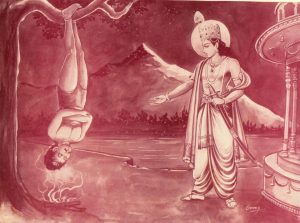

Perhaps the most controversial caste-related episode in the broader Ramayana tradition is the story of Shambuka.
It is essential, however, to distinguish between different versions of the Ramayana.
The story is associated with the Uttarakanda of the Valmiki Ramayana, not with Tulsidas’s Ramcharitmanas.
What does the story say?
According to the version of the story in which the episode appears, Rama is ruling Ayodhya when a Brahmin approaches him with the body of his dead son.
The Brahmin argues that the premature death of his child indicates a failure of the king to uphold dharma.
Rama consults his advisers and learns that a Shudra ascetic named Shambuka is performing severe penance.
Within the social and religious framework presented in this episode, Shudras were not considered entitled to undertake certain forms of ascetic practice reserved for higher varnas.
Rama finds Shambuka and asks him about his identity and purpose.
Upon learning that he is a Shudra performing tapasya, Rama kills him.
The gods celebrate the act, and the Brahmin’s son is restored to life.
The narrative is deeply troubling from a modern perspective because it appears to make a person’s spiritual aspirations subordinate to inherited social status.
The question becomes unavoidable:
Can the pursuit of spiritual knowledge or liberation be considered a privilege reserved for a particular birth group?
Is Shambuka’s story historically authentic?
This is where textual scholarship becomes particularly important.
The Uttarakanda has long been debated by scholars because linguistic, stylistic and thematic differences suggest that it contains material composed later than much of the central epic.
The Shambuka episode has also been subject to different manuscript traditions and interpretations.
Robert P. Goldman and other scholars have examined the textual history of the Uttarakanda, including the controversial episodes of Shambuka’s death and Sita’s abandonment.
Mandakranta Bose’s edited volume, The Ramayana Revisited (2004), examines how the Shambuka story has been reinterpreted in modern South Indian literature.
Thomas Seibel’s 2023 study, Killing of Sambuka: Critical and Creative Engagements, also examines the episode as a later development in the Uttarakanda tradition and explores how subsequent writers have reinterpreted it.
Importantly, the Shambuka episode is absent from Tulsidas’s Ramcharitmanas.
Therefore, attributing Shambuka’s killing directly to the Ramcharitmanas would be factually incorrect.
However, its presence in influential versions of the wider Ramayana tradition makes it an important part of the debate about caste and religious authority.
How did later writers challenge the story?
The story did not go unquestioned.
Over centuries, writers from different linguistic and social backgrounds reinterpreted it.
One particularly important example is Kannada writer Kuvempu’s Shudra Tapasvi, which reimagines the episode and challenges the caste restrictions associated with Shambuka’s death.
In these alternative narratives, the question shifts from whether Shambuka violated social norms to whether those norms themselves were unjust.
That reversal is significant.
The marginalised ascetic becomes the moral centre of the story rather than the person whose death restores the established order.
IUScholarWorks+1
- Sita, Anasuya and the Patriarchal Structure of the Ramayana
Caste is not the only issue that deserves examination. Gender relations in the Ramcharitmanas also reflect social expectations that remain relevant to contemporary debates.
Consider Sita’s meeting with Anasuya in the Ayodhyakand’s forest narrative.
Anasuya speaks to Sita about naridharma, or the duties of women.
One of the verses says:
मातु पिता भ्राता हितकारी।
अमित दानि भर्ता बैदेही॥
The passage goes on to suggest that the husband is the greatest source of a woman’s welfare and that a woman who does not serve him is inferior.
The broader conversation places considerable emphasis on a wife’s devotion and service to her husband.
This raises an important question.
Why is a woman’s moral worth so closely associated with her relationship with her husband?
Why is the ideal woman so often defined through obedience, sacrifice and loyalty, while the same expectations are not imposed on men in an equivalent manner?
Sita’s exile: When the king’s reputation outweighs a woman’s dignity
Another controversial episode occurs in the Uttarakanda of the Valmiki Ramayana.
After returning to Ayodhya, Sita becomes the subject of public suspicion because she had lived in Ravana’s captivity.
A washerman’s remarks about his own wife become associated with the public criticism of Rama’s decision to accept Sita.
Rama, concerned about his reputation and royal responsibility, abandons the pregnant Sita in the forest.
She is left to face the consequences of a public controversy over her chastity.
This episode raises profound questions about gender, power and justice.
- Why must Sita repeatedly establish her purity?
- Why is the burden of preserving the king’s reputation placed on her?
- Why does public suspicion acquire more authority than her own testimony?
- Why does the woman bear the consequences of a crisis created by society’s expectations?
The episode exposes a conflict between royal duty and personal justice.
It also illustrates how a patriarchal social order can place a disproportionate burden on women to protect family and public honour.
There is another important textual distinction: the abandonment of Sita in response to public gossip belongs to the Uttarakanda tradition and is not narrated in Tulsidas’s Ramcharitmanas, which concludes with Rama’s return and the celebration of his reign.
What about the Agnipariksha?
The fire ordeal is another deeply contested episode.
In the Valmiki tradition, after Ravana’s defeat, Rama publicly questions Sita’s purity. Sita enters the fire to establish her innocence, and Agni returns her unharmed.
Later devotional traditions, including Tulsidas’s, develop the episode through the concept of Maya Sita: the idea that the real Sita remained untouched while an illusory form had been abducted.
This theological interpretation changes the understanding of Sita’s suffering.
Nevertheless, from a feminist perspective, the larger question remains:
Why does a woman have to undergo a public test of purity when she has been the victim of abduction?
The episode invites us to examine a society in which women’s sexuality and honour are treated as matters of collective judgement.
Mandodari: A woman’s voice within the patriarchal household
Mandodari, Ravana’s wife, offers another interesting perspective.
She repeatedly advises Ravana to abandon his hostility towards Rama and return Sita.
Her counsel demonstrates political intelligence, moral judgement and foresight.
Yet she remains situated within a narrative structure in which her influence largely operates through advice to her husband.
Her warnings are ignored, and the consequences are borne by the kingdom.
It would be unfair to say that Mandodari has no agency. But her story also reveals the restricted space available to women within the political and domestic structures represented in the epic.
- One Ramayana, Many Ramayanas: Why the Versions Matter
One of the biggest mistakes in discussions about the Ramayana is treating it as a single, unchanging text.
There is no single version that represents the entire history of the Ramayana tradition.
The story has travelled across languages, regions, religious communities and historical periods. Each retelling reflects the concerns and imagination of its own society.
Paula Richman’s influential book Many Ramayanas: The Diversity of a Narrative Tradition in South Asia (1991) demonstrates precisely this diversity.
It examines how different communities have adapted the Rama story, sometimes challenging the assumptions of earlier versions.
Some particularly important traditions include:
| Ramayana tradition | Historical and literary significance |
| Valmiki Ramayana | The foundational Sanskrit epic, traditionally attributed to Valmiki |
| Ramcharitmanas | Tulsidas’s sixteenth-century devotional retelling |
| Kamba Ramayanam | A major Tamil literary interpretation |
| Adhyatma Ramayana | A theological retelling emphasising Rama’s divinity |
| Jain Ramayana traditions | Alternative narratives that reinterpret Rama, Ravana and the moral universe |
The differences are not merely linguistic.
They concern morality, caste, gender, political authority and the relationship between religious devotion and social order.
For example, Shambuka’s story has been reinterpreted in modern Kannada, Tamil and Telugu literary works.
In some retellings, the focus shifts from Rama’s authority to the injustice suffered by Shambuka.
This is important because it demonstrates that the Ramayana tradition has never been completely closed to criticism or reinterpretation.
- Was Tulsidas Simply Reflecting His Time, or Reinforcing Its Social Hierarchy?
We now arrive at the central question.
Was Tulsidas merely a product of sixteenth-century society?
Or did he actively contribute to the preservation of its caste and gender hierarchies?
The answer requires historical context.
Sixteenth-century North India was a society in which caste distinctions, Brahminical authority and patriarchal family structures were deeply established.
Tulsidas was writing within this social and religious environment.
His work also emerged during the Bhakti movement, which expanded devotional participation beyond the established structures of Sanskrit religious learning.
There is an important tension here.
On one hand, Tulsidas made religious literature accessible to ordinary people through Awadhi. He celebrated devotion and presented Rama as compassionate towards devotees regardless of their social circumstances.
On the other hand, his work contains passages that explicitly privilege Brahmins and reproduce hierarchical assumptions about Shudras and women.
A particularly useful scholarly discussion comes from a 2025 article, Of Crows and Castes: Interrogating Vignettes of the Rāmcaritmānas.
The author describes Tulsidas’s position on caste as complex.
Drawing on earlier literary scholarship, the article argues that Tulsidas could reject some of the worst injustices of caste while still accommodating the established social structure.
This interpretation helps us move beyond two simplistic positions: that Tulsidas was entirely opposed to caste hierarchy, or that his entire literary project was simply an instrument of caste oppression.
His work contains competing impulses:
- Devotional inclusion: Spiritual liberation is available through devotion.
- Social hierarchy: Brahmin status retains exceptional religious and social privilege.
- Moral universalism: Love and devotion are celebrated as superior to wealth and status.
- Conventional social morality: Women and lower-caste groups are also described through inherited hierarchical categories.
The difficulty is that these ideas coexist within the same sacred text.
It is therefore reasonable to argue that the Ramcharitmanas both reflects the social order of its historical context and provides literary and religious legitimacy to some of its hierarchical assumptions.
But establishing that effect is not the same as proving that Tulsidas consciously intended to strengthen every aspect of caste discrimination.
We should distinguish the author’s historical intentions from the social consequences of a text over subsequent centuries.
- How Did These Ideas Become Embedded in Everyday Indian Society?
The popularity of the Ramcharitmanas is central to understanding its social influence.
Unlike texts that remained restricted to learned religious communities, the Ramcharitmanas entered everyday cultural life.
Its verses were recited in homes, sung in temples, performed during festivals and transmitted orally across generations.
Its characters became models of ideal behaviour.
Rama represented ideal kingship and moral responsibility. Sita represented devotion and sacrifice. Lakshmana represented loyalty. Hanuman represented service and devotion.
But when religious characters become moral ideals, their actions and relationships can also influence social expectations.
If obedience is repeatedly celebrated as a woman’s highest virtue, it can reinforce the expectation that women should be obedient.
If inherited caste status is repeatedly presented as a legitimate basis for social respect, it can help normalise hierarchy.
If a marginalised character receives divine grace but is never represented as challenging the social structure, audiences may learn to distinguish spiritual equality from social equality.
This does not mean that every reader interprets the text in the same way.
Nor does it mean that the Ramcharitmanas alone created India’s caste system or patriarchy. Both have much older and more complex histories.
But a text with enormous cultural authority can influence how existing social arrangements are understood, defended, questioned and reproduced.
That is why the social interpretation of the Ramcharitmanas continues to matter.
- Why Has the Ramcharitmanas Become Part of Contemporary Political Debate?
The controversy surrounding the Ramcharitmanas is not simply a literary disagreement.
It is connected to wider debates about caste discrimination, religious authority, social justice and the interpretation of India’s cultural traditions.
For some people, criticism of the Ramcharitmanas appears to be an attack on Hindu faith and cultural identity.
For others, questioning its caste and gender assumptions is an essential part of confronting historical inequality.
Both reactions reflect the extraordinary place the text occupies in public life.
But there is an important distinction that often gets lost:
Criticising a passage in a religious text is not the same as rejecting the faith of those who revere it.
Similarly, respecting a religious tradition does not require accepting every social assumption expressed in its literature.
A society that values intellectual freedom should be able to discuss its most influential texts without fear or hostility.
The Ramcharitmanas can be appreciated for its poetry, devotional philosophy and cultural contribution while its hierarchical passages are examined critically.
In fact, this is precisely how great literary traditions remain relevant: through continuous interpretation, debate and reassessment.
- Conclusion: Can We Separate Devotion from Social Hierarchy?
The Ramcharitmanas is a remarkable literary and devotional achievement.
Its poetry, imagery, storytelling and influence on Indian culture are undeniable.
Its message of devotion has inspired generations.
The story of Shabari reminds us that love and sincerity can transcend social status. The relationship between Rama and Kevat celebrates the emotional bond between God and devotee. The ideals of compassion and righteousness continue to hold spiritual significance for millions.
But these inclusive elements do not erase the passages that reinforce caste distinctions or conventional patriarchal expectations.
We cannot overlook the verse that privileges a Brahmin even without virtue over a knowledgeable Shudra.
We cannot ignore the language used to describe women and marginalised communities.
And we cannot discuss the broader Ramayana tradition honestly without examining the Shambuka episode and the suffering of Sita.
At the same time, we must distinguish Tulsidas’s text from Valmiki’s, and both from the many regional and alternative Ramayana traditions.
Perhaps the most important lesson is that a sacred text need not be treated as beyond criticism to retain its literary or spiritual significance.
We can admire Tulsidas’s poetry without endorsing every social idea expressed in it.
We can respect Rama as a religious ideal while debating the ethical implications of particular episodes.
And we can celebrate Shabari’s devotion while asking why her social identity remains framed through the language of inferiority.
Ultimately, the question is not whether the Ramcharitmanas should be worshipped or rejected.
The more meaningful question is: Can we preserve the values of compassion, devotion and justice while refusing to reproduce caste discrimination and gender inequality?
If the highest purpose of religion is to make human beings more compassionate, then equality and human dignity must also be central to how we interpret our sacred literature. After all, devotion without dignity, and spirituality without equality, leave some of the most important questions unanswered.


