

The Body as an Archive: Damage, Myth, and the Stories of the World
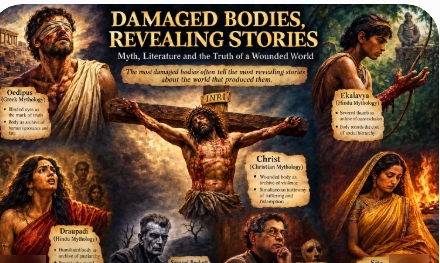

The damaged body is never exhaustively a private tragedy. It often serves as an archive, a record upon which a culture has inscribed its violence, fears, desires, hierarchies and contradictions. Often damaged or disabled bodies preserve histories that characters themselves fail to articulate explicitly.
Literature repeatedly turns attention to bodies that are wounded, diseased, mutilated, immobilised, imprisoned or otherwise broken because such bodies make visible what healthy and socially acceptable bodies are trained to keep in veil. The scar, the missing limb, the chained body, the blind eye, the starving body or the body reduced to mechanical repetition can become a historical document. From Greek tragedy and Hindu mythology to Christian narratives of suffering, and from the theatre of Samuel Beckett to the plays of Girish Karnad, damaged bodies not only reveal what has happened to individuals but what kinds of worlds make such damage conceivable.
Thus, the body is both political before it is philosophical, as it bears the marks of institutions and beliefs. Deepest societal assumptions concerning are reflected from how society treats vulnerable bodies.
The body is therefore political before it is philosophical. It bears the marks of institutions and beliefs. A society’s treatment of the vulnerable body exposes its deepest assumptions about power, purity, gender, caste, sexuality, disability, sin and redemption. This is why the most damaged literary bodies can become the most articulate ones: deprived of ordinary speech or social authority, they communicate through wounds.
Myth and the body marked by fate
Greek mythology provides some of the earliest and most powerful examples of the damaged body as cultural testimony. Oedipus is physically marked by the violence of his infancy: his feet are pierced and bound, and his very name recalls that wound. The mutilation imposed upon the infant becomes a physical prefiguration of the catastrophe, structuring and shaping his adult life. His later blinding becomes even more significant.
Oedipus is an exemplary rational man. He has solved the riddle of Sphinx. His intelligence is reflected from his commitment for trust, evidence, investigation and logical deduction. As a king of Thebes, he sincerely strives to overcome ignorance and superstition from governance. The central irony is that as he takes every step towards truth, he discovers that he himself stands at the centre of the catastrophe. When he discovers that he has unknowingly killed his father and married his mother, he blinds himself. The damaged body becomes the visible form of knowledge. He has seen too much to remain physically capable of seeing.
Oedipus’s ruined eyes expose the limits of human knowledge and the arrogance of a society that believes rational intelligence can master fate. His body tells the story of a civilisation caught between human agency and forces it cannot comprehend.
Philoctetes offers another compelling example. Abandoned on Lemnos because of a foul, incurable wound, he becomes socially useless before becoming militarily necessary. The Greeks reject his wounded body when it does not provide any utility them, only to rediscover its value when they need his bow. His wound therefore exposes the utilitarian logic of war: the individual is valued not as a person but according to utility to collective society. The damaged body tells the story of a society whose ethics collapse when confronted with necessity.
Greek tragedy repeatedly asks us to look at bodies that political communities would rather exclude. The wounded body becomes a counter-history to the official story of heroic civilisation.
Hindu mythology: the body as the site of cosmic and social conflict
Interestingly, Hindu mythology uses damaged body as a language through which the world explains itself. The mutilated body of Ganesha is perhaps the most striking example. Shiva cuts off Ganesha’s head, ignorant that the boy is Parvati’s son, and later restores him with the head of an elephant. The story represents a significant transformation: from mutilation to a myth of reconstruction. But the violence committed by Shiva also underlines a conflict between different forms of authority: the mother’s domestic space and the father’s overwhelming divine and patriarchal authority.
Consequently, Lord Ganesha’s reconstructed body becomes more than an elephant headed deity, as it narrates familial crisis, recognition and authority concomitantly. The body itself becomes the site where competing powers gravitate and where order has to be restored after violence.
The story of Ekalavya offers an even more compelling but disturbing example. Ekalavya, an exceptionally gifted tribal archer, learns by creating an image of Drona after being denied formal instruction. When Drona discovers his achievement, he demands Ekalavya’s right thumb as guru dakshina. Ekalavya immediately cuts it off. This mutilated hand of Ekalavya uncovers the social order behind the apparently noble rhetoric of education and obedience. Talent alone does not guarantee recognition and success in society, which is founded on a hierarchical order. The damaged body of Ekalavya signifies the price paid for crossing an invisible social boundary.
What makes the story powerful is that Ekalavya’s wound speaks more forcefully and profoundly than any explicit condemnation could. His severed thumb exposes a world in which knowledge is guarded by privilege and where obedience can be demanded from those whom the system refuses to acknowledge as equals.
Similarly, the dismemberment of Sati and the scattering of her body across the subcontinent transform bodily fragmentation into a geography of sacred memory. Her body becomes a map. Myth transforms violence against a female body into the foundation of sacred or divine space. The scattered body tells a story not only of grief but also a narrative of how cultures transform suffering into institutions, rituals and landscapes.
Christian mythology: suffering and the body
Christianity places the damaged body at the fulcrum of its theological imagination. The crucified body of Christ is perhaps the most significant and influential wounded body in Western culture. Christ’s suffering body is not akin to the story; rather the body is the story. Nails, wounds, blood, the crown of thorns and the pierced side make suffering physically understandable.
The crucifixion of Christ serves as important metaphor, as the divine body becomes vulnerable to political violence. Rome’s machinery of punishment writes its authority onto Christ’s flesh. Concomitantly, Christianity reverses the meaning of that violence: the body that appears defeated becomes the foundation of redemption.
The crucified body thus carries two histories simultaneously. It tells the story of imperial violence, torture and public execution; but it also tells the theological story of sacrifice and resurrection. Its power comes precisely from this tension. The damaged body can be both evidence of oppression and a source of meaning.
Christian iconography consequently makes suffering visible rather than hiding it. The wounds of Christ become objects of contemplation. Pain is transformed into testimony.
Beckett: when the body becomes the prison of existence
Samuel Beckett radically secularises and modernises this tradition. His characters inhabit bodies that are exhausted, incomplete, immobile, repetitive or trapped. Yet the body in Beckett is never merely biological. Rather it is a philosophical and social instrument.
In Waiting for Godot, Vladimir and Estragon inhabit bodies subject to hunger, pain, exhaustion, sexual vulnerability and memory loss. Their shoes hurt, their bodies tire, they contemplate even hanging themselves, and they endlessly wait without knowing what will be the outcome of waiting. Their physical deterioration reflects the collapse of meaningful structures surrounding them.
The famous image of Pozzo in the second act is even more revealing and compelling. He returns blind and helpless, while Lucky, once his servant, has also become physically diminished. The hierarchy that seemed stable in the first act has mutated into mutual dependence and bodily decline. Power is revealed as temporary because the body itself refuses permanence.
Beckett’s Endgame makes this still more explicit. Hamm is blind and confined to a chair; Clov cannot sit down; Nagg and Nell are reduced to living in ashbins. These are not simply grotesque characters. They are bodies from which ordinary human possibilities have been systematically stripped away. Movement, sexuality, reproduction, independence and even conventional domestic life have become nearly impossible.
And yet these bodies are extraordinarily revealing. The more physically constrained Beckett’s characters become, the more clearly, we see the absurd structures they inhabit. Their bodies expose dependence: the master needs the servant; the servant needs the master; the parents depend upon the son; the son is trapped by the parents. The body reveals a social truth that abstract philosophical language might obscure: human beings are radically dependent creatures.
Beckett’s damaged bodies also challenge the fantasy of autonomy. Modern individualism imagines the self as independent, mobile and self-determining. Beckett gives us the opposite: people trapped inside bodies, habits and relationships they cannot escape. Physical deterioration becomes an image of existential condition.
Girish Karnad: wounded bodies and the violence of social imagination
In his plays, Girish Karnad has frequently used myth to examine the structure of contemporary Indian society. Karnad’s plays exemplify how bodily transformation can help in uncovering social contradictions more effectively than realism.
In Karnad’s play, Hayavadana, the problem of the body is that it is inseparable from identity. Protagonists of the play Devadatta and Kapila possess different kinds of physical and intellectual attractiveness, and after their heads are exchanged, the question arises: who is the real person—the one with the original head or the one with the original body?
The apparently comic fantasy poses a philosophically unsettling question. If identity resides in the head, then the body is secondary; if identity resides in the body, then memory and consciousness become secondary. Karnad turns the body into a site of competing cultural definitions of the self.
Nevertheless, Hayavadana is deeply concerned with the impossibility of achieving perfect wholeness. The characters desire completeness, yet every attempt to reconcile opposites produces another form of incompleteness. The damaged or hybrid body therefore reflects a damaged or disintegrated social world—one in which apparently stable categories such as mind/body, man/woman, human/animal and tradition/modernity continuously break down.
Likewise, in Nagamandala, the transformation of the snake into a human lover destabilises conventional ideas about marriage, respectability and female sexuality. Rani’s body becomes the battleground on which patriarchy, social legitimacy and desire concomitantly fight. Her experience itself reveals the difference between the social institution of marriage and the emotional reality of the woman trapped inside it.
Karnad’s mythic bodies therefore speak because they are never simply individual bodies. They carry the pressure of collective expectations.
The female body and the world’s violence
The history of damaged bodies is also inseparable from the history of women’s bodies. Myth frequently makes female suffering the subject from which social order is constructed.
Draupadi, for instance, becomes the symbolic centre of humiliation in the Mahabharata. Her attempted disrobing no only underline assault upon one royal woman in the court of Hastinapur but it also exposes the political structures deeply entrenched in patriarchy, kingship and male honour. The men who possess power become spectators to violence. Draupadi’s body reveals the moral bankruptcy of the institutions that claim to protect her.
Similarly, Sita’s ordeal by fire transforms the female body into evidence in a trial conducted by patriarchal suspicion. Her body must prove what her word cannot. The demand itself exposes a world in which a woman’s virtue is made a public property subject to male judgment.
In Greek mythology, the bodies of women similarly become sites upon which male power and divine power operate. Medusa’s transformation into a monster can be read as a story of how female sexuality and transgression are rendered monstrous. Philomela, whose tongue is cut out so that she cannot speak, offers perhaps an even clearer example. Her mutilated body is intended to silence her, but she communicates through weaving. The damaged body produces another language when ordinary language has been taken away.
This is one of mythology’s deepest insights: silencing the body does not necessarily silence its story.
The body remembers what history forgets
Across these traditions, damaged bodies perform an archival function. They preserve events that official histories may suppress.
Ekalavya’s severed thumb reminds caste exclusion. Oedipus’s blinded eyes remember the violence of knowledge and fate. Christ’s wounds remind imperial punishment and concomitantly symbols of redemption. Beckett’s immobile bodies remember the collapse of inherited certainties. Karnad’s transformed and violated bodies remember the contradictions of caste, patriarchy, desire and tradition.
The body can therefore be understood as a form of counter-history. Official history tends to celebrate kings, victories, institutions and ideologies. The body remembers what these narratives leave behind: hunger, humiliation, pain, exclusion and dependence.
This is why literary representations of bodily damage can be politically more powerful than speeches. A speech can be dismissed as an argument; a wound continues to serve as evidence, a testimony.
From damaged bodies to damaged worlds
The most significant point, however, is that these works do not merely ask us to sympathise with damaged individuals. Rather they ask us to diagnose the world that produced the damage.
If Oedipus is wounded, what does that say about the human desire to control destiny? If Ekalavya is mutilated, what does that say about a social order that protects only privilege? If Christ is crucified, what does that say about the relationship between political authority and the vulnerable body? If Beckett’s characters are trapped in deteriorating bodies, what does that say about modern humanity’s faith in progress, autonomy, reason and rationality? If Karnad’s characters inhabit transformed, or violated bodies, what does that reveal about the tensions that are embedded in social institutions?
The damaged body thus becomes a diagnostic instrument. It allows literature to move from the question What happened to this person? to the more disturbing question What kind of world makes this happen?
The answer is rarely comforting. The body is damaged by war, caste, patriarchy, religion, political power, family authority, social exclusion, metaphysical uncertainty and the simple fact of mortality. But literature also demonstrates that damage can produce knowledge. The wound becomes a form of speech; mutilation becomes memory; blindness becomes vision; confinement becomes revelation.
Ultimately, the most damaged bodies tell the most revealing stories because they cannot pretend that the world is whole. Their fractures correspond to fractures in the cultures that created them. The wounded body is the place where private suffering becomes public history. It carries upon its flesh the values, violences and contradictions of a civilisation.
From the pierced feet of Oedipus to the severed thumb of Ekalavya, from the crucified body of Christ to Beckett’s immobilised figures and Karnad’s hybrid and violated characters, literature repeatedly insists on one profound truth: when a society damages a body, it inadvertently writes its own autobiography upon it. The scar is therefore not only a mark of what happened to an individual. It is a revelation of what happened to the world.
Therefore, damaged body is not merely a victim’s history: It is witness to history.
SChandra Literature Team
References
Beckett S. Complete Dramatic Works. London: Faber; 1989.
Foucault, Michel, 1926-1984. Discipline and Punish : the Birth of the Prison. New York :Pantheon Books, 1977.
Brown, N., & Gershon, S. A. (2017). Body politics. Politics, Groups, and Identities, 5(1), 1–3. https://doi.org/10.1080/21565503.2016.1276022
Feuer, Lewis S. “Political Myths and Metaphysics.” Philosophy and Phenomenological Research, vol. 15, no. 3, 1955, pp. 332–50. JSTOR, https://doi.org/10.2307/2103502. Accessed 6 Apr. 2024.
Frye, Northrop. “Ethical Criticism: Theory of Symbols.” Critical Theory Since Plato. Ed. Hazard Adams. New York: Harcourt Brace Jovanovich College Publishers, 1992. 1046-1073
Bhabha, Homi K. 1996, “Culture’s In-Between.” Questions of Cultural Identity. Stuart Hall & Paul du Gay. Eds. SAGE Publication, London. pp. 53-60. Print. —. 1994, The location of Culture, Routledge, New York, Print.
Karnad, Girish. Hayavadana (1975). New Delhi: Oxford University Press, 2000
Mahadevan, Anand. “Switching Heads and Cultures: Transformation of an Indian Myth by Thomas Mann and Girish Karnad.” Comparative Literature. 54.1 (2002): 23-41.
Mann, Thomas. The Transposed Heads (1941). Trans. Lowe-Porter. New York: Vintage Books, 1959.
Turner, Victor.19 69, The Ritual Process: Structure and Anti-structure. Aldine Pub.Chicago, Print


2 Comments
[…] Source: The Body as an Archive: Damage, Myth, and the Stories of the World […]
[…] ओडिपस: जब आँखों ने सत्य देखा और फिर अंधी हो गईं […]