
When Politics Becomes a Product: How the Modi Era Turned Elections into a Battle for Attention
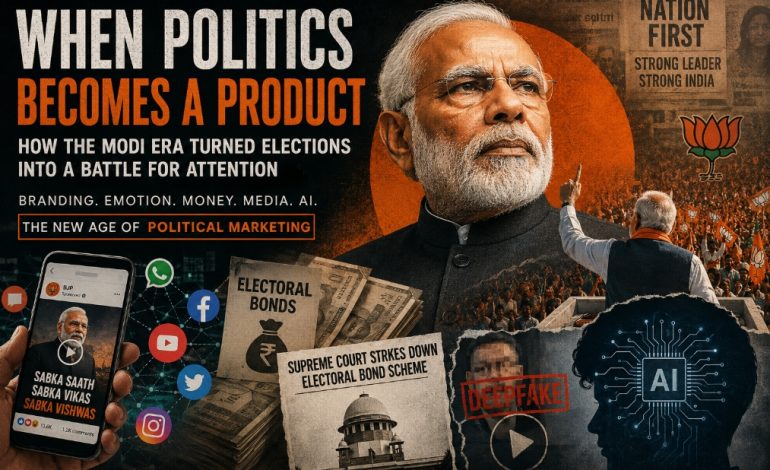

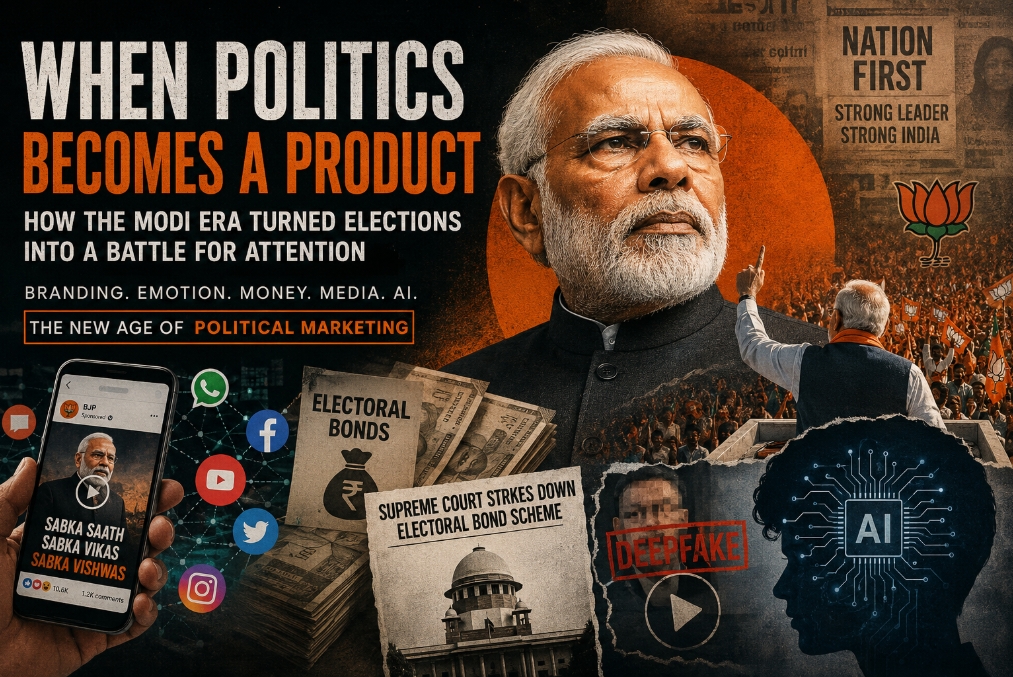
What happens when a politician is marketed like a brand, voters become an audience, and democracy becomes a competition for clicks, emotions and headlines? How Modi era has reduced election into marketing gimmick?
Politics has always involved persuasion. Politicians have promised, performed, symbolised and staged themselves for voters for as long as elections have existed.
But something has changed. The modern political campaign is no longer confined to rallies, posters and newspaper advertisements. It lives on television, Instagram, YouTube, WhatsApp, X and increasingly in AI-generated images, videos and audio. A political message can now travel across millions of screens before a voter has had time to ask a basic question:
Is this information, or is this marketing? This question becomes particularly interesting in India, where Narendra Modi has built one of the most recognisable political brands of the contemporary era.
The point is not to reduce Modi’s electoral success to marketing. Nor is it to suggest that voters are passive consumers who simply buy whatever politicians sell. Elections remain complicated contests shaped by ideology, governance, identity, leadership, economic conditions and local politics.
But Modi’s rise offers an unusually revealing case study of what political marketing can do, and where it can become troubling. How parliamentary democracy can be transformed into presidential style election and subsequent elections often become referendum on Modi.
- When the politician becomes the product
The first criticism of political marketing is perhaps the simplest: politics can begin to look less like a contest between policies and more like a contest between brands, as political marketing shifts attention towards the image of the political actor rather than the informed evaluation of competing programmes. The Modi phenomenon illustrates the power of this logic.
“Modi” is not merely a name on a ballot. It is a political identity associated with particular visual symbols, slogans, speeches, social-media posts, international appearances and carefully repeated narratives. This creates a powerful political advantage. Instead of asking voters to remember dozens of policy details, a campaign can give them something much easier to remember: a face, a feeling and a story.
That is classic branding. And branding is powerful precisely because it simplifies complexity.
- The election is no longer only fought at the polling booth
The second transformation is technological. The political campaign now continues long after the rally ends. A speech can become a short video. A slogan can become a meme. A photograph can become a thousand posts. A thirty-second clip can travel further than a thirty-minute policy speech.
The Election Commission itself recognises the importance of social media in electoral communication, including targeted digital messaging and audience engagement. The 2024 general election demonstrated how quickly this environment can become a battlefield of competing narratives.
Reuters reported that AI-generated deepfake videos involving Bollywood actors Aamir Khan and Ranveer Singh circulated during the election, illustrating how synthetic media could be used to influence political opinion. Suddenly, political marketing has acquired a new weapon: the ability to manufacture concocted reality at scale.
- From slogans to emotions in Modi Era
Political marketing does not necessarily win by providing voters with more information. Sometimes it wins by making voters feel more strongly. The successful campaigns frequently operate in an “emotional marketplace” rather than simply competing through ideas. This helps explain why nationalism, religion, security, pride, fear and grievance have become such powerful campaign themes in Modi era.
Economic statistics require concentration. Emotion does not. A complicated discussion about unemployment may take ten minutes. A slogan about national pride can take three seconds. That is why emotional politics is so attractive to modern political marketers: it is memorable, repeatable and highly shareable.
During the 2024 campaign, Reuters reported that Modi’s messaging increasingly emphasised themes of national identity, security and India’s global standing, while BJP campaign material also generated controversy over content targeting the Congress and Muslims.
The important question is not whether emotion belongs in politics. It obviously does. The question is: When emotion becomes the product, what happens to evidence?
- When the opponent becomes the villain
Another criticism of political marketing is the rise of negative and personalised campaigning. Personal attacks against political opponents have emerged as a recurring feature of Modi’s campaign style. This reflects a broader truth about political communication.
It is often easier to tell voters what is wrong with someone else than to explain what you will do yourself. “Here is my policy” requires argument. “They are the problem” requires only an enemy. Modern digital platforms can intensify this tendency at scale because outrage travels exceptionally well. A furious post attracts attention. A nuanced policy paper usually does not.
India’s Election Commission explicitly says campaign criticism should focus on parties’ policies, programmes and public record, and advises against unverified allegations, distortion and appeals to communal feelings. The existence of such rules tells us something important: political communication is not merely a question of style. It can affect the quality of democratic competition.
- The money behind the message
No political marketing story is complete without discussing money. Campaigns require advertising, consultants, data, travel, media production, social-media teams and increasingly sophisticated digital infrastructure. That makes political finance central to the question of democratic equality.
The issue became particularly significant in India after the Supreme Court struck down the Electoral Bond Scheme in February 2024, holding that non-disclosure of political funding violated citizens’ right to information. The Court also found the changes permitting unlimited corporate political contributions arbitrary.
That judgment changed the conversation around political marketing. If voters are expected to evaluate political messages, they also have a legitimate interest in understanding who has the resources to put those messages in front of them.
Political persuasion may be democratic. Invisible financial power behind political persuasion is a different question.
- The social-media echo chamber
Political marketing becomes especially powerful when the same message appears everywhere.
A leader says something in a speech.
Party supporters repeat it.
Influencers discuss it.
Television debates pick it up.
Short clips circulate online.
Memes emerge.
Eventually, repetition itself can create a sense of importance.
The original text describes this phenomenon as a coordinated ecosystem in which political messages are rapidly reproduced across social platforms.
Whether every example fits that description is a matter for evidence and debate. But the underlying communication principle is undeniable:
repetition makes messages familiar, and familiarity can make messages feel true.
That is why digital political campaigns are no longer simply about broadcasting information. They are all about controlling attention.
- The misinformation problem has entered the AI era
Political misinformation is no longer limited to a misleading headline or an edited photograph. Generative AI can produce convincing faces, voices and videos. The Election Commission responded to this emerging threat in 2024 election by advising political parties to clearly label AI-generated or synthetic campaign content and warning about the potential effect of such material on voter opinion and trust. But what happens when election commission brazenly starts favouring incumbent political party and selectively targets only opposition party.
This is a crucial development because the old question was: “Did the politician really say that?” The new question is: “Did that politician even appear in this video?” That is a much more dangerous information environment.
- From leadership to celebrity
One of the deepest criticisms of political marketing is that it can transform leadership into celebrity.
A leader becomes omnipresent.
The face appears on posters.
The voice dominates speeches.
The image appears in social-media content.
Personal stories become political assets.
The leader becomes easier to recognise than the institution they represent. Political marketing can create a “cult-like” or messianic image around political leadership. This is what exactly happened as BJP’s marketing machine has created Narendra Modi a cult like figure
But there is an important democratic danger here. A democracy is supposed to depend on institutions, parties, legislatures, courts, civil society and citizens. A political brand depends heavily on one personality. When politics becomes too personalised, criticism of the leader can begin to look like criticism of the nation itself. That is when political marketing becomes more than advertising. It becomes identity.
- The danger of confusing popularity with performance
Here lies perhaps the most uncomfortable question. A successful political brand can survive failures that would damage an ordinary product. Why? Because voters do not judge leaders using only economic spreadsheets. They judge them through identity, trust, ideology, emotion, memory and expectations.
The lesson is broader than Modi.
Popularity is not proof of performance.
And criticism is not proof of failure.
A mature democracy needs citizens capable of holding both ideas concomitantly.
- Political marketing can crowd out complexity
Modern campaigns reward simple messages. The problem is that governing is rarely simple.
The issue of employment is complicated.
The issue of inflation is complicated.
The issue of foreign policy is complicated.
The issue communal relations are complicated.
The issue of public health is complicated.
The issue of education is complicated.
But digital politics rewards the opposite: short videos, slogans, dramatic confrontations and instantly understandable villains.
The result can be a strange imbalance.
The politician who explains the most complicated issue in the simplest emotional language may defeat the politician who has the better but more complicated argument.
That is not necessarily manipulation.
But it is certainly a structural weakness of modern political communication.
- The real product may be attention
Perhaps the most useful way to understand all eleven criticisms is to stop thinking about political marketing as simply “selling a politician.”
The real product may be attention, and attention has become the scarcest resource in democracy.
Every political party wants it.
Every television channel wants it.
Every influencer wants it.
Every social-media platform is designed around capturing it.
The politician who controls attention gains the ability to define the conversation.
This is why political marketing matters so much.
It does not merely tell citizens what to think.
At its most powerful, it can help determine what citizens think about.
So, is Modi a product of political marketing?
Yes—but that answer is far too simple.
Modi’s political success cannot reasonably be explained by marketing alone. His appeal has been connected to ideology, governance, nationalism, welfare politics, organisational strength, opposition weakness, economic aspirations, social identity and his own political career.
Yet his rise also demonstrates the extraordinary power of political communication in the digital age.
The original study argued that the Modi campaign embodies many of the classic criticisms of political marketing: personalisation, emotional appeals, ideological mobilisation, negative campaigning, media management, populism and the privileging of image over informed choice.
The developments since then make the argument even more relevant.
Electoral finance has faced greater scrutiny after the Supreme Court’s electoral-bonds ruling.
Social-media campaigning has become central to elections.
AI has introduced deepfakes into political communication.
And regulators are now having to confront a problem that would have sounded like science fiction only a few years ago: machines that can manufacture political reality.
The final question
The future of democracy may therefore depend on a skill that sounds almost old-fashioned, but it depnds on:
the ability to pause.
Pause before sharing.
Pause before believing.
Pause before cheering.
Pause before hating.
Ask who created the message.
Ask who benefits from it.
Ask what evidence supports it.
Ask what has been left out.
And, most importantly, ask whether we are choosing a political programme—or simply responding to a brilliantly marketed political identity.
Because elections may still be decided by votes.
But before a vote is cast, a much bigger battle is being fought:
the battle for the voter’s attention, emotion and imagination.
And in that battle, the most successful political marketer may not be the person with the best argument. It may be the person who tells the most concocted, malicious and communal stories. Critics argue that transformation of election into attention machine in Modi era has deepened polarisation and hatred on communal ground. More importantly, Modi Era has transformed voter into consumers by stripping their status of citizens.
SChandra Literature
References
Butler, P. and Harris, P. 2009. Considerations on the evolution of political marketing theory, Marketing Theory, Vol. 9 (2), pp. 149-164.
Chopra, R. 2021. Explained: Why is the electoral bond scheme being opposed by transparency activists?, The Indian Express https://indianexpress.com/article/explained/electoral-bond-scheme-transparency-elections-7243078/
Das, K.N. 2019. Factbox: India’s Modi crafts populist measures ahead of elections, REUTERS, retrieved from < https://www.reuters.com/article/us-india-election-factbox/factbox-indias-modi-crafts-populist-measures-ahead-of-elections-idUSKCN1PJ0LH>
Financial Express, 2020. Fearing horse-trading, Congress shifts Rajasthan MLAs to Jaisalmer, https://www.financialexpress.com/india-news/over-50-gehlot-camp-mlas-moved-to-jaisalmer-in-chartered-flights-others-to-follow/2041413/>
Gupta, M. 2019. BJP’s ‘Warfare-Welfare’ Model: Development Was Never a Substitute for Hindutva, The Wire https://thewire.in/politics/bjp-warfare-welfare-model-hindutva-development
Gupta, S. 2020. Poke fun at taali, thaali, diya and mombatti all you want. Modi couldn’t care less, The Print, https://theprint.in/national-interest/poke-fun-at-taali-thaali-diya-and-mombatti-all-you-want-modi-couldnt-care-less/394961/>
Halder. 2020. How the BJP Tried to Manipulate Public Opinion on Social Media in Favour of the CAA, https://thewire.in/politics/how-bjp-tried-manipulate-public-opinion-social-media-favour-caa
Hebbar, N. 2020. Resort politics is now a de rigueur feature of Indian political life, The Hindu https://www.thehindu.com/news/national/resort-politics-have-become-a-de-rigueur-feature-of-indian-political-life/article32124341.ece
Hindustan Times, 2020. Nationwide campaign to apprise people of Ram Mandir’s history to begin https://www.hindustantimes.com/india-news/nationwide-campaign-to-apprise-people-of-ram-mandir-s-history-to-begin-from-jan-15/story-IMqbeZJUXbCXpEPoOIhQIK.html
Karnad, R. 2017. It’s Not What Modi Is Tweeting – It’s What He Is Reading, The Wire https://thewire.in/politics/narendra-modi-twitter-trolls
Lock & Harris (1996), “Political Marketing: Vive la Différence!”, European Journal of Marketing, Vol. 30 (10/11): 21-31.
Lilleker. 2005. “The Impact of Political Marketing on Internal Party Democracy”, Parliamentary Affairs, Vol. 58 (3): 570-584.
Mishra, P. 2019. How Narendra Modi Seduced India With Envy and Hate, The New York Times, https://www.nytimes.com/2019/05/23/opinion/modi-india-election.html>
News indiatimes, 2020. Modi inaugurates Shree Ram Janmabhoomi Mandir in Ayodhya, devotees, supporters celebrate https://www.newsindiatimes.com/modi-inaugurates-shree-ram-janmabhoomi-mandir-in-ayodhya-devotees-supporters-celebrate/
Ormrod, R.P. Henneberg, S.C. O’Shaughnessy, N.J. (2013), Political Marketing: Theory and Concepts. London: Sage, Google book, https://www.google.co.in/books/edition/Political_Marketing/lLJR_NM7iVAC?hl=en&gbpv=1&dq=Political+Marketing:+Theory+and+Concepts&printsec=frontcover
Rasid, O. 2021. ‘Injustice’, tampering done against those who created history being ‘rectified’: Narendra Modi, The Hindu, https://www.thehindu.com/news/national/other-states/pm-modi-lays-foundation-stone-for-warrior-king-suheldevs-statue-in-ups-bahraich/article33848574.ece>
Sharma, M. 2020. Why Modi May Be the Most Popular Populist, BloombergQuint, https://www.bloombergquint.com/opinion/why-india-s-modi-remains-popular-despite-coronavirus-crisis
Singh, T. (2020). Media has been managed so well by Modi government that for ministers to dare speak of ‘press freedom’ is offensive, The Indian Express https://indianexpress.com/article/opinion/columns/arnab-goswami-arrest-narendra-modi-tavleen-singh-7001283/
The Hindu, 2020. Congress condemns PM Modi’s remarks against Nehru, https://www.thehindu.com/news/national/telangana/congress-condemns-pm-modis-remarks-against-nehru/article30764658.ece>
The Wire, 2020. For the First Time in India, Twitter Flags BJP IT Cell’s ‘Manipulated Media’ https://thewire.in/politics/twitter-amit-malviya-bjp-it-cell-manipulation
Varshney, A. 2017. Is Narendra Modi a populist?, The Indian Express, https://indianexpress.com/article/opinion/columns/india-prime-minister-narendra-modi-a-populist-populism-democracy-donald-trump-pro-hindu-4901786/
Vij, S. 2019. Why and how ideology is central to winning elections in India, The Print, https://theprint.in/opinion/why-and-how-ideology-is-central-to-winning-elections-in-india/319349/
Vij, S. 2020. Elections have become meaningless in India — the BJP wins even when it loses, The Print, https://theprint.in/opinion/elections-meaningless-in-india-bjp-wins-even-when-it-loses/462971/