
Translating the Untranslatable: Dalit Literature, Cultural Residue, and the Politics of Language

When Language Refuses Assimilation
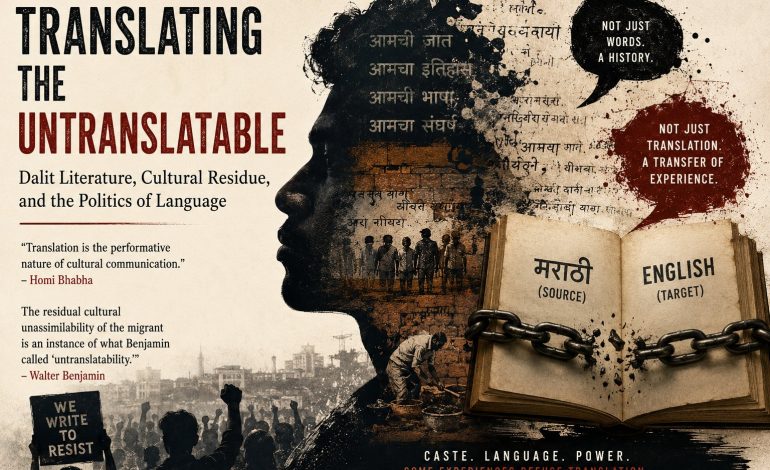
“Translation is the performative nature of cultural communication,” argues Homi Bhabha, while simultaneously invoking Walter Benjamin’s notion of “untranslatability” to describe the residual cultural excess that refuses assimilation within migrant and marginal experiences. This theoretical framework becomes profoundly significant when placed within the socio-political and linguistic terrain of Dalit literature in India.
Dalit writing is not just a literary category; it is a historical testimony, a political intervention, and an epistemological rebellion against caste oppression. Yet, the moment Dalit literature enters the domain of translation, particularly into English, it encounters an unsettling paradox: while the text travels, the lived experience often does not.
The politics of translation, therefore, cannot be understood simply as a linguistic transfer between source and target languages. In the context of Dalit literature, translation becomes a site of contestation where caste, culture, language, and power collide.
Dalit Language as Experience, Not Ornament
The linguistic vocabulary of Dalit literature is deeply embedded in personal, ontological, and collective histories shaped by caste-based exclusion. Dalit writers derive their lexicon not from institutionalized literary traditions but from lived realities—manual labour, humiliation, resistance, hunger, migration, and survival.
Their language emerges through regional dialects, fractured idioms, oral memories, and caste-marked speech patterns that often remain undecipherable to dominant literary cultures. It is a language sharpened through historical violence and political assertion.
Unlike mainstream literary aesthetics that seek refinement and universality, Dalit literature deliberately employs slurs, satire, dark humour, and abrasive speech as acts of resistance. These linguistic choices are not accidental stylistic devices; they are political strategies intended to destabilize Savarna authority and expose the brutality of caste society.
Consequently, translation confronts a critical dilemma: how does one translate humiliation, caste-inflected silence, or the weight of inherited social stigma into a language structurally detached from those experiences?
The issue is not merely semantic equivalence. It is the impossibility of carrying over the socio-historical residue embedded within Dalit expression.
The Myth of Neutral Translation
Mainstream translation practices often assume the existence of equivalence between the source text and the target text. However, Dalit literature fundamentally disrupts this assumption.
English translations frequently domesticate Dalit texts by smoothing out linguistic ruptures, sanitizing caste-marked abuses, or universalizing pain into abstract human suffering. In doing so, translation risks erasing the very specificity that gives Dalit writing its political force.
This exposes the limitations of concepts such as “Translation as Culture” or “Cultural Translation,” especially when they fail to account for caste as a lived structure of power. Cultural translation, in many academic frameworks, presumes mobility, hybridity, and negotiation. But Dalit experiences often emerge from histories of exclusion rather than participation.
Translation, therefore, cannot be celebrated uncritically as a bridge between cultures. In caste society, it may also function as a mechanism of absorption where the radical sharpness of Dalit assertion becomes diluted within elite literary consumption.
Marathi Dalit Poetry and the Crisis of Transferability
The crisis becomes particularly visible in Marathi Dalit poetry, where language itself carries the scars of caste violence.
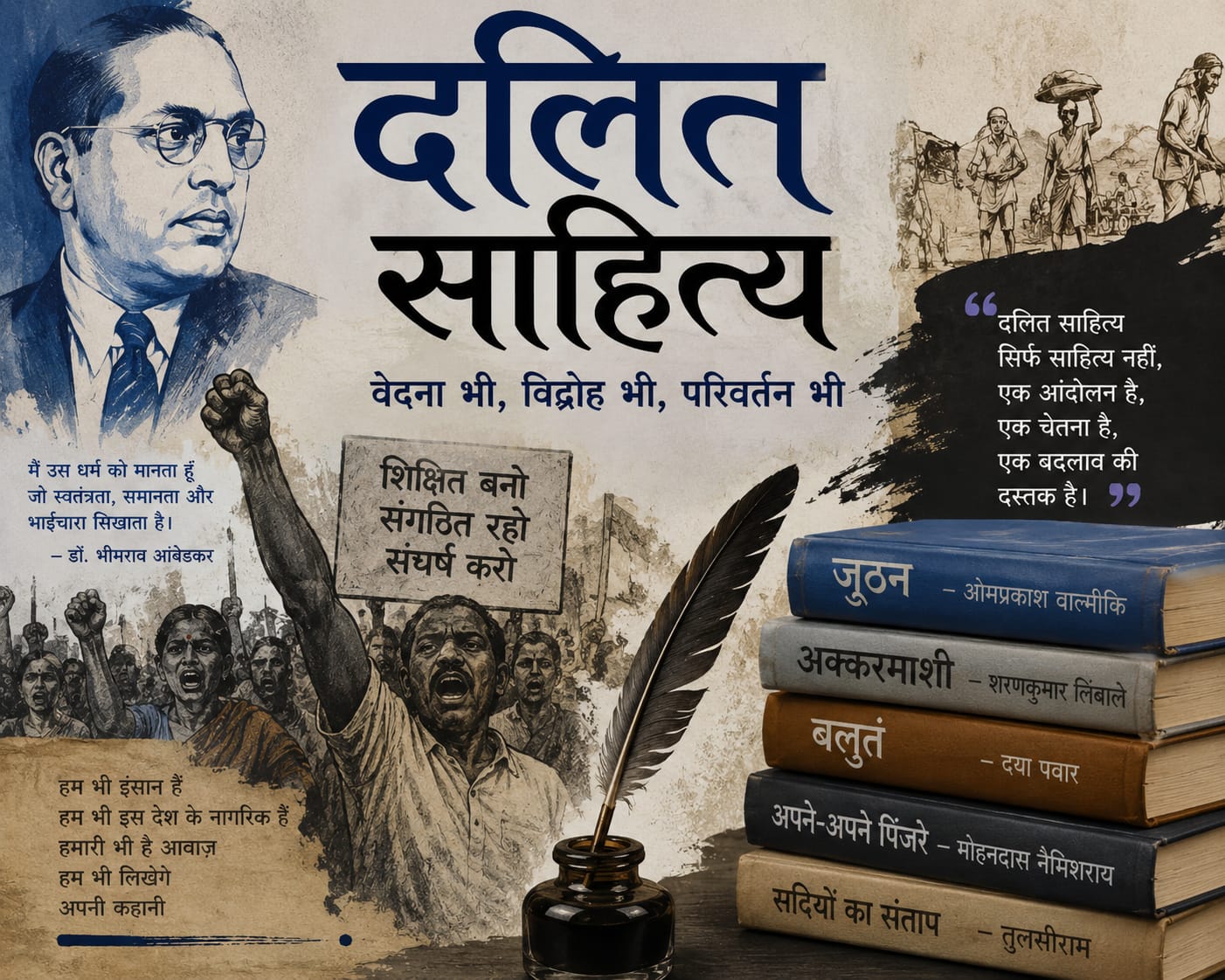
The poetry of writers associated with the Dalit Panthers movement transformed Marathi literary culture through raw imagery, colloquial aggression, and anti-caste radicalism. Their poems refused Brahmanical notions of literary purity and instead foregrounded the corporeal realities of Dalit existence.
However, when translated into English, several layers of meaning become inaccessible:
- Caste-specific abuses lose their historical intensity.
- Rural dialects flatten into standardized literary English.
- Oral rhythms disappear.
- Cultural metaphors rooted in labour and locality become generalized.
As a result, what remains in translation is often the narrative of suffering but not the texture of caste.
This creates what may be termed a “casteless translation”—a version of the text where the structural violence of caste becomes linguistically invisible despite being thematically present.
Translation as a Site of Caste Politics
The question is not whether Dalit literature should be translated. Translation remains crucial for visibility, circulation, and solidarity across linguistic borders. Rather, the concern lies in understanding who translates, for whom, and under what ideological frameworks.
Can translation genuinely carry caste experience without reproducing upper-caste modes of interpretation?
Can English—historically associated with modernity, institutional privilege, and elite discourse in India—adequately embody the linguistic anger of Dalit resistance?
Or does translation inevitably create distance between lived oppression and literary representation?
These questions reveal that translation is never politically neutral. It is implicated within systems of knowledge production, literary legitimacy, and caste hierarchy.
Beyond Linguistic Transfer: Towards Ethical Translation
Dalit literature demands a rethinking of translation itself. Instead of pursuing seamless readability or cultural assimilation, translators may need to preserve discomfort, opacity, and linguistic rupture within the translated text.
Perhaps the task of translating Dalit literature is not to make it fully accessible, but to retain traces of its resistance—to allow language to remain partially unassimilable.
In this sense, untranslatability is not failure. It is political residue.
It marks the point where caste experience exceeds the limits of dominant language systems and refuses incorporation into sanitized literary universality.
The challenge before translation studies, therefore, is not simply how to translate Dalit literature, but how to confront the caste privileges embedded within translation itself.
Conclusion: The Language That Refuses Erasure
Dalit literature stands at the intersection of memory, pain, resistance, and linguistic rebellion. Its power lies not only in what it narrates but in how it speaks.
Translation can carry words across languages, but it cannot always transport the historical wounds embedded within them. The gap between source language and target language in Dalit writing is not merely linguistic—it is civilizational.
To translate Dalit literature ethically requires more than technical skill. It demands political sensitivity, historical accountability, and an acknowledgement that some experiences resist smooth cultural transfer.
And perhaps that resistance—the refusal to become fully translatable—is precisely where Dalit literature retains its radical force.