
The significance and role of clowns in Christopher Marlowe’s play Doctor Faustus
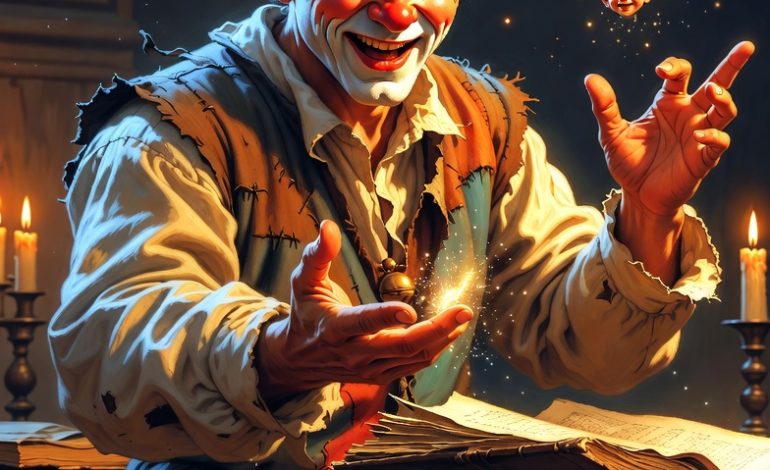

The clowns in Christopher Marlowe’s Doctor Faustus (Wagner, Robin/the Clown, Dick/Rafe, and associated low characters like the Horse-courser and Carter) serve multiple dramatic, structural roles and thematic roles. They provide comic relief in a tragedy, satire the protagonist’s ambitions and downfall, democratize or trivialize the play’s central concerns with magic and damnation, and elevate the moral and ironic dimensions of the story
The ambiguity associated with Christopher Marlowe’s play Doctor Faustus largely pertains to a definite time and date when the play was written. The extensive research performed by W.W Greg reveals that the play exists in two principal texts; A-text and B-Text or A-quarto of 1604 and B-quarto of 1616. Both the editions of the play are substantially different from each other specifically in terms of the comic scenes. The comic scenes involving characters of little or no intellectual capability like Robin and Dick furthermore appears to be largely incongruent if viewed in the entirety of the play. These scenes have received diminutive attention from the critics and scholars and furthermore they have been criticized on the grounds of trivializing Faustus’s character by providing a break from the inherent tragedy which the Protagonist is going through.
Marlowe purposely creates characters such as clown in depicting the life journey of Dr.Faustus, and to create a sharp distinction between Dr. Faustus and clown in terms of cognitive structure and intellectual prowess. Marlowe deliberately treats human soul as a commodity that can be traded for the fulfillment of humanistic desires. An agent with ordinary intellectual capability such as clown can trade his soul for achieving ordinary purpose in life whereas an agent with higher intellectual prowess such as Dr. Faustus trades his soul for the attainment of extraordinary purpose of life. Therefore, Marlowe also quite strikingly makes a sharp distinction between a clown and Dr. Faustus in terms of their individual motivation and personality.
Marlowe quite innovatively creates a continuum of human desire, whose one end is being represented by the clown whereas the other end is being explored by Dr. Faustus. A revered management thinker of 20th century, Abraham Maslow’s “hierarchy of needs theory” also quite strikingly expounds difference between individual desire and aspirations of a clown and Dr. Faustus. Maslow postulates that it is important to have value free, value neutral and value rejecting stance in order to comprehend humanity from the lenses of natural scientists. He argues that ordinary people can be motivated by the fulfillment of most generalized needs such as food, water, shelter or protection.
On the other hand, intelligent or extraordinary people can be driven by higher order of need such as self actualization. Maslow also argues that individuals first make attempt to fulfill basic level of needs and then move higher on the hierarchies of need continuum. Marlowe quite creatively explains that Dr. Fasutus’ motivation to achieve extraordinary life purpose sharpens the difference between ordinary and extraordinary individuals. It is rather interesting to observe that Marlowe creates a value of soul, unique to the individual, which helps in creating distinction between individuals completely divergent in terms of human desires, motivations and overall purpose of life (Bouzenita and Boulanouar, 2016).
However a deeper critical evaluation of the comic scenes and the inclusion of characters like Robin and Dick within the larger narrative of the play reveals two possible intentions; first, the inclusion of such lowly characters can be a way of heightening or elevating Faustus’s intellectual supremacy, academic excellence and scholarly methods. From the beginning of the play Faustus has been shown as a human who is of a greater stature as compared to the other human characters introduced by Marlowe in the play. Faustus’s character is in stark contrast with the character traits of Robin and dick and therefore this difference between the protagonist and the other set of characters inherently suggests that the choices which Faustus makes and the essential purpose which he aspires to achieve is far more distanced from the idiosyncratic behavioural patterns and imprudent actions which the clown commits.
In Act one, scene four of the play wagner states that Robin would trade his soul for a shoulder of mutton highlighting the ignorance of the clown. This instance can further be analyzed in terms of a bleak contrast with Faustus’s pact with the devil, where he trades his soul in order to achieve his desires and aspirations. It is imperative to note that Faustus towers above all the other human characters due to his intellectual pursuits whereas on the other hand characters like Cornelius, valdes, Robin and Dick are involved solely in a pursuit of materialistic and covetous gains.
Second intention can be Marlowe’s sardonic attempt in mocking the audience for their blatant judgement in condemning Faustus as an immoral human. The clown in this sense reflects the audience or the larger societal worldview on the stage. Commonly, the clown in the Renaissance period emerged as a figure that stands outside the societal construction; therefore he gained liberty to express himself more generously. Clowns generally represented as figures of low rational and intellectual capacity were taken rather not seriously, with an ignorant ease. Therein, these caricatures were excused from the societal norms and were postured at the bottom of the hierarchy attaining an exceptional freedom to state facts which are always present in the common consciousness but were deemed to be controversial. In this respect, the clowns attained the authority to provide the outsiders a profound insight in the lives of the characters and mirrored the audience on the stage.
Through the insertion of characters like the clown, Marlowe by and large tries to infuse a realist paradigm within the larger structure of the play which covertly questions the paranormal activities and supernatural aspects. But by placing Doctor Faustus on the higher continuum on the hierarchies of needs – Marlowe launches a spirit of scientific inquiry in the society whose one end remains value laden. By making Dr Faustus the protagonist of his play – Marlowe intends to make a transition from a society which is value laden to a society which is value free.
Chandra, S. 2026
References
Bouzenita, A.I. and Boulanouar, A.W. 2016. Maslow’s hierarchy of needs: An Islamic critique, Intellectual Discourse, Vol.24 (1), PP. 59–81