

Beauty, Power, and Patriarchy: Aristocratic Women in Alexander Pope’s The Rape of the Lock
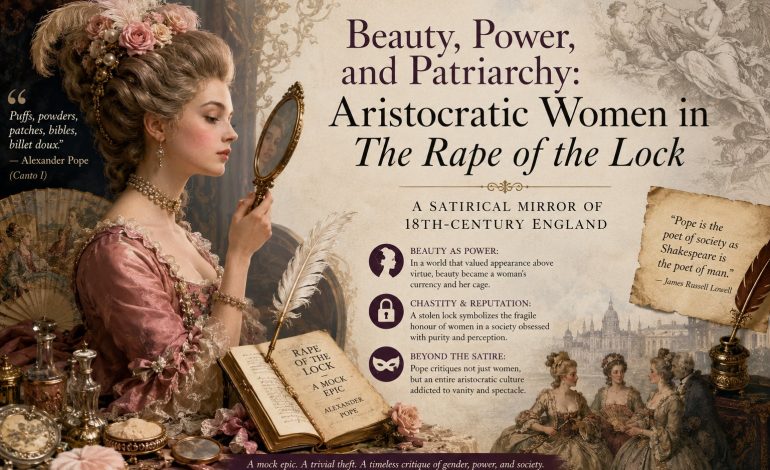

Alexander Pope’s The Rape of the Lock (1712; revised 1714) is often celebrated as the finest mock-epic in English literature. Beneath its wit, elegance, and comic treatment of a trivial social incident, however, lies a sharp commentary on the culture of early eighteenth-century England. Through the figure of Belinda and the fashionable world she inhabits, Pope presents a vivid portrait of aristocratic women whose lives appear defined by beauty, leisure, courtship, and social performance. Yet the poem is far more complex than a straightforward satire of female vanity. It simultaneously reflects the restricted social position of women, exposes the superficiality of aristocratic culture, and reveals Pope’s own ambivalent attitudes towards femininity.
The Aristocratic Woman as a Social Performance
Belinda, the poem’s heroine, epitomizes the fashionable aristocratic woman of Pope’s age. Unlike women of lower social classes burdened with domestic or economic responsibilities, Belinda occupies a world of privilege and leisure. Her day revolves around rituals of dressing, social visits, flirtation, and entertainment. Pope’s famous description of her toilet scene transforms an ordinary act of beautification into a sacred ceremony:
“And now, unveiled, the toilet stands displayed,
Each silver vase in mystic order laid.”
The mock-epic style elevates cosmetics and accessories to the status of epic weapons and sacred objects. Through this exaggeration, Pope satirizes a society in which appearance has replaced substance and beauty functions as a form of social currency. The dressing table becomes an altar, suggesting that aristocratic culture worships external appearance rather than moral virtue.
Yet Belinda’s obsession with beauty should not be interpreted merely as a personal flaw. In a society where women’s social value depended heavily upon attractiveness, elegance, and reputation, beauty became one of the few forms of power available to them. Pope therefore exposes not only female vanity but also a social system that encourages women to define themselves through appearance.
Freedom within Constraints
One striking feature of Belinda’s characterization is the degree of independence she appears to enjoy. She moves freely within fashionable society, attends social gatherings, engages in witty conversation, and participates in public amusements. Unlike many literary representations of women as passive dependents, Belinda displays agency and confidence.
Her spirited response to the Baron’s theft of her lock demonstrates this strength. Pope describes her reaction with epic energy:
“See fierce Belinda on the Baron flies,
With more than usual lightning in her eyes.”
The image portrays Belinda not as a submissive victim but as an active participant in the conflict. Her anger is legitimate, and her resistance challenges assumptions about female passivity.
However, this apparent freedom remains limited. Belinda’s identity is still governed by the expectations of a patriarchal society. Her social standing depends upon preserving her reputation and desirability. Thus, while she enjoys a degree of autonomy unavailable to many women of the period, that autonomy operates within carefully prescribed boundaries.
Chastity, Reputation, and Female Vulnerability
The symbolic significance of the stolen lock extends beyond a mere prank. In eighteenth-century culture, a woman’s honour and reputation were deeply connected to notions of chastity and sexual propriety. The title itself, The Rape of the Lock, deliberately invokes the language of violation. Although the act is comic rather than physically violent, Pope uses the theft to dramatize the fragility of female reputation.
The Sylphs, supernatural guardians assigned to protect Belinda, reinforce this cultural anxiety. Ariel explains that their primary duty is to guard women’s honour and purity. Their presence reflects a society obsessed with regulating female behaviour and preserving ideals of feminine virtue.
Ironically, despite their vigilance, the Sylphs ultimately fail. Their failure suggests the impossibility of fully protecting women within a social order that simultaneously idealizes and objectifies them. Belinda’s lock becomes a symbol of how women’s identities are reduced to physical attributes over which they possess limited control.
Pope’s Ambivalent View of Women
A critical reading of the poem must also consider Pope’s personal attitudes toward women. Scholars such as Maynard Mack have argued that Pope’s relationships with women, particularly Martha and Teresa Blount, informed his literary representations of femininity. Likewise, critics have noted how Pope’s experiences of physical deformity and social exclusion may have shaped his perceptions of female beauty and courtship.
Belinda often appears through a satirical lens. She is portrayed as vain, flirtatious, and excessively concerned with appearances. Such representation has led some critics to accuse Pope of misogyny. The poem repeatedly associates women with fickleness, emotional excess, and superficiality.
Yet Pope’s satire is not directed exclusively at women. The Baron is equally ridiculous in his obsession with acquiring the lock. The fashionable men who populate the poem are no less trivial than the women they pursue. The entire aristocratic world emerges as a theatre of vanity, where both genders participate in empty rituals and social games.
Thus, rather than reading the poem simply as an attack on women, it is more accurate to view it as a critique of the culture that shapes both male and female behaviour.
Aristocratic Society under Satire
Pope’s greatest achievement in The Rape of the Lock lies in his transformation of a minor social incident into a broad cultural satire. As critics have often observed, the poem functions as a miniature portrait of eighteenth-century aristocratic life. Card games become battles, cosmetics become sacred relics, and flirtation assumes epic proportions.
The poem reveals a society preoccupied with fashion, status, and spectacle. Genuine moral concerns are displaced by trivial anxieties. Pope’s mock-heroic technique exposes the absurdity of a culture that invests immense emotional energy in insignificant matters.
In this context, aristocratic women become both participants in and victims of the social order. They embrace the values of beauty, fashion, and flirtation, yet these values are imposed upon them by a culture that measures female worth through appearance and reputation.
Conclusion
The Rape of the Lock offers a fascinating and multifaceted portrayal of aristocratic women in early eighteenth-century England. Through Belinda, Pope captures both the privileges and limitations of upper-class femininity. Women appear empowered through beauty, charm, and social influence, yet remain constrained by expectations surrounding chastity, reputation, and appearance.
While traces of Pope’s personal biases undoubtedly shape the poem, his satire ultimately extends beyond individual women to critique the entire aristocratic culture of his age. Belinda is neither simply a vain coquette nor a feminist heroine; she embodies the contradictions of a society in which women were simultaneously admired, objectified, celebrated, and controlled. It is this complexity that continues to make The Rape of the Lock one of the most insightful literary reflections on gender and social life in eighteenth-century England.