
Milton’s Influence on William Blake’s The Tyger: Satan, Revolution, and Symbolism

Few poems in English literature have generated as much fascination as William Blake’s The Tyger. With its unforgettable opening—“Tyger Tyger, burning bright, / In the forests of the night”—the poem has captivated readers for more than two centuries. Yet beneath its mesmerizing rhythm and haunting imagery lies a profound dialogue with one of the greatest epics in English literature: John Milton’s Paradise Lost.
While The Tyger is often celebrated for its exploration of creation, innocence, and evil, it is equally a poem about rebellion. Blake draws upon Milton’s powerful portrayal of Satan, transforming the tiger into a symbolic figure of revolutionary energy, spiritual defiance, and creative power.
The Tiger as a Symbol of Revolution
Blake wrote during an age of extraordinary upheaval. The Industrial Revolution was reshaping society, the American Revolution had challenged imperial authority, and the French Revolution promised liberty while unleashing unprecedented violence. These events profoundly influenced Blake’s imagination.
Literary scholars have long argued that Blake’s poetry reflects these revolutionary currents. Jacob Bronowski famously observed that Blake did not simply witness these revolutions—he lived them inwardly, allowing them to shape his prophetic vision. Likewise, David V. Erdman interprets The Tyger as a poetic affirmation of revolutionary energy rather than a condemnation of it.
For Blake, however, revolution was never merely political. It was fundamentally spiritual—a struggle between opposing eternal forces. This understanding owes much to Milton’s depiction of Satan in the opening books of Paradise Lost, where rebellion becomes an expression of immense will, ambition, and tragic grandeur.
“Burning Bright”: Echoes of Milton’s Hell
Blake’s opening stanza immediately immerses readers in an atmosphere of mystery and terror:
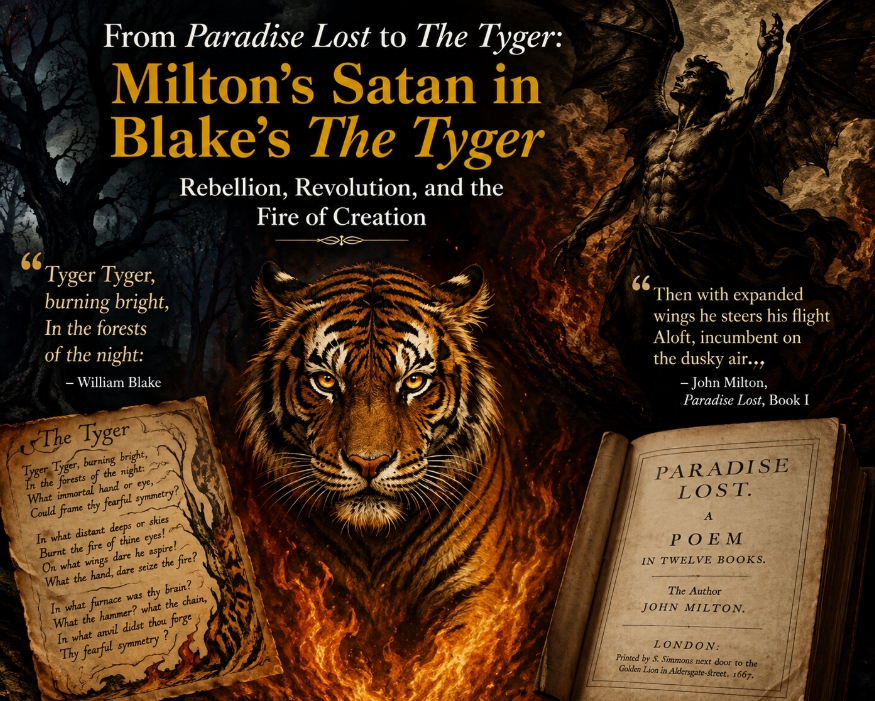
Tyger Tyger, burning bright,
In the forests of the night:
What immortal hand or eye,
Could frame thy fearful symmetry?
The imagery of darkness, blazing fire, and shadowy forests evokes far more than a dangerous animal. The “forests of the night” symbolize a chaotic spiritual landscape remarkably similar to Milton’s vision of Hell and primordial Chaos.
In Paradise Lost, Satan journeys through the dark abyss after his expulsion from Heaven, traversing the realms of Chaos and Night before embarking upon his mission to corrupt humankind. Blake’s nocturnal forest echoes this unsettling environment, where creation exists on the threshold between divine order and destructive freedom.
The tiger, like Milton’s Satan, emerges from darkness surrounded by awe, fear, and sublime power.
Furnace Imagery and the Fires of Creation
One of the poem’s most striking questions asks:
In what furnace was thy brain?
This furnace imagery unmistakably recalls Milton’s depiction of Hell:
“A dungeon horrible, on all sides round
As one great furnace flam’d; yet from those flames
No light, but rather darkness visible.”
Rather than simply borrowing imagery, Blake reimagines Milton’s infernal furnace as the mysterious workshop of creation itself. The tiger is not merely born—it is forged.
The repeated references to fire throughout the poem suggest creative energy that is simultaneously destructive and magnificent. Fire becomes both the source of terror and the symbol of divine imagination.
Wings, Fire, and the Spirit of Rebellion
The second stanza strengthens Blake’s Miltonic allusions:
In what distant deeps or skies
Burnt the fire of thine eyes!
On what wings dare he aspire!
What the hand, dare seize the fire?
These lines weave together several mythic traditions. The daring ascent recalls Satan’s flight across the universe in Paradise Lost, while the image of seizing fire evokes Prometheus stealing divine fire for humanity. The aspiration toward the heavens also hints at the tragic ambition associated with Icarus.
Milton describes Satan’s majestic flight:
Then with expanded wings he steers his flight
Aloft, incumbent on the dusky air…
Both Blake and Milton present flight not merely as movement through space but as an act of fearless defiance. The wings symbolize ambition, freedom, and the willingness to challenge established authority.
Blake’s Tiger as a New Lucifer
Literary critic Harold Bloom argues that Blake’s tiger functions as a unique version of Lucifer. Like the fallen archangel, the tiger inspires both admiration and terror. It possesses immense strength, fierce independence, and a mysterious beauty that resists easy moral judgment.
Unlike conventional representations of evil, neither Milton’s Satan nor Blake’s tiger can be dismissed as purely monstrous. Both command respect because they embody extraordinary energy and determination.
This ambiguity lies at the heart of Blake’s poetic genius. The tiger is neither wholly evil nor entirely good; instead, it represents the dangerous vitality necessary for creation itself.
Revolution Beyond Politics
Reading The Tyger solely as a response to the political revolutions of Blake’s age overlooks its deeper philosophical ambition. Blake transforms revolution into a spiritual condition—a perpetual conflict between imagination and oppression, freedom and authority, creation and destruction.
Milton’s Satan provides the imaginative blueprint for this vision. His heroic defiance, immense willpower, and tragic grandeur become the foundations upon which Blake constructs one of literature’s most enigmatic creatures.
The tiger is therefore not simply a wild beast but a living metaphor for revolutionary consciousness.
Why Milton Still Matters in Reading The Tyger
Recognizing the Miltonic influence enriches our understanding of Blake’s masterpiece. The poem becomes more than an exploration of divine creation; it becomes an inquiry into the nature of power, rebellion, and the creative imagination itself.
Blake admired Milton while simultaneously challenging him. He inherited Milton’s unforgettable portrait of Satan and reshaped it into a new symbol—one that reflects the political revolutions of the eighteenth century while pointing toward an eternal spiritual revolution within the human soul.
The enduring mystery of The Tyger lies precisely in this tension. It asks whether terrifying power can also be beautiful, whether rebellion can become a force of creation, and whether the same divine hand that fashioned innocence could also forge the sublime energies that transform history.
More than two hundred years after its publication, Blake’s tiger continues to burn brightly—not only in the forests of the night but also in the imagination of every reader willing to confront its fearless questions.
Chandra, S. 2026
References
- Alhas, Hüseyin. The Impact of The French Revolution on William Blake’s Poetry and Painting: The Changing Phases of Evil, Master’s Thesis, Ankara, 2017 http://www.openaccess.hacettepe.edu.tr:8080/xmlui/bitstream/handle/11655/3833/THE%20IMPACT%20OF%20THE%20FRENCH%20REVOLUTION%20ON%20WILLIAM%20BLAKE%E2%80%99S%20POETRY%20AND%20PAINTING%20THE%20CHANGING%20PHASES%20OF%20EVIL.pdf?sequence=2
- Eugenie R. Freed(2014) ‘By Wondrous Birth’: The Nativity of William Blake’s ‘The Tyger’, English Studies in Africa, 57:2, 13-32, DOI: 1080/00138398.2014.963281
- Kaplan, Fred. “‘The Tyger’ and Its Maker: Blake’s Vision of Art and the Artist.” Studies in English Literature, 1500-1900, vol. 7, no. 4, [Rice University, Johns Hopkins University Press], 1967, pp. 617–27, https://doi.org/10.2307/449529
- Milton, John, 1608-1674. Paradise Lost. London ; New York :Penguin Books, 2000.
- Miner, Paul. “Blake’s ‘Tyger’ as Miltonic Beast.” Studies in Romanticism, vol. 47, no. 4, Boston University, 2008, pp. 479–505, http://www.jstor.org/stable/25602166.
- MINER, PAUL. “‘The Tyger’: Genesis & Evolution in the Poetry of William Blake.” Criticism, vol. 4, no. 1, Wayne State University Press, 1962, pp. 59–73, http://www.jstor.org/stable/23091046.