

Beyond the Confessional: Reading Sylvia Plath Through Disability and the Politics of the Medical Gaze
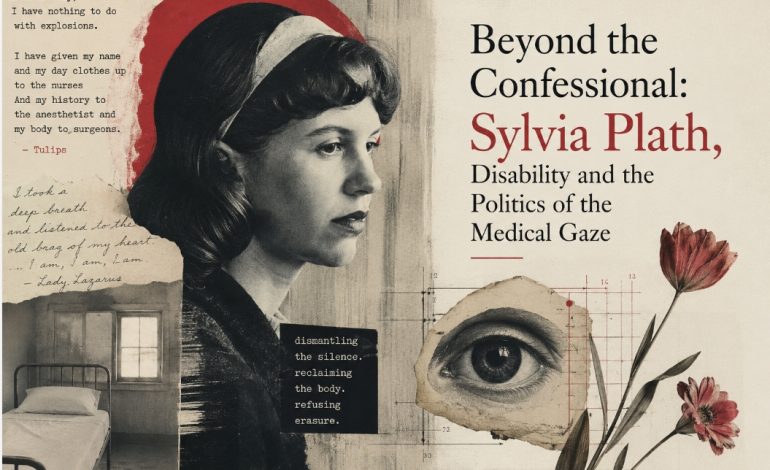

Sylvia Plath has long occupied an uneasy place within literary criticism. For decades, her poems have been read almost exclusively through the lens of biography—her depression, her turbulent marriage, and ultimately, her suicide. Such readings have undeniably shaped Plath’s literary legacy, often reducing her poetry to a series of autobiographical confessions. Yet this persistent critical impulse risks overlooking the remarkable theoretical sophistication embedded within her work. What if Tulips and Lady Lazarus are not merely poems of personal suffering but radical critiques of the cultural, medical, and political systems that regulate disabled bodies?
A disability-gender studies perspective offers precisely this possibility. Rather than approaching Plath as a tragic poet chronicling her own psychological collapse, it allows us to see her as a writer who dismantles essentialist assumptions about illness, femininity, and bodily identity. Her poetry interrogates not simply what it means to suffer, but how institutions construct suffering, how medicine disciplines the body, and how identity itself becomes vulnerable under the authority of clinical power.
When the Patient Becomes “Nobody”
Few opening lines in modern poetry are as unsettling as those that begin Tulips:
“I am nobody; I have nothing to do with explosions.”
The declaration immediately announces the disappearance of identity. The speaker has surrendered not only her clothes and possessions but her very history:
“I have given my name and my day clothes up to the nurses / And my history to the anesthetist and my body to surgeons.”
Here, hospitalization is not portrayed simply as a place of healing. Instead, it functions as a mechanism of depersonalization. The patient’s identity is gradually dismantled until she exists only as a body to be examined, treated, and controlled. Plath exposes the unsettling transformation whereby an individual becomes a clinical object.
This experience resonates profoundly with Michel Foucault’s notion of the medical gaze, where the patient’s subjective experience is subordinated to medical authority. The body becomes something to be interpreted, corrected, and normalized, while the patient’s voice recedes into silence. In Tulips, disability emerges not solely from physical illness but from institutional structures that erase agency. The hospital itself becomes a disabling environment.
Such a reading challenges traditional assumptions that disability resides exclusively within the body. Instead, Plath anticipates the central insight of contemporary disability studies: impairment may be biological, but disability is often produced socially through relationships of power.
The Violence of Essentialism
Essentialism assumes that identities possess fixed and universal meanings. Whether discussing gender or disability, essentialist thinking reduces individuals to stable categories that supposedly define who they are. Contemporary feminist theorists such as Judith Butler have repeatedly challenged this assumption, arguing that identities are fluid, socially produced, and continually negotiated.
Disability scholars extend this critique further. The experiences of disabled individuals are shaped not only by bodily difference but also by class, race, gender, geography, and countless other intersecting social forces. Disability is therefore never singular or static.
Plath’s poetry consistently resists these fixed definitions. Her speakers occupy unstable positions—simultaneously patient and observer, victim and survivor, object and subject. Rather than accepting the identities imposed upon them, they expose the instability of those very categories.
This anti-essentialist impulse gives Plath’s poetry a remarkable contemporary relevance. Decades before disability studies emerged as a formal academic discipline, her poems were already questioning whether medical institutions possess the authority to define the meaning of illness.
The Medical Body as an Object
One of the most striking images in Tulips compares the speaker’s body to an inanimate object:
“My body is a pebble to them…”
The metaphor is devastating in its simplicity. Pebbles possess no voice, no history, no individuality. They are merely objects over which water passes, smoothing every irregularity into uniformity. Likewise, the medical institution seeks to standardize the patient’s body, transforming difference into conformity.
Plath repeatedly returns to images of numbness, sleep, surgical intervention, and bodily passivity. These are not merely descriptions of treatment but representations of how medicine can erase subjectivity under the guise of care. The poem quietly asks an uncomfortable question: when does healing become a form of control?
Rather than rejecting medicine itself, Plath critiques medical paternalism—the assumption that professionals possess complete authority over patients’ bodies and experiences. In doing so, she reveals how healthcare can become entangled with systems of surveillance and power.
Lady Lazarus: Performing Survival
If Tulips explores institutional control, Lady Lazarus stages resistance.
The poem famously begins:
“I have done it again.”
The speaker presents survival as performance. Death and resurrection become cyclical spectacles repeatedly consumed by an audience. Plath deliberately invokes the Biblical Lazarus while simultaneously transforming resurrection into theatrical display.
This performance exposes another form of social violence: the ableist gaze. The speaker becomes both patient and spectacle, constantly observed, interpreted, and consumed by others. Her suffering is public, yet her interiority remains inaccessible.
The poem’s unsettling Holocaust imagery has generated extensive debate, but within disability studies it also foregrounds questions of bodily regulation, dehumanization, and institutional violence. Totalitarian imagery functions metaphorically to illustrate systems that reduce individuals to bodies requiring management, correction, or elimination.
In this sense, Lady Lazarus becomes more than a poem about suicide. It is a fierce refusal to allow institutional power—medical, social, or patriarchal—to determine the meaning of survival.
Escaping the Biographical Trap
The dominance of biographical criticism has often overshadowed these broader political dimensions of Plath’s work. Critics such as David Holbrook and A. Alvarez interpreted her poetry largely through the framework of mental illness, treating the poems as evidence of psychological pathology.
While Plath’s struggles with depression undoubtedly inform her writing, reducing every metaphor to autobiography limits the richness of her literary imagination. Her journals reveal profound emotional suffering, yet her poems transform private experience into complex explorations of power, embodiment, and identity.
Reading Plath exclusively as a confessional poet risks collapsing literature into diagnosis. Her poems deserve to be approached not simply as documents of illness but as intellectually rigorous interventions into debates about gender, disability, medicine, and authority.
A Pioneer of Disability Consciousness
Long before disability studies challenged the medical model, Plath’s poetry had already begun exposing its limitations. Her patient-speakers refuse to internalize social definitions of abnormality. Instead, they reveal how institutions manufacture disability through practices of surveillance, categorization, and control.
Unlike literary traditions that portray disabled characters merely as symbols of tragedy, redemption, or moral failure, Plath insists upon the complexity of lived embodiment. Disability is neither metaphor nor punishment; it is a deeply political condition shaped by relationships of power.
Her work therefore anticipates what contemporary scholars now identify as crip aesthetics—a literary practice that foregrounds vulnerability, embodiment, resistance, and the refusal of normative bodily expectations.
Reclaiming Sylvia Plath
Perhaps the greatest injustice done to Sylvia Plath has been the persistent temptation to read every poem as a suicide note. Such interpretations obscure the radical intellectual force of her writing.
Viewed through disability-gender studies, Tulips and Lady Lazarus emerge not as confessions of defeat but as profound critiques of the institutions that discipline bodies and silence identities. They expose the politics of care, challenge essentialist definitions of disability, and insist that illness can never be understood apart from gender, power, and social structures.
Plath’s poetry continues to resonate because it reminds us that healing is never merely biological. It is also cultural, political, and profoundly human. Her enduring achievement lies not only in giving language to suffering but in revealing the invisible systems that shape how suffering itself is understood.
References
Foucault, M., & Faubion, J. D. (2000). The essential works of Foucault, 1954–1984. Vol 3 Power. New York: Penguin.
Holbrook, David. Sylvia Plath: Poetry And Existence, (The Athlone Press, University of London: 1976). Pg 125.
Ibid. Pg 125-6
Ibid. Pg 1.
Ibid. Pg 125-7.
Lant, Kathleen Margaret, and Sylvia Plath. “The Big Strip Tease: Female Bodies and Male Power in the Poetry of Sylvia Plath.” Contemporary Literature, vol. 34, no. 4, 1993, pp. 620–69. JSTOR, https://doi.org/10.2307/1208804.
Moss, Stephen. “The Journals of Sylvia Plath”, The Guardian, April 4, 2000.
http://www.theguardian.com/books/2000/apr/04/sylviaplath
Plath, Sylvia. Ariel: The Restored Edion “Foreword” by Frieda Hughes. (Faber and Faber Ltd, London: 2007). Pg ix.
SCHWARTZ, MURRAY M., and CHRISTOPHER BOLLAS. “The Absence at the Center: Sylvia Plath and Suicide.” Criticism, vol. 18, no. 2, 1976, pp. 147–72. JSTOR, http://www.jstor.org/stable/23100084.