
Alice Walker’s Womanism: Beyond Feminism in The Color Purple


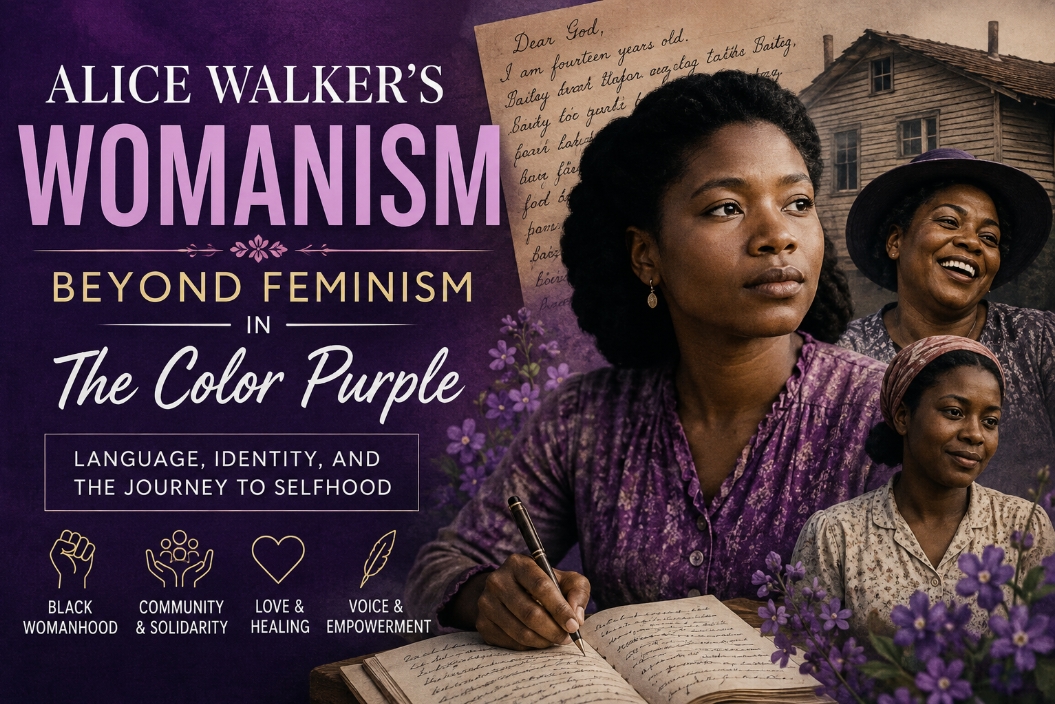
Few novels have reshaped feminist literary criticism as profoundly as Alice Walker’s The Color Purple. Since its publication in 1982, the novel has been celebrated for exposing racism, and patriarchal oppression and domestic violence. Yet reducing it to a “feminist novel” grossly ignores its most radical intervention. Walker does not merely advocate equality between men and women; she propounds an entirely different philosophical framework of womanism—that centers the experiences of Black women while embracing community, spirituality, healing, and cultural identity.
Unlike mainstream feminism, which historically evolved from the concerns of middle-class white women, womanism recognizes that race, gender, class, history, family, and culture cannot be separated. Walker argues that liberation is never individualistic in nature, rather it is communal, emotional, spiritual and expressed through language.
The most revolutionary side of ‘The Colour Purple’ is its linguistic structure. Rather than sticking to standardised literary English, Walker writes through Celie’s intimate letters, lived experiences and black Southern dialects. She makes language as an instrument of resistance against mainstream literary traditions that have historically marginalised Black women’s voices. It is important to note that language serves as principal medium through which sense of self is expressed by individuals. In this regard, ‘The Colour Purple’ shows that one’s voice is inseparable from one’s identity. The novel traces a Celie’s journey from silence and objectification to selfhood and liberation through her own language.
This article explores how Alice Walker transforms language into a political act, why womanism differs fundamentally from conventional feminism, and how The Color Purple continues to redefine conversations about gender, race, and identity in contemporary literary criticism.
Understanding Womanism: Alice Walker’s Alternative to Traditional Feminism
In the novel, Walker sincerely tries to redefine womanism. But what Warker means by the notion ‘womanism. The term ‘womanism’ first appeared in Walker’s collection In Search of Our Mothers’ Gardens (1983). She describes the term exclusively in the context of a black women who is not only committed to women’s survival but also the wholeness and survival of the entire communities. This distinction is significant as feminism often focuses on dismantling the patriarchal structures and attainment of gender equality. Womanism is a wider term as it acknowledges oppression of black women through understanding intersectionality of systems, racism, economic exploitation, historical marginalisation and cultural erasure.
Womanism asks broader questions:
- How does racism shape gender?
- How does language reinforce power?
- What happens when women’s experiences are excluded from cultural history?
- Can liberation occur without healing communities?
- Is equality enough if cultural identity is erased?
Walker tries to ascertain answers of these questions by focusing on storytelling.
Why The Color Purple Is More Than a Feminist Novel
Many literary discussions describe The Color Purple as a feminist novel because it exposes male violence and female oppression. While this description is accurate, it remains inadequate, as the novel does not portray all men as enemies. Importantly, the novel does not insinuate that liberation of women is exclusively contingent upon resisting male authority. Interestingly, Walker conceives a world wherein healing is only possible through relationship, community, self-discovery, spirituality and creativity.
In the novel, even male characters undergo transformation. Albert, initially presented as an abusive husband, progressively evolves into someone capable of friendship and self-reflection. This idiosyncratic narrative profoundly establishes distinction between Walker’s philosophy and conventional models of feminism.
Womanism goes beyond simple reversal of power dynamics, as it seeks restoration. Its foundation is grounded in healthier relationships, rather than dismantling of hierarchies. The novel offers hope without ignoring historical violence, helping to develop a unique perspective of womanism. That is why the Colour Purple continues to resonate across generations.
Language as the Foundation of Identity
Walker’s greatest contribution lies in recognising that language can become an important and elementary tool of oppression. Perhaps Walker tries to foreground that oppression begins with language. Individuals use language the most significant medium to construct and express identity. Internal thoughts acquire social existence only when they are articulated within essential linguistic framework. Consequently, controlling language also influences how individuals understand themselves.
Walker captures Celie’s suffering by providing her complete authority over her own story, as a result readers experience every event through her language. Nothing is translated, nothing is corrected and nothing is filtered by employing institutional standards. Walker’s approach is fundamentally transformative as readers inhabit her consciousness, instead of observing her from outside.
Her grammar becomes her identity.
Her vocabulary becomes her worldview.
Her voice becomes the novel’s moral center.
Challenging Literary Standards Through Black Vernacular
For centuries, perceived literary greatness has often been associated with standardized English. Deviation from standardised English standard were frequently judged as less intellectual or sophisticated work. Yet Walker methodically and deliberately rejects this foregrounded literary assumption.
Celie’s letters preserve the rhythms of Black Southern speech. Sentences remain short. Grammar appears unconventional. Vocabulary reflects everyday experience rather than academic precision. These stylistic decisions are intentional.
Walker refuses to “correct” Celie’s language because correction would imply that dominant linguistic standards are inherently superior. Instead, authenticity becomes a literary value. Readers gradually realize that emotional truth matters more than grammatical perfection. This radical shift democratizes literature. It insinuates that powerful storytelling does not require conformity to institutional norms. Rather, authenticity itself possesses literary authority.
Womanism Begins with Reclaiming Voice
Throughout the novel, Celie initially speaks very little outside her letters. Years of abuse have taught her that silence is safer than resistance. But her language reflects this psychological condition.
She rarely questions authority.
She rarely imagines alternatives.
She describes events rather than interpreting them.
This restrained voice mirrors her limited sense of agency. However, something remarkable unfolds as the narrative progresses. Her sentences become more reflective.
Her confidence gradually increases. She begins asking questions instead of accepting inherited beliefs. Eventually she challenges those who once controlled her life. Importantly, Walker never tries to dissociate linguistic transformation from emotional transformation.
Celie does not first become independent and then discover her voice. Finding her voice is the process through which independence becomes possible. Womanism therefore begins not with political slogans but with self-expression.
Liberation starts when individuals believe their experiences deserve language.
The Politics of Naming Experience
The most compelling observations in the novel concerns Celie’s understanding of pregnancy, menstruation, and womanhood. Rather than employing medical terminology or culturally accepted definitions, Celie describes these experiences according to her own consciousness. Words associated with reproduction acquire meanings shaped by trauma rather than biology, reflecting her lived reality, not abstract concepts.
This narrative strategy demonstrates Walker’s extraordinary sensitivity to language.
Vocabulary is never neutral.
Words carry histories.
Definitions often reflect those with social power.
By allowing Celie to redefine experience through personal language, Walker disrupts dominant cultural assumptions. Readers are invited to understand womanhood not through institutions but through lived experience. This approach exemplifies womanism.
Knowledge emerges from marginalized voices rather than established authority.
Beyond Patriarchal Language
Exposing phallologocentrism can be also considered as an important contribution of Walker through the novel, The Color Purple. The phallologocentrism is used to describe and expound systems of language, thought, and knowledge that place male experience and authority at the center while treating women’s experiences as secondary, marginal, or less authoritative. On the contrary, Walker responds not by writing theoretical criticism but by constructing a completely different narrative model that centers Black women’s voices.
Instead of allowing patriarchal language to define reality, Walker replaces it.
Authority shifts.
Women become narrators.
Personal testimony becomes historical evidence.
Emotion becomes intellectual insight.
Community becomes knowledge.
This literary revolution extends far beyond The Color Purple.
It influences contemporary discussions about representation, identity politics, intersectionality, and inclusive storytelling.
Chandra, S. 2026
References
- Abrams, M. H. (Meyer Howard), 1912-2015. A Glossary of Literary Terms. Boston, MA :Thomson, Wadsworth, 2005.
- Bhattacharjee, R. 2020 “The Politics of Translation; disability, language and the in-between”. Disability in Translation; the Indian Experience. London and New York; Routledge. Pp 198-199
- Walker, Alice. Color Purple. 2007 .W&N Publishing
- Rickert, Thomas. “Toward the Chōra: Kristeva, Derrida, and Ulmer on Emplaced Invention.” Philosophy & Rhetoric, vol. 40, no. 3, 2007, pp. 251–73. JSTOR, http://www.jstor.org/stable/25655276.
- Tavormina, M. Teresa. “Dressing the Spirit: Clothworking and Language in ‘The Color Purple.’” The Journal of Narrative Technique, vol. 16, no. 3, 1986, pp. 220–30. JSTOR, http://www.jstor.org/stable/30225154.
- Tucker, Lindsey. “Alice Walker’s The Color Purple: Emergent Woman, Emergent Text.” Black American Literature Forum, vol. 22, no. 1, 1988, pp. 81–95. JSTOR, https://doi.org/10.2307/2904151.