
Camus’ Greatest Misunderstanding? Why The Myth of Sisyphus Rejects Suicide Without Offering Comfort

“There is but one truly serious philosophical problem, and that is suicide.” Few opening lines in philosophy are as startling as this one. With these words, Albert Camus refuses to begin with God, morality, or politics. Instead, he begins with a question that cuts straight to existence itself: If life has no inherent meaning, why continue living? Why The Myth of Sisyphus Rejects Suicide Without Offering Comfort?
For many first-time readers, Camus appears to flirt with the idea that suicide may be the logical response to an indifferent universe. Yet The Myth of Sisyphus ultimately argues the exact opposite. Suicide, for Camus, is not the solution to absurdity—it is its surrender.
When the Universe Refuses to Answer
Camus believed that human beings are wired to seek meaning. We search for purpose in careers, relationships, achievements, and even suffering itself. Almost every aspect of life seems to operate through some form of significance or exchange. Yet when we ask the biggest question—Why do I exist?—the universe offers no reply.
This collision between humanity’s hunger for meaning and the universe’s silence is what Camus famously calls the Absurd.
The Absurd is not simply a meaningless world. Nor is it merely human despair. It exists in the relationship between the two: the endless demand for answers confronting a reality that refuses to provide them.
The tragedy begins not with meaninglessness itself, but with the moment we become conscious of it.
The Temptation of Easy Answers
Once confronted with the Absurd, people often reach for certainty. Religion, ideology, or grand philosophical systems promise an objective purpose beyond human existence. Camus is deeply skeptical of these responses.
He argues that any doctrine claiming to solve the mystery by appealing to transcendence commits what he provocatively labels “philosophical suicide.” Rather than confronting the Absurd, such systems leap over it. They replace uncertainty with comforting illusion.
For Camus, this leap is not courage. It is an escape.
Is Suicide the Logical Conclusion?
Having rejected religious consolation, Camus turns to the darker possibility. If existence possesses no objective meaning, why not simply end it?
This is why he calls suicide the only truly serious philosophical problem. Unlike abstract debates, suicide forces philosophy to answer whether life itself deserves continuation.
Initially, suicide appears almost rational. If life lacks ultimate purpose, ending it may seem like the final act of freedom—a rebellion against an indifferent universe.
But Camus quietly dismantles this reasoning.
Why Suicide Cannot Defeat the Absurd
The brilliance of The Myth of Sisyphus lies in an uncomfortable realization: suicide changes nothing about the Absurd.
Whether one continues living or chooses death, the universe remains silent. The conflict between human longing and cosmic indifference is never resolved because it cannot be resolved.
Suicide does not conquer the Absurd.
It merely removes the person who experiences it.
In Camus’ view, the Absurd survives even in the final moments of consciousness. Death offers no philosophical victory, no hidden revelation, and no reconciliation. It is simply an exit that abandons the struggle rather than overcoming it.
This is why suicide becomes, paradoxically, another form of surrender.
Sisyphus: The Hero Nobody Expected
Camus’ answer arrives through one of Greek mythology’s most tragic figures.
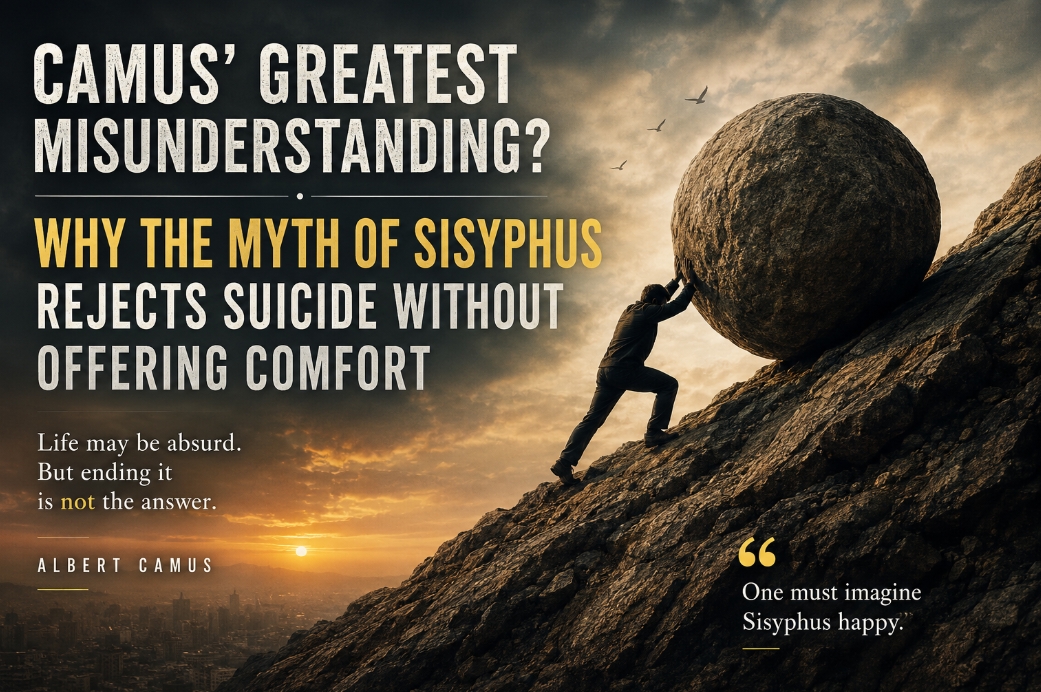
Sisyphus is condemned to push a massive boulder up a mountain for eternity, only to watch it roll back down every single time. His labor has no reward, no completion, and no escape.
At first glance, Sisyphus appears to embody despair.
Yet Camus sees something extraordinary.
The moment Sisyphus walks back down the mountain, fully aware that the task will repeat forever, he possesses something the gods cannot take away: consciousness.
He knows his fate.
He refuses illusion.
He continues anyway.
That choice transforms punishment into rebellion.
His victory does not lie in escaping the Absurd but in refusing to let it dictate the value of his existence.
Living Without Illusions
Camus never promises happiness in the conventional sense.
He offers something arguably more demanding: the courage to live without guarantees.
His philosophy asks us to abandon fantasies of ultimate meaning while refusing the temptation to escape through death or false certainty. The challenge is not to solve the Absurd but to inhabit it consciously.
To live becomes an act of resistance.
To continue becomes an act of freedom.
Camus’ Real Solution
Many readers mistakenly believe The Myth of Sisyphus is a book about suicide.
It is not.
It is a book about refusing every shortcut that avoids confronting reality. Suicide, like blind faith, attempts to escape the human condition. Camus rejects both because each abandons the very tension that defines existence.
His answer is neither hope nor despair.
It is revolt.
To acknowledge that life lacks predetermined meaning—and yet to live passionately, lucidly, and defiantly—is, for Camus, humanity’s greatest triumph.
Perhaps this is why the book ends with one of philosophy’s most unforgettable lines:
“One must imagine Sisyphus happy.”
Not because his burden disappears. But because he has stopped expecting the universe to carry burden for him. There is no assurance, as it appear in Camus argument sketched in The Myth of Sisyphus that suicide is a reasonable resolution in the innate tussle of the human being with the indifference of the universe.
Chandra, S. 2026
References
Camus, Albert. The Myth of Sisyphus. Translated by Justin O’Brien, Penguin Classics, 2000.
Caraway, James E. “Albert Camus and the Ethics of Rebellion.” Mediterranean Studies, vol. 3, 1992, pp. 125–36. JSTOR, http://www.jstor.org/stable/41166823. Accessed 2 Aug. 2022.
Hochberg, Herbert. “Albert Camus and the Ethic of Absurdity.” Ethics, vol. 75, no. 2, 1965, pp. 87–102. JSTOR, http://www.jstor.org/stable/2379406. Accessed 1 Aug. 2022.