

Beyond Religion: Kierkegaard’s Leap of Faith and the Courage to Live the Paradox
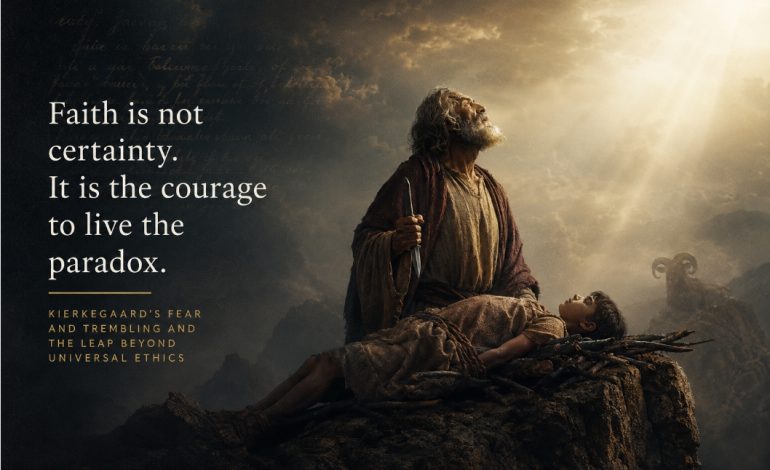

What makes Abraham a hero? What is Kierkegaard’s Leap of Faith ?
It is a deceptively simple question. If we judge him by ordinary ethical standards, the answer should be obvious: he is not. A father willing to sacrifice his son violates every moral principle that structures human society. Yet for centuries Abraham has been revered as the “Father of Faith.” How can someone who appears to transgress the highest ethical law also become the highest model of religious life?
This paradox lies at the heart of Søren Kierkegaard’s Fear and Trembling. More than a meditation on a biblical story, the text becomes an inquiry into whether faith can exist beyond the boundaries of religion as institutional doctrine or moral code. Although deeply rooted in Christianity, Kierkegaard’s exploration of Abraham offers a radically modern understanding of faith—one that is less about belonging to a religion and more about confronting the uncertainty of existence.
Kierkegaard begins with a challenge to the philosophical tradition inherited from Hegel. For Hegel, the individual realizes themselves through the universal—the shared ethical order that binds society together. Ethics represents humanity’s highest purpose, or telos. Any departure from it is understood as temptation or moral failure.
Abraham refuses to fit into this framework.
When God commands him to sacrifice Isaac, Abraham neither argues nor seeks justification. His action cannot be defended by ethics, reason, or public explanation. To everyone else, he appears either insane or murderous. Yet Scripture celebrates him not as a criminal but as the greatest believer.
Rather than dismissing this contradiction, Kierkegaard asks us to inhabit it.
His answer is startling: perhaps ethics is not humanity’s highest end after all. Faith, not universal morality, is our ultimate telos. In Abraham’s case, the ethical is not destroyed but suspended. Kierkegaard famously calls this the “teleological suspension of the ethical”—a moment in which an individual’s absolute relation to God temporarily exceeds their obligation to universal moral law.
This does not make Abraham a moral exception in the ordinary sense. Nor does it authorize anyone to violate ethical norms in God’s name. The paradox remains precisely because it cannot be generalized into a rule. If it could, it would simply become another ethical principle.
This is why Kierkegaard introduces the figure of the “Knight of Faith.” Unlike the tragic hero, whose sacrifices are publicly intelligible, the Knight of Faith walks alone. Their actions cannot be translated into universal language because they emerge from an inward relationship that no one else can verify. Faith, therefore, becomes radically personal. It is not certainty but risk; not knowledge but trust.
In this sense, Fear and Trembling begins to imagine faith beyond religion. Religion often seeks stability through doctrines, institutions, and shared moral systems. Kierkegaard does not reject these entirely, but he insists that genuine faith can never be reduced to them. The decisive encounter with God occurs within the individual, in a space where certainty disappears and explanation fails. Faith is not inherited through tradition; it is lived through existential commitment.
Here Kierkegaard’s thought resonates strikingly with Blaise Pascal. Pascal similarly argues that reason alone cannot lead one to God. Human beings endlessly search for rational certainty, yet faith begins precisely where reason reaches its limits. His famous observation that “the heart has its reasons which reason knows nothing of” captures a truth remarkably close to Kierkegaard’s leap of faith.
For both thinkers, universal reason is insufficient because it seeks objective proof where only subjective commitment is possible. Pascal’s wager is often misunderstood as a logical argument for belief, but beneath it lies a deeper insight: faith requires a decision that reason can never fully justify. One must wager one’s life before certainty arrives—if it ever does.
Kierkegaard radicalizes this insight.
For him, faith is not merely believing despite insufficient evidence; it is embracing the paradox itself. Abraham cannot know that God will spare Isaac. His faith consists in trusting the impossible without dissolving the uncertainty. The leap is therefore existential rather than intellectual. It transforms the individual from within.
Seen in this light, Fear and Trembling offers a conception of faith that speaks far beyond Christianity. Faith becomes the courage to remain committed when universal systems—whether religious, philosophical, or scientific—cannot provide complete answers. It is less about accepting doctrines than about inhabiting uncertainty without surrendering to despair.
This is perhaps why Kierkegaard continues to resonate in a secular age. Many people today find themselves estranged from organized religion while still searching for meaning, commitment, and transcendence. Kierkegaard suggests that faith survives precisely in this space of uncertainty. It is not the opposite of doubt but its companion.
The individual who chooses faith does not escape paradox; they learn to live within it.
Abraham therefore becomes more than a biblical patriarch. He embodies the unsettling possibility that the deepest truths of human existence cannot always be translated into universal concepts or ethical formulas. His story reminds us that there are moments when life demands not greater certainty but greater courage.
Perhaps this is Kierkegaard’s most enduring contribution to thinking about faith beyond religion. Faith is no longer confined to institutional belief or moral conformity. Instead, it becomes an existential practice of trusting what cannot be fully explained, remaining faithful in the absence of guarantees, and embracing the paradoxes that define human life.
In a world increasingly organized around rational systems and measurable outcomes, Fear and Trembling remains a powerful reminder that not everything essential can be justified before it is lived.




1 Comment
[…] का लक्ष्य (telos) सार्वभौमिक नैतिकता (universal ethics) में होता है। हम सब उसी नैतिकता में खुद […]