

Who Gets to Speak? Rethinking Swaraj Through the Eyes of the Subaltern
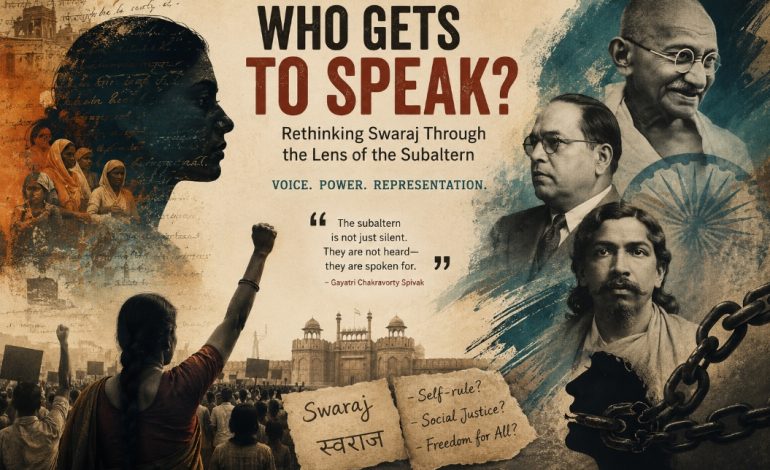

History is often narrated by those who possess the power to record it. The voices of emperors, politicians, intellectuals, and revolutionaries echo across textbooks, while countless ordinary lives remain buried beneath the weight of official narratives. This uncomfortable reality lies at the heart of Subaltern Studies, a field that asks a deceptively simple question: What happens to history when we begin listening to those who were never allowed to tell their own stories?
The term subaltern does not merely refer to the poor or the oppressed. As literary theorist Gayatri Chakravorty Spivak famously argued, the subaltern occupies a position where their voice is systematically excluded from dominant structures of knowledge and power. It is not simply that they are unheard—they are often spoken for. Their experiences are translated, interpreted, and reshaped by intellectuals, colonial administrators, and even nationalist leaders until the original voice becomes almost impossible to recover.
This unsettling insight fundamentally changes how we think about India’s struggle for independence. The freedom movement is usually remembered through towering figures such as Mahatma Gandhi, B.R. Ambedkar, and Sri Aurobindo. Their ideas shaped modern India, but an important question remains: Did their visions of Swaraj truly create space for those who stood at the margins of society?
Beyond Political Freedom
For many Indians, Swaraj simply means self-rule—the end of British colonial domination. Yet the concept has never been so straightforward.
Gandhi envisioned Swaraj as far more than political independence. In Hind Swaraj, he imagined a society built upon moral responsibility, decentralized governance, village autonomy, and the empowerment of minorities. His famous insistence that majorities are not always right reflected an awareness that democracy must protect dissent rather than merely celebrate numbers.
This vision was remarkably progressive for its time. Gandhi recognized that meaningful freedom could not exist without ethical transformation. Political liberation, in his eyes, had to be accompanied by social and economic justice.
Yet from Spivak’s perspective, an uncomfortable tension remains.
While Gandhi consistently invoked the importance of the “minor,” the structural conditions that silenced marginalized communities often remained intact. The subaltern appeared within the nationalist imagination, but rarely emerged as an independent political voice capable of defining its own future.
Ambedkar’s Radical Intervention
If Gandhi imagined Swaraj through moral reform, B.R. Ambedkar grounded it in social reality.
For Ambedkar, equality could never be achieved merely through appeals to conscience. Centuries of caste discrimination demanded institutional safeguards, constitutional protections, and political representation. The Scheduled Castes were not simply another minority; they occupied a uniquely disadvantaged position requiring protections beyond ordinary citizenship.
Ambedkar’s intervention shifts the conversation dramatically.
Instead of asking whether the nation should include marginalized communities, he asks whether the nation has been designed in a way that allows them to participate as equals. Freedom, therefore, cannot be measured only by the departure of colonial rulers. It must also be measured by whether historically oppressed communities gain genuine agency.
In many ways, Ambedkar comes closest to addressing the concerns that later scholars of Subaltern Studies would articulate. His politics begins not with abstract ideals but with the lived experiences of exclusion.
Sri Aurobindo and the Spiritual Journey of Swaraj
Sri Aurobindo offers yet another fascinating interpretation.
Unlike Gandhi or Ambedkar, Aurobindo viewed Swaraj primarily as a spiritual awakening. Political independence was important, but it represented only the first step toward a deeper realization of individual and collective consciousness.
His writings describe Swaraj as freedom of the mind, body, and spirit—a journey toward harmony with the divine. This philosophical vision transformed nationalism into a profoundly spiritual project.
However, this inward-looking approach raises difficult questions.
While Aurobindo explored the metaphysical dimensions of freedom with extraordinary depth, his framework devoted comparatively less attention to the material realities of caste, exclusion, and social inequality. The spiritual quest often overshadowed the everyday struggles of those whose voices remained unheard within both colonial and nationalist discourses.
Can the Subaltern Truly Speak?
Spivak’s famous essay, Can the Subaltern Speak?, continues to challenge scholars because it refuses easy answers.
Her argument is not that marginalized people literally cannot speak. Rather, she suggests that existing structures of power are so deeply embedded that whenever the subaltern attempts to speak, their voice is filtered through institutions, intellectuals, political movements, or dominant cultural narratives. What eventually reaches history is often not the authentic voice of the marginalized but an interpretation shaped by those who possess greater authority.
This insight transforms how we evaluate nationalist thought.
Gandhi sought moral transformation.
Ambedkar demanded structural justice.
Aurobindo envisioned spiritual liberation.
Each offered a powerful understanding of Swaraj. Yet each, in different ways, reveals the difficulty of allowing the most marginalized sections of society to become the authors of their own political narratives.
Why This Debate Still Matters
More than seventy-five years after independence, the question remains surprisingly relevant.
Who gets represented in public discourse? Whose stories dominate the media? Which communities continue to struggle for visibility despite constitutional guarantees and democratic institutions?
The conversation initiated by Subaltern Studies reminds us that freedom is never a finished achievement. Political independence may dismantle one form of domination while leaving others untouched. True Swaraj demands more than national sovereignty—it requires creating conditions where every citizen, regardless of caste, class, gender, or social location, possesses the ability to speak, participate, and shape history on equal terms.
Perhaps that is the enduring legacy of Spivak’s challenge. Instead of asking whether the subaltern has finally spoken, we should ask a more uncomfortable question: Have we built a society capable of genuinely listening?
Chandra, S. 2026
References
Gandhi, Mahatma, 1869-1948. Hind Swaraj and Other Writings. Cambridge; New York: Cambridge University Press, 1997.
Maggio, J. “‘ Can the Subaltern Be Heard?’: Political Theory, Translation, Representation, and Gayatri Chakravorty Spivak.” Alternatives: Global, Local, Political, vol. 32, no. 4, 2007, pp. 419–43. JSTOR, http://www.jstor.org/stable/40645229. Accessed 12 Apr. 2024.
Spivak, G.C. “Can the Subaltern Speak?” in Colonial Discourse and Post-Colonial Theory, eds. P. Williams and L. Chrisman, New York: Columbia University Press, 1992), pp. 66-111


2 Comments
[…] Gayatri Chakravorty Spivak ने अपने चर्चित निबंध Can the Subaltern Speak? में एक महत्वपूर्ण प्रश्न […]
[…] Gayatri Chakravorty Spivak ने अपने चर्चित निबंध Can the Subaltern Speak? में एक महत्वपूर्ण प्रश्न […]