
Ambedkar on Caste: Understanding the “Division of Labourers”

Introduction: When Work Becomes a Social Destiny
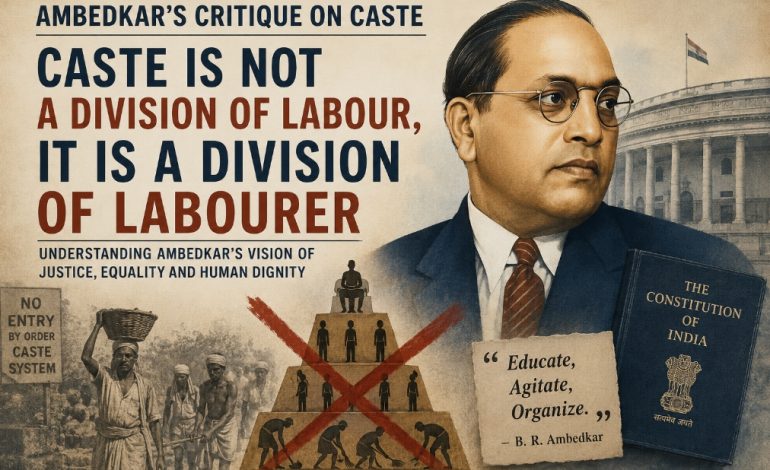
The organisation of labour is essential to any complex society. Different people perform different tasks, acquire different skills, and contribute to different aspects of collective life. Yet B.R. Ambedkar’s critique of caste asks us to distinguish between dividing work and dividing the people who perform it. This distinction lies at the heart of his powerful formulation: “caste is not a division of labour, it is a division of labourers.” In Annihilation of Caste, Ambedkar challenges the idea that caste can be understood simply as a system for allocating occupations. For him, caste is fundamentally a social structure that ranks human beings, restricts their opportunities, and fixes their social position according to birth.
The significance of this argument extends beyond occupational organisation. Caste, in Ambedkar’s analysis, influences communication, social relations, education, economic opportunity, political participation, and individual freedom. It transforms occupational difference into social hierarchy.
The question, therefore, is not merely who does what work, but who is permitted to choose that work, who is prevented from changing it, and what social value is assigned to the person who performs it.
Ambedkar’s Critique of the Division of Labour
Ambedkar did not reject the division of labour itself. On the contrary, he recognised it as a necessary feature of an organised and civilised society. The problem begins when a functional division of work becomes a hereditary division of human beings.
A genuine division of labour can emerge from differences in ability, training, interest, experience, and social requirements. Caste, however, assigns occupations in advance. The individual’s possibilities are constrained by the social position of the family into which they are born.
This is why Ambedkar’s argument is fundamentally about human agency.
In a flexible social order, individuals can develop their capacities and pursue careers according to their abilities and aspirations. In the caste system described by Ambedkar, occupation becomes closely associated with inherited status. The profession of one’s parents can effectively become the profession of the child.
Such a system becomes particularly problematic because economic life is not static. Industries change, technologies develop, and social needs evolve. A society that prevents individuals from changing occupations consequently restricts not only personal freedom but also its own economic and social adaptability.
Ambedkar’s critique thus shifts the discussion from the organisation of work to the organisation of opportunity.
From Division of Work to Division of Human Beings
The phrase “division of labourers” captures something deeper than occupational specialisation. It describes a hierarchy in which one group of workers is socially valued above another.
Under caste, occupational categories are not simply different; they are ranked. Social status becomes attached to inherited occupation, and the resulting hierarchy shapes how communities interact with one another.
Ambedkar therefore sees caste as producing what might be called socially enclosed communities. Each caste develops boundaries around itself, limiting communication and social interaction with others. The result is not merely occupational differentiation but social separation.
This distinction is crucial for understanding Ambedkar’s broader political thought. If the problem were simply that society had different occupations, reform could focus on redistributing jobs. But if the problem is the hierarchical classification of people themselves, reform must address the social structure that determines dignity, status, mobility, and rights.
Education, Democracy and Social Mobility
Ambedkar’s understanding of caste is also connected to his engagement with the democratic thought of John Dewey. The supplied scholarship highlights the importance of Dewey’s idea of social endosmosis, through which education and experience become part of a broader social process.
This connection helps explain why education occupies such an important place in Ambedkar’s vision of social transformation.
Education can weaken rigid social boundaries by expanding communication, developing individual capacities, and enabling people to imagine lives beyond inherited social positions. In this sense, education is not merely a means of acquiring qualifications. It becomes an instrument for challenging structures that define a person’s possibilities before that person has had an opportunity to define themselves.
Ambedkar’s democratic vision consequently places considerable emphasis on the relationship between individuals and their social environment. Individuals are shaped by society, but they can also transform that society through education, communication, and collective action.
The struggle against caste is therefore also a struggle for social mobility and individual self-determination.
Caste, Class and Economic Life
Ambedkar’s analysis also invites a comparison between caste and class. The source text distinguishes class as particularly associated with capitalist society and the caste system as a social formation characteristic of pre-capitalist India.
The comparison is important because it highlights the distinctive character of caste-based inequality. Economic exploitation alone does not fully explain caste. Caste combines economic relationships with inherited social status, communal boundaries, occupation, exclusion, and stigma.
In this framework, a worker is not valued solely according to the economic contribution of their labour. Their social position is already partly determined by birth.
This makes caste especially restrictive. A person may possess the ability to pursue a particular occupation, yet caste can intervene before individual choice becomes meaningful. The question of what one can become is therefore inseparable from the question of where one is socially located at birth.
Ambedkar’s criticism consequently presents caste as an unnatural division of labourers—one that creates rigid social compartments rather than a flexible and productive division of work.
Varna, Shudras and the Logic of Hereditary Subordination
The connection between caste, occupation, and inherited status becomes particularly visible in Ambedkar’s discussion of the varna system.
The source text draws attention to restrictions historically associated with Shudras, including limitations on access to knowledge, economic activity, and the bearing of arms. Such restrictions illustrate Ambedkar’s larger concern: a social system can reproduce inequality across generations by making subordination appear inherited and permanent.
For Ambedkar, the consequences are not confined to material deprivation. The caste-based organisation of labour can affect personality, intellectual development, dignity, and access to civil rights.
This is an important dimension of his argument. Caste does not merely determine the work a person performs; it can shape the kind of social person that individual is allowed to become.
The problem is therefore simultaneously economic, social, psychological, and political. A system that assigns occupation through birth restricts the development of human capabilities while legitimising unequal social relations.
Caste and the Question of Freedom
Ambedkar’s critique becomes even sharper when caste is considered alongside slavery.
The source text emphasises his analogy between the condition of historically subordinated castes and slavery. The comparison is significant because slavery is not simply the extraction of labour. It involves the denial of autonomy—the reduction of one person’s capacity to determine their own purposes and actions.
From this perspective, caste can function as a form of deeply embedded social domination. Its power lies partly in its ability to reproduce hierarchy over generations and to make that hierarchy appear normal.
Ambedkar’s concern is therefore not limited to whether people have access to economic resources. He asks whether subordinated communities possess the consciousness, rights, and social conditions necessary to challenge their subordination.
The struggle against caste thus becomes a struggle for human dignity and democratic agency.
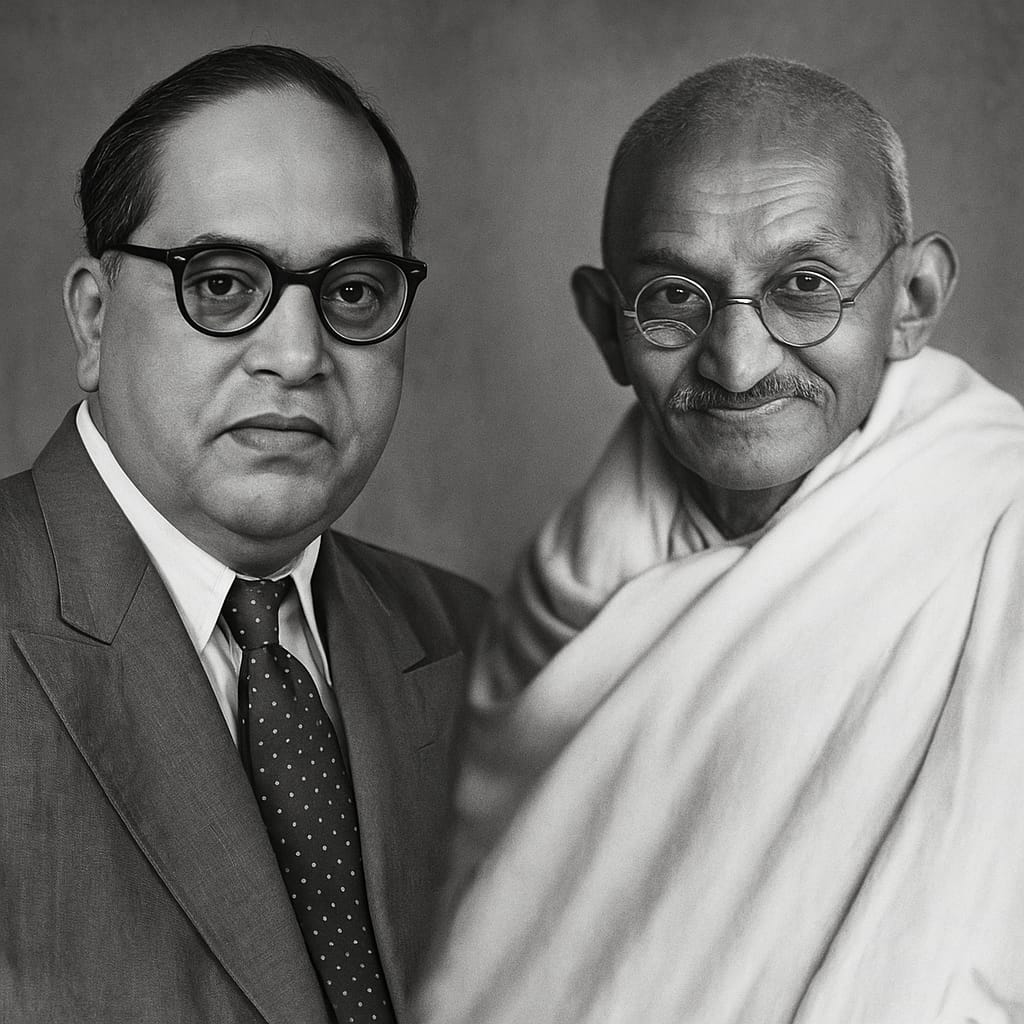
Ambedkar and Gandhi: Two Visions of Social Reform
The debate between Ambedkar and Mahatma Gandhi provides another important dimension to the question of caste reform.
Both recognised untouchability as a profound social problem, but they differed significantly in their understanding of how Indian society should respond to caste and varna.
For Ambedkar, political independence could not be separated from social emancipation. A society seeking freedom from colonial rule had to confront the unfreedom experienced by its own oppressed communities. Political reform, in his view, required a foundation of social reform.
The disagreement became especially consequential around political representation. The 1932 controversy over separate electorates for the “untouchables” revealed competing understandings of political identity, representation, and the relationship between oppressed communities and the broader Hindu social order.
Yet the deepest disagreement concerned the meaning and future of varna.
Varna as Reform or Obstacle?
Gandhi and Ambedkar approached varna from markedly different intellectual positions.
The source text presents Gandhi as attempting to reinterpret varna as a system of harmonious and interdependent social units, while separating it conceptually from caste and untouchability. Ambedkar, by contrast, regarded varna as inseparable from the historical structures of hierarchy that had sustained caste oppression.
This difference is more than a disagreement over terminology.
For Gandhi, reform could be imagined through a reconstruction of the social order. For Ambedkar, the inherited vocabulary of varna itself risked preserving the structures that reform was supposed to overcome.
The disagreement becomes particularly visible in their contrasting attitudes toward inter-caste relations. The source text notes that Ambedkar placed considerable importance on inter-dining and inter-caste marriage as means of weakening caste boundaries, whereas Gandhi did not regard these practices as essential to cultivating democratic social relations.
The distinction reveals two fundamentally different approaches to social transformation:
- Reconstruction: reform the existing social framework so that it can embody greater harmony and equality.
- Annihilation: dismantle the inherited structures that make hierarchy possible in the first place.
Ambedkar’s position belongs decisively to the second approach.
Why “Division of Labourers” Still Matters
Ambedkar’s formulation remains analytically powerful because it prevents caste from being reduced to an economic question.
If caste were merely a system for distributing occupations, its injustices could perhaps be addressed through occupational redistribution. But Ambedkar argues that the deeper problem is the classification of human beings into hierarchical communities.
That classification affects:
Occupation — because work can be inherited rather than freely chosen.
Mobility — because individuals can be prevented from changing their social and occupational position.
Education — because access to knowledge has historically been shaped by social hierarchy.
Dignity — because occupations become associated with unequal social worth.
Rights — because caste hierarchy can restrict participation in social and political life.
Social relations — because caste creates boundaries between communities and regulates interaction.
The phrase “division of labourers” therefore functions as more than a rhetorical contrast. It is a theory of how a social system can convert occupational differentiation into inherited inequality.
Conclusion: The Human Cost of Hereditary Occupation
Ambedkar’s critique of caste ultimately returns us to a deceptively simple question: Should a person’s birth determine the possibilities of their life?
His answer is unequivocally negative.
A division of labour can contribute to social organisation and economic functioning. A division of labourers, however, assigns unequal social value to human beings and restricts their capacity to choose, change, and develop. It turns occupation into inheritance and social hierarchy into destiny.
The Ambedkar–Gandhi debate demonstrates that the question of caste reform cannot be separated from a deeper disagreement about the nature of social transformation. Gandhi’s approach, as represented in the source text, sought to reconstruct varna within a reformed social order. Ambedkar’s approach treated caste hierarchy itself as the problem that had to be dismantled.
This is what gives Ambedkar’s argument its enduring intellectual force. He moves the discussion from the organisation of work to the freedom of the worker; from occupational categories to human dignity; and from social order to social justice.
To understand the phrase “caste is not a division of labour, it is a division of labourers” is therefore to understand one of Ambedkar’s central insights: a society cannot claim to be genuinely democratic merely because its institutions distribute work efficiently. Democracy also requires that human beings remain free to develop their capacities, choose their occupations, cross inherited boundaries, and claim equal social dignity.
Chandra, S. 2026
References
Choure, Tapan. “Dr. BR Ambedkar’s Thoughts on Labour-Some Reflections.” Arthavati an International Journal: 73.
Kumar, Awanish. “BR Ambedkar on caste and land relations in India.” Review of Agrarian Studies 10, no. 2369-2020-1859 (2020).
Mathur, Meghna, and Thakur, Pallavi. “Resonance of ambedkar’s vision of social democracy in bama’s karukku: empowerment of dalits through education.” Contemporary Voice of Dalit (2022).
Mukherjee, Arun P. “BR Ambedkar, John Dewey, and the meaning of democracy.” New Literary History 40, no. 2 (2009).
Singh, Aakash. “Gandhi and Ambedkar: Irreconcilable Differences?.” International Journal of Hindu Studies 18, no. 3 (2014).
Sukumar, N. “Ambedkar: Democracy and Economic Theory.” M. p. Singh, & H. Roy, Indian Political Thoughts (2011): 211-239.
Chaudhary, Piyush B. “Ambedkar and Annihilation of Caste–Performing Theory, Praxis, Counter Identity.” Ramanujan International Journal of Applied Ethics 8 (2022).
Stroud, Scott R. “Echoes of pragmatism in India: Bhimrao Ambedkar and reconstructive rhetoric.” Recovering Overlooked Pragmatists in Communication: Extending the Living Conversation about Pragmatism and Rhetoric (2019).
Ambedkar, B. R. (Bhimrao Ramji), 1891-1956. Annihilation of Caste: an Undelivered Speech. New Delhi:Arnold Publishers, 1990.
Barua, A. (2019). Revisiting the Gandhi–Ambedkar Debates over ‘Caste’: The Multiple Resonances of Varņa. Journal of Human Values, 25(1), 25-40. https://doi.org/10.1177/0971685818805328.
Purkayastha, A. S., & Alam, M. (2016). Book Review: Arundhati Roy (Ed.), Annihilation of Caste: The Annotated Critical Edition, B.R. Ambedkar with an Introduction, ‘The Doctor and the Saint’. South Asia Research, 36(3), 413-416. https://doi.org/10.1177/0262728016663783