
Why Babban Khan’s Adrak Ke Punjey became a cult classic?
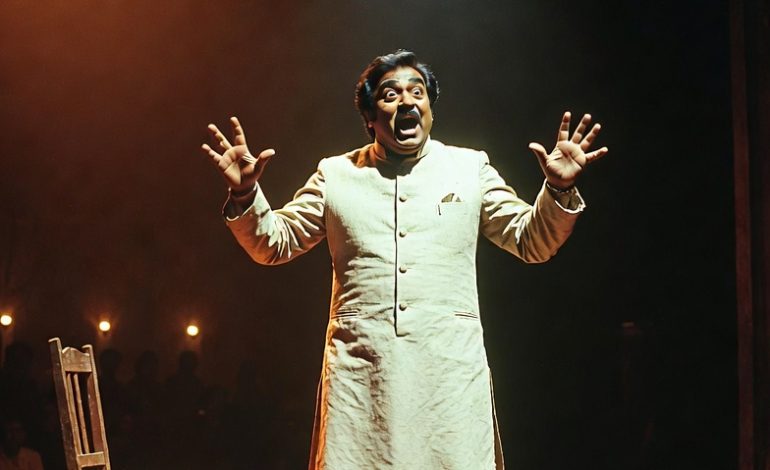

Babban Khan’s Adrak Ke Punjey became a cult classic because it connected deeply with ordinary people while being incredibly simple, local, timeless, relatable Hyderabadi humor, sharp social commentary, and universal appeal as a one-man satirical comedy
About the show
- A one-man show written, directed, produced, and performed entirely by Babban Khan (playing the central character, a harried middle-class bank clerk named Ramsu/Rumsu).
- Premiered on 22 September 1965 in Hyderabad (first staged under tough conditions—he wrote it under a streetlight and pawned his mother’s gold chain to fund the hall).
- Ran for over 35 years until February 2001, with 10,180 performances.
- Entered the Guinness Book of World Records in 1984 (after ~5,169 shows) as one of the world’s longest-running one-man shows. It outlasted classics like Agatha Christie’s The Mousetrap.
Origin Story
This comedy born out of tragedy. This satirical play is in fact mirror of what the writer’s parents faced because of their large family. His father, Ghouse Khan, a lowly paid clerk. Due to financial hardship, he lost his three sons and four daughters one after other to malnutrition and lack of medical care. The only surviving child was not given a name till the age of 1O as his parents feared, he would meet similar fate. Interestingly, Babban Khan wrote Adrak Ke Punjey in just a few hours under a streetlight on 15 August 1965. To stage it, he sold his mother’s gold pendant (a “laccha”) for just ₹275, using the money to rent a hall, pay for printing, and buy food—and even owed the tailor for his sherwani. The first show was a flop financially, but a generous benefactor backstage lent him ₹500 for a second attempt, which became a breakthrough success.
Plot and Title
The title “Adrak Ke Panje” (Ginger Roots/Claws/Offshoots) is a metaphor for an unplanned, sprawling family—ginger grows in irregular, multiplying directions, just like Ramsu’s chaotic household with a sharp-tongued wife (locally BeePasha or, Bipasha) and many kids.
The story follows Ramsu’s everyday struggles: debts, a demanding landlord (Nawab Saheb), creditors, domestic friction, and the burdens of a large family. It mixes slapstick, witty one-liners in Hyderabadi Dakhani Urdu (a flavorful local dialect), and relatable middle-class woes. It ends with a strong pro-family-planning message: “Chota parivar, sukhi parivar” (Small family, happy family).
Legacy & Achievements
- Over its 35-year run, Adrak Ke Punjey was performed in 10,180 shows, watched by over 30 million people, across more than 60 countries, translated into 27 languages, and staged in 25 U.S. cities and dozens across India. The play’s success intertwined simplicity with timeless humor: only basic set pieces, no lighting effects or music, and the same costume and props (including a tattered sherwani, an umbrella, and tiffin carrier) were used throughout the entire run.
- Distinguished global recognition followed, with acknowledgments from prestigious bodies such as the Royal Academy of Dramatic Art (London), USA’s National Press Club, and even notable world personalities like Nelson Mandela, Queen Elizabeth, Margaret Thatcher, and more. The play left far behind Agatha Christie’s The Mousetrap and the Broadway musical A Chorus Line.
Why It Endures in Memory
Audiences still laugh at iconic one-liners and Ramsu’s sly wit,
Wife: “Dekho Ramsu, mai boodhi lag rahi kya?”
👉 Ramsu: “Arrey biwi, tum toh abhi bhi nayi si lagti ho… nayi-nayi 1947 ki note jaisi.”
Instead of romantic reassurance, he compares her to an old but still “valid” note—hilarious yet cutting. The charm lies in its relatable Hyderabadi humor and Dakhni dialect, rooted in everyday life, making it nostalgia-laden yet ever-relevant.
It remains a benchmark in Indian theatre—a testament to how simplicity, authenticity, and a strong message can entertain millions and transcend generations.
Why It Became a Cult Classic
Authenticity and relatability: Drawn directly from Babban Khan’s own impoverished life. Audiences saw their own lives mirrored in the characters—debts, nagging spouses, nosy neighbors, and economic hardship. Hyderabadi audiences especially loved the pure local slang and “drawing-room” feel.
Brilliant comic timing and minimalism: Pure performance—no fancy sets or props needed. Khan’s energy, voices, and physical comedy carried everything. Iconic lines like “Baba aaye, baba aaye…” or responses to his wife became quotable for decades. People watched it multiple times, treating it like a stress-buster or ritual.
Social impact with humor: In an era of India’s family planning drives, it delivered a serious message (consequences of overpopulation and poverty) without being preachy—through laughter. This made it educational yet massively entertaining, helping shift attitudes.
Cultural legacy: It preserved and popularized Dakhani wit and Hyderabadi culture on the world stage. Even today, dialogues are recalled fondly, and it influenced later Hyderabadi comedy films and theatres.
Chandra, D. 2026
References
The Federal, Babban Khan obit: Creator of Adrak Ke Panje, custodian of Dakhani wit and humour [online] https://thefederal.com/category/features/babban-khan-obit-creator-adrak-ke-panje-dakhani-play-theatre-obit-hyderbad-239935
Deccan Chronicle, 2026. Adrak Ke Panje: Why Babban’s Play Had The World In Splits [online] https://www.deccanchronicle.com/southern-states/telangana/adrak-ke-panje-why-babbans-play-had-the-world-in-splits-1951362
The Hindu, 2019. ‘Adrak Ke Panje’ creator celebrates 35 years of Guinness glory sans fanfare [online] https://www.thehindu.com/news/cities/Hyderabad/adrak-ke-panje-creator-celebrates-35-years-of-guinness-glory-sans-fanfare/article26715206.ece