

Beyond Drawing Rooms: How Jane Austen’s Persuation Turned the Home into a Battlefield
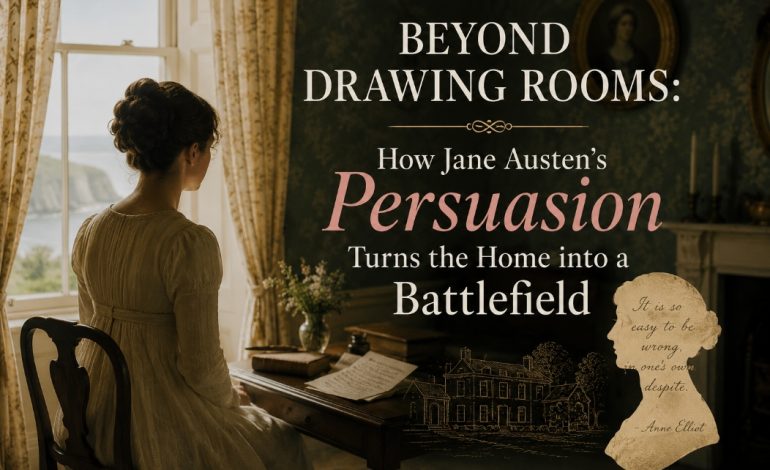

When people think of Jane Austen, they often imagine elegant drawing rooms, tea conversations, country estates, and romantic misunderstandings. At first glance, her novels seem confined to the domestic world—a handful of families, marriage prospects, and everyday social rituals. Yet beneath these seemingly ordinary settings lies a sophisticated exploration of power, identity, and social change. In Persuasion, Austen transforms the home from a peaceful sanctuary into a contested space where gender, class, and personal freedom collide.
Far from being limited by domestic settings, Austen uses them to reveal the complexities of nineteenth-century English society. The walls of country houses, family estates, and drawing rooms become mirrors of a rapidly changing world.
The Home as a Political Space
In the late eighteenth and early nineteenth centuries, homes were not neutral spaces. Every room reflected social expectations, especially for women. Conduct manuals written largely by men instructed women not only on how to behave but also on how to occupy physical and psychological space. Respectability was measured by one’s ability to remain within carefully defined domestic boundaries.
Austen subtly challenges these assumptions. Rather than presenting domestic life as naturally harmonious, she exposes its tensions and contradictions. Her heroines possess remarkable emotional intelligence and moral strength, yet they constantly negotiate environments that restrict their independence.
This tension reaches its fullest expression in Persuasion, where domestic life is portrayed not as comforting stability but as an arena of emotional negotiation.
Anne Elliot’s Quiet Resistance
Anne Elliot is one of Austen’s most introspective heroines. Unlike the spirited Elizabeth Bennet or the witty Emma Woodhouse, Anne’s resistance is internal. Her struggle unfolds within the very spaces she inhabits.
Uppercross, for instance, appears cheerful and lively to everyone else. Yet Anne experiences it as what she memorably calls a “domestic hurricane.” The bustling household, crowded rooms, constant interruptions, and overwhelming intimacy leave her emotionally exhausted. Even seemingly trivial encounters—such as caring for an energetic child—drive her to seek solitude simply to recover her composure.
These moments are not merely personal preferences. They illustrate how domestic space itself can become oppressive, particularly for women whose emotional needs are overlooked in favour of familial expectations.
Austen reminds us that confinement does not always require locked doors. Sometimes it emerges through constant obligation, endless togetherness, and the absence of privacy.
Kellynch Hall: A House Without a Home
If Uppercross symbolizes emotional suffocation, Kellynch Hall represents something even more complicated.
Anne has grown up within its walls, knows every room, and carries deep emotional ties to the estate. Yet she never truly belongs there. As a woman, she has no legal claim to the ancestral home. She can love it, preserve its memories, and care for its traditions—but ownership remains beyond her reach.
This paradox captures one of Austen’s sharpest insights. Home can offer familiarity without security, affection without authority, belonging without possession.
Kellynch Hall therefore becomes a symbol of Anne’s own position in society: deeply rooted yet perpetually displaced.
Domestic Interiors Reflect Social Change
Austen’s houses do much more than reveal personal emotions—they reflect broader historical transformations.
The arrival of Admiral and Mrs. Croft at Kellynch Hall signals the rise of a new social order. Traditional aristocratic privilege, represented by Sir Walter Elliot, begins to give way to merit earned through naval service. Without leaving the domestic sphere, Austen quietly introduces debates about class mobility, changing wealth, and the shifting foundations of English society.
Remarkably, these political transformations unfold through conversations in drawing rooms, family decisions, and household arrangements rather than through grand public events.
In Austen’s hands, the domestic becomes political.
Spaces That Speak
Literary critics have often noted Austen’s fascination with thresholds, staircases, windows, and doorways. These transitional spaces are rarely accidental. They represent moments where characters move between public and private selves, certainty and uncertainty, convention and desire.
Anne’s emotional journey similarly unfolds through movement across spaces. Every house she enters reveals not only its architecture but also its emotional climate. Homes become extensions of character, exposing relationships, hierarchies, and hidden anxieties.
By paying close attention to interiors, Austen teaches readers to see architecture as language.
Why Persuasion Still Feels Modern
More than two centuries after its publication, Persuasion continues to resonate because its questions remain strikingly relevant.
Who truly belongs in a home?
Can familiar spaces also become sources of confinement?
How do family expectations shape individual identity?
What does it mean to possess a place emotionally without ever owning it legally or socially?
These are not merely historical concerns. They continue to shape conversations about gender, belonging, emotional labour, and personal autonomy today.
Austen’s Greatest Achievement
Jane Austen’s genius lies in her ability to make the ordinary extraordinary. She never needed wars or revolutions to explore power. Instead, she located society’s deepest conflicts within family homes, quiet conversations, and everyday routines.
Persuasion demonstrates that domestic life is never simply private. Every room reflects broader social forces, every household embodies cultural values, and every act of quiet resistance reveals the possibility of change.
What appears to be a story about a few families ultimately becomes a profound meditation on gender, identity, and the shifting landscape of English society. Austen’s world may begin in the drawing room, but its implications extend far beyond its walls.
Chandra, S. 2026
References
Austen, Jane. Persuasion. Penguin Classics, 2012.
Austen, Jane. Pride and Prejudice. New York: Penguin Classics, 2003
Gilbert, Sandra M. The Madwoman in the Attic: the Woman Writer and the Nineteenth-Century Literary Imagination. New Haven: Yale University Press, 1979.
Posusta, Rebecca. “Architecture of the Mind and Place in Jane Austen’s ‘Persuasion.’” Critical Survey, vol. 26, no. 1, 2014, pp. 76–91. JSTOR, http://www.jstor.org/stable/24712590.
Sodeman, Melissa. “Domestic Mobility in ‘Persuasion’ and ‘Sanditon.’” Studies in English Literature, 1500-1900, vol. 45, no. 4, 2005, pp. 787–812. JSTOR, http://www.jstor.org/stable/3844615.