
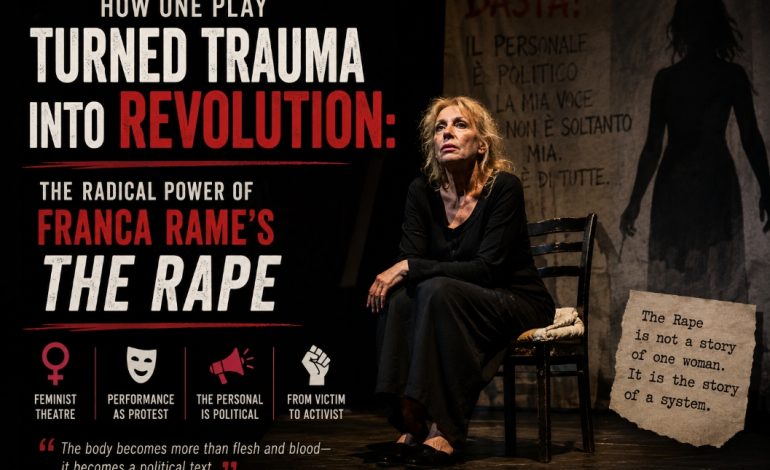
How One Play Turned Trauma into Revolution: The Radical Power of Franca Rame’s The Rape

What if the most powerful protest wasn’t shouted in the streets—but whispered from a theatre stage?
In 1977, Italian playwrights Franca Rame and Dario Fo created a series of feminist monologues that challenged everything society thought it knew about women, power, and the body. Among them, The Rape remains one of the most haunting and politically charged performances ever written. It is not merely a story about sexual violence. It is an act of resistance that transforms private suffering into public rebellion.
More Than a Victim: The Politics of the Body
Most portrayals of sexual assault focus on the victim’s pain. Rame does something radically different.
Her performance separates two identities on stage: the woman who experienced the violence and the actor who narrates it. Rather than allowing the audience to become emotionally overwhelmed by the trauma alone, Rame creates distance. This deliberate separation forces viewers to think critically about the larger systems that enable violence against women instead of seeing rape as an isolated tragedy.
The body becomes more than flesh and blood—it becomes a political text.
When Performance Becomes Protest
Franca Rame was not writing from imagination alone.
In 1973, she was abducted and brutally assaulted by a fascist group because of her political activism. Instead of allowing the attack to silence her, she transformed her own experience into The Rape, returning to the stage to expose not only sexual violence but also the cruelty women often face afterward through victim-blaming and degrading investigations.
Her performance refuses sensationalism. There are no exaggerated screams or melodramatic displays. Instead, the horror emerges through fragmented memories, detached observations, and chilling details. Ironically, this restraint makes the violence even more devastating.
The audience is no longer watching a victim.
They become witnesses.
Breaking the Fiction Society Creates
Throughout her feminist monologues, Rame repeatedly exposes the false identities imposed on women.
In A Woman Alone, the housewife is trapped inside consumerism and domestic expectations.
In An Arab Woman Speaks, clothing becomes a symbol of political identity and resistance.
In The Rape, the female body becomes the battlefield where power, control, and politics collide.
Each character performs the identity society has assigned to her—but only long enough to reveal how artificial those identities really are.
The performance dismantles stereotypes instead of reinforcing them.
From Personal Pain to Collective Resistance
Perhaps the most remarkable achievement of The Rape is how it transforms individual trauma into collective action.
Rame’s story refuses to remain personal. Every word invites the audience to recognize that violence against women is not simply the act of one perpetrator but the product of wider social structures, institutions, and cultural beliefs.
The performance echoes one of feminism’s most enduring principles:
The personal is political.
By the end of the monologue, the distinction between actor and victim begins to disappear. What emerges instead is a third figure—an activist.
The woman on stage is no longer defined by what happened to her.
She is defined by what she chooses to do with it.
Why The Rape Still Matters Today
Decades after it was first performed, The Rape remains painfully relevant.
Around the world, survivors continue to encounter disbelief, victim-blaming, and legal systems that often retraumatize them. Conversations surrounding consent, institutional accountability, and gender-based violence have become more visible, yet the questions Rame raised continue to challenge audiences today.
Her work reminds us that theatre is not simply entertainment.
It can document history.
It can expose injustice.
It can demand accountability.
And sometimes, it can transform unimaginable pain into a movement that refuses to be ignored.
Final Thoughts
Franca Rame’s The Rape is more than a dramatic monologue—it is an extraordinary act of political courage. By separating the performer from the victim and ultimately merging both into the figure of an activist, Rame redefines what it means to survive, to testify, and to resist.
Her stage becomes a courtroom, a battlefield, and a manifesto all at once.
Few performances blur the line between art and activism as powerfully as this one—and that is precisely why it continues to resonate with audiences across generations.