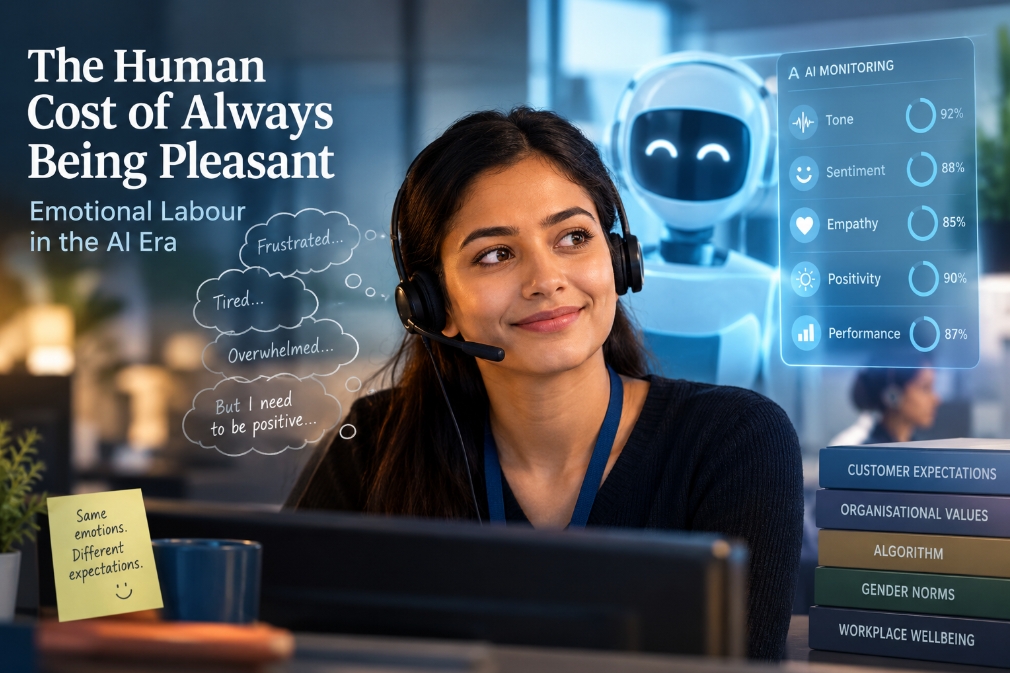

Emotional Labour in the AI Era: The Human Cost of Always Being Pleasant

AI can generate empathy in seconds. But what happens to Emotional Labour in the AI Era?
A customer-service employee ends a difficult call and immediately prepares for the next one. The customer was rude. The employee is exhausted. But the voice must remain warm.
A nurse comforts a frightened family while suppressing her own anxiety.
A manager walks into a meeting after a terrible morning and performs confidence, patience and enthusiasm because that is what leadership requires.
None of these tasks may appear in a formal job description. Yet they are work.
We call it emotional labour.
The concept is most closely associated with sociologist Arlie Russell Hochschild, whose The Managed Heart examined how workers manage their emotions as part of paid employment. Hochschild distinguished between surface acting—displaying an emotion one does not genuinely feel—and deep acting, in which workers attempt to alter their internal feelings so that their outward behaviour becomes more authentic.
The idea remains remarkably relevant. But artificial intelligence is changing the environment in which emotional labour occurs.
AI can now draft empathetic responses, analyse customer sentiment, automate routine service interactions, coach employees during conversations and operate as an always-available digital agent. In service organisations, AI is increasingly becoming part of the very infrastructure through which emotional labour is performed.
That creates a new question:
What happens when the workplace does not simply demand an emotion from us, but has technology capable of measuring, predicting and optimising that emotion?
Emotional labour was never simply about smiling
Hochschild’s insight was deeper than the familiar image of the smiling flight attendant.
Her argument was that workplaces can establish “feeling rules”—expectations about what employees should feel and display in particular situations. Workers therefore experience a potential gap between what they actually feel and what their organisation expects them to feel.
That gap is important.
Imagine a customer-service worker who has just been insulted by a customer. Internally, they may feel anger. Their organisation, however, expects patience and warmth.
Surface acting means suppressing the anger and producing the required smile or pleasant tone.
Deep acting involves trying to reconstruct the emotional situation: Perhaps the customer is frustrated. Perhaps I can understand why they are angry.
Both require emotional effort.
And research suggests that the distinction matters. A meta-analysis covering 95 independent studies found substantial associations between emotional-rule dissonance and surface acting and impaired wellbeing, while deep acting showed weaker relationships with poor wellbeing and some positive relationships with emotional performance and customer satisfaction.
A more recent meta-analysis of 84 studies involving more than 28,000 participants similarly found that surface acting was positively associated with burnout, whereas deep acting was negatively associated with burnout.
The message is not that emotional labour is inherently harmful.
It is that being required to continually perform emotions that conflict with one’s internal state can become costly.
And this is precisely where AI changes the conversation.
The algorithm joins the conversation
For decades, managers have communicated emotional expectations through training, appraisal systems, employee handbooks, corporate values and customer-service scripts. Your source highlights precisely these organisational mechanisms.
AI adds another layer.
Imagine a customer-service system that analyses conversations and provides real-time recommendations:
Use a warmer tone.
Express more empathy.
Avoid sounding defensive.
Offer reassurance.
Such systems can potentially help employees navigate difficult conversations. But they also introduce the possibility that emotional behaviour becomes increasingly measurable.
The organisation no longer merely says:
“Be empathetic.”
It can begin to ask:
“Why was your empathy score lower this week?”
This is a profound change.
Emotion becomes data.
The smile becomes a metric.
Empathy becomes a performance indicator.
And emotional regulation becomes something that can potentially be monitored at scale.
The concern is not that every AI system will necessarily be used this way. Rather, the technological capability changes what organisations could demand.
The workplace may move from emotional management to something closer to emotional optimisation.
AI is already entering customer service
This is not a distant scenario.
Microsoft’s 2025 Work Trend Index described customer service as one of the leading areas of AI investment and reported that 46% of surveyed leaders said their organisations were using agents to automate workstreams or business processes. Microsoft also highlighted Holland America’s AI customer-service agent, “Anna,” which was developed to answer customer questions and assist with cruise bookings around the clock.
The significance extends beyond chatbots.
If AI can handle routine customer questions 24 hours a day, the human role may increasingly involve the conversations that are too complicated, sensitive or emotionally volatile for automation.
That creates an intriguing paradox.
AI may reduce the quantity of emotional labour while increasing the emotional intensity of the labour that remains human.
The chatbot handles the simple complaint.
The employee receives the furious customer who has already tried three automated systems.
The AI handles the booking.
The human handles the grieving traveller whose plans have collapsed.
The machine answers the routine question.
The human receives the exception.
In this world, emotional labour does not disappear.
It may become more concentrated.
When the machine cannot handle the emotion, the human gets it
This is one of the most important issues for organisations adopting AI.
Automation is often discussed as though tasks simply disappear.
But jobs are bundles of tasks. When technology removes some tasks, it changes the composition of the remaining job.
A service worker might spend less time answering routine questions but more time dealing with complex escalations. Their work could become less repetitive—but also more emotionally demanding.
Recent research is beginning to examine precisely this relationship.
A 2026 study of frontline service employees found that dependence on generative AI can have a double-edged effect on emotional labour. Innovative use of GenAI was associated with deeper acting through greater cognitive flexibility, while routine dependence could encourage surface acting by narrowing cognition.
Another 2026 study involving 386 frontline service employees examined perceived algorithmic support and intrusion. It found that perceived AI support could facilitate deep acting through cognitive adaptability, while the broader research agenda highlights the possibility that AI can simultaneously support workers and become an intrusive presence in their work.
This is crucial.
AI is not inherently good or bad for emotional labour.
Its consequences depend on how it is designed and how organisations use it.
AI can reduce emotional burden—but it can also relocate it
There is a strong case for using AI to reduce harmful emotional labour.
A 2026 study in Manufacturing & Service Operations Management examined AI service agents in loan-collection operations and found that undisclosed AI agents displayed required positive and negative emotions more accurately than human employees in the researchers’ field experiments. The authors argue that AI may help address some of the psychological strain associated with emotional labour in service operations.
That possibility deserves serious attention.
If a machine can handle repetitive hostility without becoming exhausted, why should a human have to absorb every unpleasant interaction?
If an AI assistant can draft a compassionate response during a difficult customer conversation, perhaps it can give the employee more cognitive space.
If automation removes repetitive emotional performances, workers may have more energy for genuinely meaningful human interaction.
But there is another possibility.
Instead of asking:
“How can AI reduce unnecessary emotional labour?”
organisations may ask:
“How can AI help us demand even more emotional performance from fewer employees?”
That is where the ethics become complicated.
The new emotional supervisor
Traditional managers could observe only a fraction of employee interactions.
AI systems potentially change that.
A workplace equipped with conversation analytics can, in principle, evaluate enormous numbers of interactions. This creates the possibility of continuous emotional performance management.
An employee might be assessed on:
- customer sentiment;
- conversational tone;
- response speed;
- positivity;
- empathy;
- conflict resolution;
- adherence to communication scripts.
Again, these capabilities can be beneficial when used for coaching and support.
But they become problematic when workers have no meaningful control over how emotional data is collected, interpreted or used.
There is a fundamental difference between:
“The system noticed that difficult calls are exhausting you, so let’s provide support.”
and:
“The system noticed that your tone deteriorated after eight hours of calls, so improve your performance.”
The first treats emotion as evidence of human wellbeing.
The second treats emotion as another productivity variable.
That distinction may define the future of emotional labour.
The gender question has not disappeared
Emotional labour has always had a gender dimension.
The material underlying this article points out that qualities such as care, empathy, affection, attention and respect have historically been associated with women, while organisational cultures have often privileged masculine ideals of rationality, authority and goal-oriented behaviour.
AI does not automatically erase these inequalities.
In fact, the International Labour Organization’s 2026 research on generative AI and occupational segregation warns that the effects of GenAI are not gender-neutral. Female-dominated occupations are almost twice as likely to be exposed to GenAI as male-dominated occupations—29% compared with 16%—reflecting women’s concentration in clerical, administrative and business-support roles. The ILO also notes women’s continued underrepresentation in AI-related occupations.
This matters for emotional labour.
If women are disproportionately represented in roles involving care, administration, coordination and service, then AI-driven restructuring of these occupations can have gendered consequences.
There are at least two possible futures.
AI could devalue traditionally feminised emotional skills by suggesting that machines can perform them cheaply.
Or AI could liberate workers from repetitive emotional demands while increasing the value of genuinely human judgement, care and connection.
Which future emerges will depend less on the technology itself than on organisational choices.
The mental-health cost cannot be ignored
The evidence on emotional labour and wellbeing is increasingly difficult to dismiss.
A 2025 systematic review and meta-analysis covering 27 studies found that high-exhaustion forms of emotional labour—including surface acting and emotional dissonance—were significantly associated with negative mental-health outcomes. Surface acting was associated with depression and anxiety, while emotional dissonance was associated with depression. The researchers also caution that the evidence base remains heterogeneous and that more longitudinal research is needed.
This matters because workplaces sometimes individualise stress.
When an employee becomes exhausted, organisations may offer resilience workshops, mindfulness sessions or productivity coaching.
Those interventions can help.
But they cannot answer the structural question:
Why is the employee experiencing such a high emotional demand in the first place?
The problem becomes particularly serious if AI accelerates an already overloaded workplace.
Microsoft’s 2025 Work Trend Index found that 80% of the global workforce surveyed reported lacking sufficient time or energy to get their work done, while 82% of leaders expected to use digital labour to expand workforce capacity over the following 12–18 months.
AI can therefore be used in two radically different ways.
It can reduce the burden.
Or it can accelerate the burden.
As Microsoft itself cautioned in its research on the “infinite workday,” organisations risk using AI to accelerate a broken system rather than redesigning the system itself.
That warning applies directly to emotional labour.
The authenticity problem
There is another issue AI brings into sharper focus: authenticity.
If an AI system writes the perfect empathetic response, is the organisation receiving empathy—or merely its simulation?
For customers, the distinction may sometimes be irrelevant. A person who receives a useful, compassionate answer may simply care that the problem has been solved.
But for workers, authenticity matters differently.
The employee may increasingly be expected to supervise, edit or deliver machine-generated empathy.
They become responsible for making artificial language sound human.
This creates a strange new form of emotional labour:
the worker may no longer have to generate the emotion from scratch, but they may have to authenticate it.
They check whether the AI’s apology sounds sincere.
They soften its language.
They remove an insensitive phrase.
They add warmth.
They ensure that the machine does not sound like a machine.
In other words, AI can outsource the production of emotional language while leaving humans responsible for its social legitimacy.
We need a new social contract around emotional labour
The lesson is not that organisations should abandon AI.
Nor is it that every form of emotional labour is exploitative.
Emotional labour can be meaningful. Caring for another person, calming a frightened customer or helping someone through a difficult situation can generate genuine satisfaction. The original research tradition itself recognises that emotional work can produce both resource gains and resource losses.
The challenge is to distinguish meaningful emotional engagement from compulsory emotional performance.
A responsible AI workplace should therefore ask five questions.
- Is AI reducing emotional burden—or merely increasing expectations?
If AI makes workers faster, the organisation should not automatically respond by giving them more customers.
- Who controls emotional data?
Employees should know whether conversations, voice characteristics or sentiment indicators are being analysed and how the information affects evaluation.
- Are workers allowed to be human?
A worker should not be penalised simply because they cannot perform endless positivity.
- Is AI supporting judgement rather than replacing it?
The most effective human-AI systems may be those that allow technology to handle repetitive work while leaving humans control over complex interpersonal decisions.
- Are the benefits shared?
If AI saves an organisation time and money, workers should also experience some of the gains through reduced workload, greater autonomy, better training, higher-quality work or improved working conditions.
The future is not emotionless. It is more contested.
The great irony of AI is that as machines become better at producing language that sounds emotionally intelligent, human emotion may become more economically valuable—and more heavily managed.
We are moving towards workplaces where AI agents can work around the clock, handle routine tasks and increasingly participate in customer interactions. Microsoft’s 2026 Work Trend Index describes this emerging model as one in which agents take on more execution while humans gain greater agency over direction, judgement and outcomes.
That could be a hopeful future.
But only if organisations resist the temptation to treat human agency as another resource to optimise.
The goal should not be a workplace where every employee is perpetually calm, cheerful, available and emotionally intelligent.
The goal should be a workplace where people have enough autonomy, support and dignity that they do not have to pretend to be machines.
AI can generate the perfect apology.
It can recommend the ideal response.
It can analyse a customer’s mood.
It can even perform emotions with remarkable consistency.
But it cannot answer the most important question:
How much emotional effort should one human being reasonably be expected to give for a wage?
That question cannot be automated.
It is a question of organisational ethics.
And in the AI era, it may become one of the most important questions we ask about the future of work.
Author: Chandra, D.
Citations
Burton, H. and Piercy, G. 2012. THE WORKPLACE EXPERIENCES OF WAITRESSES: EXPLORING THE NATURE OF EMOTIONAL LABOUR, Labour Employment and Work Conference.
Domagalski, T.A. 1999. Emotion in organizations: Main currents, Human Relations; Vol 52 (6), PP. 833-851.
Hayward, R.M. and Tuckey, M.R. 2011. Emotions in uniform: How nurses regulate emotion at work via emotional boundaries, human relations, Vol 64(11), pp. 1501–1523.
Hochschild, A. 1983. The Managed Heart: Commercialization of Human Feeling. University of California Press.
Hülsheger & Schewe — meta-analysis of three decades of emotional-labour research.
Yin et al. — meta-analysis of emotional-labour strategies and burnout.
Taylor, S. and Tyler, M., 2000. Emotional labour and sexual difference in the airline industry. Work, Employment and Society, 14(1), pp.77-95.
Vincent, C. and Braun, A. 2012. Being ‘fun’ at work: emotional labour, class, gender and childcare, British Educational Research Journal, 39(4), pp.751-768.
Zhao et al. — systematic review/meta-analysis of emotional labour and mental health.
International Labour Organization — Gen AI, occupational segregation and gender equality in the world of work (2026).
Microsoft — Work Trend Index 2025 and Work Trend Index 2026.
Aspara & Fang — Artificial Intelligence, Emotional Labor, and Service Operations (2026).
2026 Journal of Retailing and Consumer Services research on GenAI dependence and emotional labour.