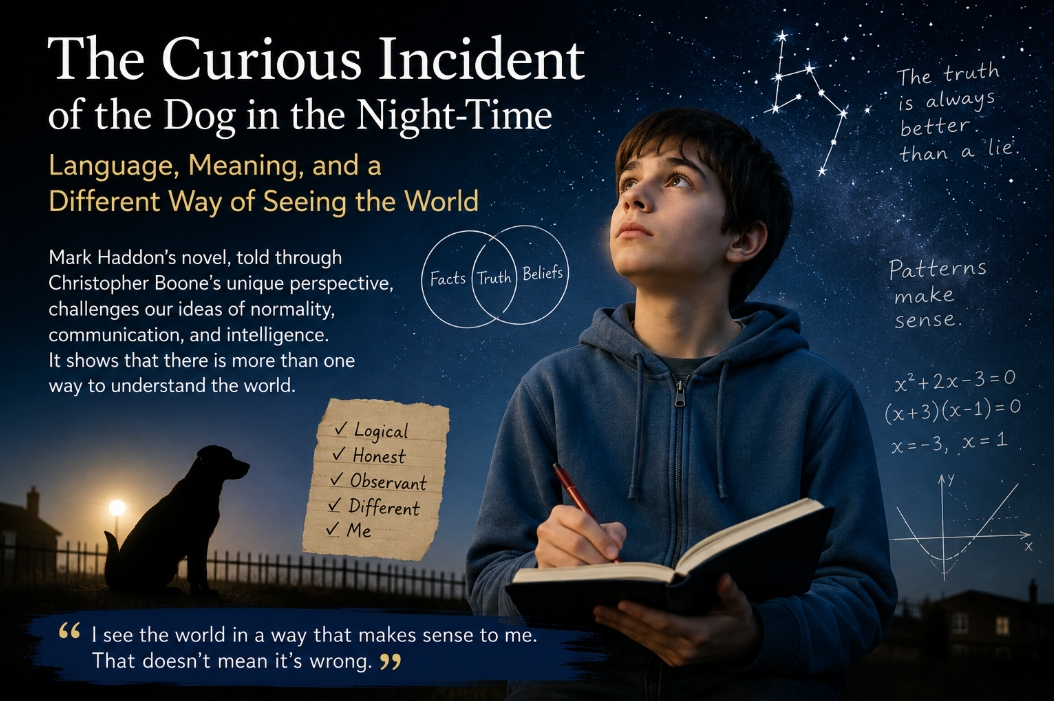

How The Curious Incident of the Dog in the Night-Time Redefines Language, Meaning, and Normalcy

Mark Haddon’s The Curious Incident of the Dog in the Night-Time is often celebrated as a compelling coming-of-age mystery narrated by Christopher Boone, a fifteen-year-old boy with autism. Yet beneath its detective plot lies a far more profound exploration of language, cognition, and the politics of normality. Rather than presenting Christopher merely as a protagonist with distinctive behavioural traits, Haddon constructs an entirely different linguistic world—one where conventional assumption about communication, understanding, and truth are fundamentally questioned.
What makes the novel remarkable is not simply Christopher’s diagnosis or his extraordinary mathematical abilities. Its true innovation lies in the way the narrative forces readers to abandon familiar linguistic expectations and enter Christopher’s unique system of meaning-making. In doing so, the novel quietly dismantles the idea that there is only one “correct” way to understand reality.
This shift has significant literary and social implications. Instead of portraying Christopher as someone who fails to fit into society, Haddon subtly suggests that society itself depends upon linguistic conventions that are often ambiguous, metaphorical, and exclusionary. Christopher’s straightforward interpretation of the world exposes the hidden complexities—and sometimes the contradictions—embedded within everyday language.
This article explores how The Curious Incident of the Dog in the Night-Time transforms language into a political and cognitive tool. Through Christopher Boone’s distinctive mind style, the novel challenges dominant ideas about disability, meaning, and normalcy while encouraging readers to reconsider how language shapes the way we perceive the world.
Understanding Meaning-Making: Why Language Shapes Reality
Human beings constantly interpret the world around them. Every conversation, social interaction, memory, and observation contributes to a larger process known as meaning-making—the cognitive ability to organize experiences into understandable patterns.
Meaning-making is much more than interpreting words. It involves constructing mental models that allow individuals to predict events, understand relationships, and navigate complex social environments. These mental models are influenced by personal experiences, education, culture, and social expectations, creating different ways of understanding reality.
Most people rarely notice these invisible cognitive structures because society largely shares similar assumptions about communication. Idioms, metaphors, sarcasm, indirect speech, and emotional expressions are interpreted almost automatically.
Christopher Boone disrupts this entire process.
Instead of relying on culturally accepted assumptions, Christopher processes information through literal observation, logical reasoning, and empirical certainty. His understanding of reality depends on facts rather than implication. This alternative cognitive framework becomes the foundation of the novel’s narrative structure, allowing readers to experience the world through an entirely different system of logic.
Rather than depicting Christopher’s perspective as deficient, Haddon positions it as internally coherent. Readers gradually realize that Christopher’s way of understanding reality is not broken—it simply operates according to different linguistic and cognitive principles.
Christopher Boone’s Language Challenges the Idea of “Normal”
Traditional literary narratives often assume that readers share common social knowledge. Characters understand metaphors, detect irony, recognize emotional cues, and interpret hidden meanings without explicit explanation.
Christopher refuses these assumptions.
His narration is remarkably precise, factual, and literal. Every observation is grounded in evidence rather than inference. Uncertainty makes him uncomfortable because uncertainty introduces multiple interpretations, and multiple interpretations threaten logical consistency.
This linguistic precision creates an unexpected reversal.
Normally, neurotypical language functions as the invisible standard against which autistic communication is measured. Haddon inverts this hierarchy. Since readers experience the entire story through Christopher’s narration, his linguistic system becomes the novel’s default reality.
Consequently, it is the behaviour of neurotypical characters that increasingly appears confusing.
Parents hide information.
Police officers speak indirectly.
Neighbours imply more than they explicitly say.
Adults frequently contradict themselves.
Christopher, however, remains consistently logical.
As readers spend more time within his narrative, they begin questioning whether conventional communication is actually more effective—or simply more socially accepted.
This subtle inversion represents one of Haddon’s most powerful literary achievements. Instead of asking readers to sympathize with Christopher from an external perspective, the novel invites them to inhabit his cognitive framework. The result is not simply empathy but a fundamental reconsideration of what society labels as “normal.”
Mind Style: The Literary Technique That Defines Christopher’s World
One of the most distinctive features of Haddon’s novel is its construction of Christopher’s mind style—the linguistic representation of an individual’s unique way of thinking.
Unlike conventional first-person narrators, Christopher’s narration is not primarily emotional or introspective. Instead, it reflects the structure of his cognition.
Every sentence reinforces particular patterns:
- Logical sequencing
- Mathematical precision
- Literal interpretation
- Systematic categorization
- Evidence-based reasoning
These recurring linguistic choices shape far more than Christopher’s personality. They determine how readers experience every event within the novel.
For example, Christopher frequently organizes information into numbered lists, diagrams, mathematical observations, and carefully structured explanations. Rather than slowing the narrative, these techniques immerse readers within his cognitive processes.
The detective plot itself reflects Christopher’s preference for order.
Murder mysteries promise something Christopher deeply values: certainty.
Every mystery contains evidence.
Evidence produces logical conclusions.
Logical conclusions restore order.
This narrative structure aligns perfectly with Christopher’s worldview, where uncertainty is one of the greatest sources of anxiety. His investigation into Wellington’s death therefore becomes more than a search for a culprit—it becomes an attempt to restore coherence to a world increasingly disrupted by lies, emotional complexity, and hidden motives.
When Language Becomes Political
Language is never neutral.
Every society develops preferred ways of speaking that gradually become accepted as normal. These conventions shape not only communication but also power.
Expressions like “reading between the lines,” “breaking the ice,” or “wearing your heart on your sleeve” appear harmless because most speakers immediately recognize them as figurative.
Christopher does not.
For him, words should correspond directly to observable reality.
This seemingly simple preference carries significant political implications.
If society privileges indirect communication, then individuals who communicate literally are often perceived as lacking social competence.
Haddon challenges this assumption.
Christopher does not misunderstand language because he is incapable of thought. Rather, he rejects linguistic systems that rely upon ambiguity instead of precision. His discomfort with metaphors, irony, and implied meanings reveals how much ordinary communication depends upon conventions that many people simply accept without questioning.
Readers therefore begin noticing something remarkable.
Perhaps figurative language is not inherently superior.
Perhaps it is simply culturally dominant.
This shift transforms language from a neutral communication tool into a site of power, where ideas of ability, intelligence, and normality are constantly negotiated.
Visual Thinking and an Alternative Way of Understanding Reality
Christopher repeatedly demonstrates that he thinks visually rather than verbally. Memories appear in his mind almost like recordings rather than abstract recollections.
This explains why diagrams, illustrations, maps, mathematical formulas, and visual patterns occupy such an important place within the novel.
While many literary protagonists explain emotions through descriptive language, Christopher often replaces emotional explanation with visual organization.
Readers encounter:
- Mathematical puzzles
- Prime-numbered chapters
- Maps and diagrams
- Scientific explanations
- Logical classifications
These features are not stylistic decoration.
They are extensions of Christopher’s cognition.
Instead of translating visual thought into metaphorical language, Christopher presents the visual structures themselves.
The result is a narrative unlike most contemporary fiction.
Rather than asking readers to imagine Christopher’s thought process, Haddon allows them to experience it directly. The novel therefore becomes not merely a story about autism but an experiment in representing alternative cognitive realities through literary form.
Why Christopher Rejects Metaphors—and Why It Matters
One of the most memorable aspects of Christopher Boone’s narration is his discomfort with figurative language. Throughout the novel, he repeatedly explains that metaphors make little sense to him because they ask readers to accept something that is not literally true. When someone says, “It’s raining cats and dogs,” Christopher cannot simply overlook the factual impossibility of the statement. Instead, he focuses on its logical inconsistency.
At first glance, this appears to be a limitation in communication. Yet Haddon transforms it into a powerful literary strategy.
Metaphors are often celebrated as one of language’s greatest strengths because they compress complex emotions and abstract ideas into vivid imagery. However, they also depend on shared cultural knowledge. A metaphor works only when both speaker and listener agree on its intended meaning. Christopher’s refusal to participate in this convention exposes an uncomfortable truth: figurative language is not universal. It is a learned social practice.
This realization shifts the reader’s perspective. Rather than asking why Christopher cannot understand metaphors, the novel encourages us to ask why society relies so heavily on expressions that sacrifice clarity for convention.
Christopher prefers language that says exactly what it means. In his world, precision is not a stylistic preference but a necessity. By rejecting metaphor, he reveals how much ordinary communication depends upon assumptions that many people rarely notice.
Far from weakening the narrative, this literalism creates a refreshing honesty. Readers begin to appreciate the elegance of direct communication, even as they recognize the richness that figurative language can provide. The tension between these two approaches becomes one of the novel’s most compelling themes.
The Search for Order in an Unpredictable World
Christopher’s relationship with language is inseparable from his desire for order. Every chapter, observation, and investigation reflects his need to transform uncertainty into certainty.
This explains his fascination with mathematics and science.
Unlike human emotions, mathematical equations produce predictable results. Scientific principles operate according to observable rules rather than hidden intentions. Prime numbers, logical proofs, and factual evidence offer Christopher something that everyday social interactions often fail to provide: reliability.
Haddon reinforces this preference structurally throughout the novel.
The chapters are numbered using prime numbers instead of consecutive integers. Christopher frequently interrupts the detective narrative with mathematical puzzles, scientific explanations, and logical digressions. Rather than distracting from the story, these moments deepen readers’ understanding of how he experiences the world.
His investigation into Wellington’s death follows the same pattern. Christopher gathers facts, evaluates evidence, eliminates impossible explanations, and steadily builds a logical case. He approaches mystery as a problem that can be solved through careful observation rather than intuition or emotional judgment.
Ironically, it is the adults around him who introduce confusion. They conceal information, tell partial truths, and make decisions based on emotion rather than evidence. Christopher’s unwavering commitment to honesty often appears more dependable than the behaviour of those society considers “normal.”
In this way, Haddon subtly reverses traditional assumptions about competence and rationality. Christopher’s cognitive style is not portrayed as an obstacle to understanding reality; instead, it becomes one of the most reliable ways of navigating it.
Self-Presentation: Christopher as Both Narrator and Author
Another remarkable feature of the novel is Christopher’s awareness that he is writing a book. Early in the narrative, he explains that he has decided to write a murder mystery and even discusses why the story begins with Wellington’s death. These moments draw attention to the act of storytelling itself and establish Christopher not merely as a narrator but as an author shaping his own account.
This self-awareness gives readers direct access to his methods of organizing experience. Christopher frequently explains his habits, preferences, fears, and behavioural patterns in a matter-of-fact manner. Rather than inviting sympathy through emotional confession, he offers carefully catalogued observations about himself.
He openly acknowledges difficulties with prolonged conversations, discomfort with physical contact, confusion about facial expressions, and distress when routines are disrupted. Yet these descriptions are never framed as requests for pity. Instead, they function as explanatory guides that help readers understand the principles governing his behaviour.
This approach significantly alters the reader’s relationship with disability.
Traditional narratives often define disabled characters through the observations of others. Their identities emerge from external descriptions, medical diagnoses, or social judgments.
Christopher rejects this framework.
He defines himself.
By controlling the narrative, he determines which aspects of his identity deserve attention and how those aspects should be interpreted. This narrative authority becomes an act of empowerment, allowing Christopher to replace stereotypes with first-hand experience.
As readers spend more time with his voice, disability ceases to function as a defining label. Instead, Christopher becomes a complex individual whose personality extends far beyond any diagnostic category.
The Vocabulary of Difference: Less Is More—and Sometimes More Is More
Christopher’s language demonstrates another fascinating characteristic: his vocabulary changes dramatically depending on the subject matter.
In everyday social situations, he occasionally struggles with expressions that many people use without conscious thought. Certain common words require clarification because their meanings depend heavily on context rather than precise definition. These moments reveal that ordinary language is often less straightforward than it appears.
However, this apparent limitation tells only half the story.
When the conversation turns to mathematics, physics, astronomy, or logic, Christopher’s vocabulary becomes exceptionally rich. He effortlessly employs specialised terminology, explains complex concepts, and recalls detailed factual information with remarkable accuracy. What might seem like a restricted vocabulary in one context becomes extraordinary precision in another.
This contrast challenges simplistic assumptions about intelligence.
Society often measures linguistic competence through conversational fluency, emotional expressiveness, or social adaptability. Haddon broadens this definition by showing that expertise can manifest in many different forms. Christopher’s strengths are not exceptions to his communication style—they are direct expressions of it.
Readers therefore encounter two parallel realities.
In one, Christopher occasionally pauses to interpret socially coded language.
In the other, he navigates scientific and mathematical discourse with confidence that surpasses many of the adults around him.
The novel refuses to privilege one form of knowledge over another. Instead, it demonstrates that language always reflects the environments in which individuals think, learn, and communicate.
Reading the World Through Visual Logic
Christopher repeatedly explains that his memory resembles a film. Instead of recalling vague impressions, he reconstructs experiences through highly detailed visual images. This distinctive way of processing information influences every aspect of the novel’s structure.
Maps, diagrams, constellation drawings, mathematical layouts, and symbolic illustrations are woven naturally into the narrative. These visual elements are not decorative additions; they function as an extension of Christopher’s thought process.
For many readers, literary fiction relies primarily on descriptive prose to create mental imagery. Haddon takes a different approach. Rather than describing how Christopher thinks visually, he incorporates visual organisation directly into the storytelling.
This strategy produces an unusually immersive reading experience.
Readers are invited to solve problems, follow diagrams, recognise patterns, and interpret information in the same way Christopher does. The novel therefore becomes more than a story about an autistic protagonist—it becomes an experiment in reshaping how readers themselves process information.
This emphasis on visual reasoning also reinforces one of the novel’s central ideas: there is no single correct way to understand reality. Different cognitive styles generate different but equally valid ways of making sense of the world.
Reimagining Disability Through Narrative Authority
Perhaps the novel’s greatest achievement lies in how it reshapes readers’ understanding of disability.
Christopher is never reduced to a symbol of inspiration or tragedy. His challenges are real, but so are his strengths, humour, intelligence, and unwavering commitment to truth. By granting him complete narrative authority, Haddon shifts attention away from diagnostic labels and toward lived experience.
As readers become increasingly comfortable with Christopher’s logic, it is the behaviour of supposedly “normal” characters that often begins to appear contradictory, emotionally inconsistent, or ethically questionable.
This reversal is profoundly significant.
Rather than asking autistic individuals to conform to dominant linguistic norms, the novel asks society to reconsider whether those norms should remain unquestioned.
Language, communication, and cognition emerge not as fixed standards but as diverse ways of engaging with reality. In doing so, The Curious Incident of the Dog in the Night-Time challenges readers to replace assumptions with curiosity—and judgment with understanding.
The Lasting Literary Significance of Christopher Boone’s Narrative
Few contemporary novels have transformed readers’ understanding of language and cognition as profoundly as The Curious Incident of the Dog in the Night-Time. While it is often discussed as a novel about autism, its deeper achievement lies in exposing the invisible assumptions that shape everyday communication. Mark Haddon invites readers to question not only how people speak but also how language constructs ideas of intelligence, normality, and belonging.
Christopher Boone’s narration demonstrates that meaning is never neutral. Every word, metaphor, gesture, and social convention reflects a particular way of seeing the world. By presenting reality through Christopher’s perspective, the novel temporarily suspends the linguistic habits that many readers take for granted. What initially appears unusual gradually becomes logical, coherent, and even reassuring.
This reversal is one of Haddon’s greatest literary accomplishments.
Rather than asking readers to observe Christopher from the outside, the novel places them inside his cognitive framework. As they navigate his precise, fact-driven narration, they begin to recognize the inconsistencies of conventional communication. Irony, euphemism, sarcasm, and metaphor—devices often celebrated for their sophistication—are revealed as systems that depend heavily on shared cultural assumptions and implicit knowledge.
Christopher’s literal interpretation of language is therefore not merely a characteristic of his personality; it becomes a critical lens through which the limitations of ordinary communication are exposed.
The novel also challenges long-standing representations of disability in literature. Traditionally, disabled characters have often been portrayed as symbols of tragedy, inspiration, or social dependence. Christopher resists these conventions. He is neither idealized nor diminished. Instead, he is presented as a complete individual whose strengths, frustrations, intelligence, fears, and aspirations coexist naturally.
By allowing Christopher to tell his own story, Haddon shifts narrative authority away from external observers. Readers are encouraged to understand disability not through labels or diagnoses but through lived experience. This narrative choice humanizes Christopher while simultaneously questioning the cultural structures that define some forms of communication as “normal” and others as “deviant.”
Ultimately, The Curious Incident of the Dog in the Night-Time is not simply about solving the mystery of Wellington’s death. It is about investigating the hidden structures through which human beings construct meaning. Every chapter encourages readers to reconsider how language influences perception, relationships, and identity.
The novel reminds us that communication is far more diverse than conventional standards suggest. Different cognitive styles do not represent failures of understanding; they represent alternative ways of engaging with reality. Recognizing this diversity allows literature to become more inclusive, more empathetic, and more intellectually expansive.
Final Thoughts
More than two decades after its publication, The Curious Incident of the Dog in the Night-Time continues to resonate with readers because it asks timeless questions about communication and understanding. It reminds us that language is never simply a collection of words; it is a framework through which we interpret ourselves and others.
Christopher Boone’s voice compels readers to question assumptions, and appreciate the diversity of human cognition. In doing so, Mark Haddon creates a novel that is intellectually stimulating as well as emotionally compelling.
The lasting power of the novel lies not in solving a mystery but in transforming the way we think about language itself. By inviting readers into Christopher’s world, Haddon ultimately reveals that empathy begins not with speaking differently but with learning to listen differently.
Christopher Boone’s narrative becomes a discursive space where Boone as a narrator and as an authorial figure supplants and concomitantly eliminates elements of extant linguistic, lexical and semantic structure to assemble an alternate space that is more inclusive of his mental model and mind style. There’s no additional attempt to synthesize or to forcefully explicate the narratorial progression to the abled-bodied readers in ableist terminologies. Within the narrative, Christopher’s metalinguistic and metanarratorial comments about his difficulties with language and social interactions including his tussle with lexis, grammar, figurative language, and deixis, and various aspects of the way he communicates form a pragmatic base for the construction of an alternate world order, wherein his marginalized position is inverted.
Chandra, S. 2026 [Research Scholar]
References
- Bhattacharjee, R. 2020 “The Politics of Translation; disability, language and the in-between”. Disability in Translation; the Indian Experience. London and New York; Routledge. Pp 198-199
- Fowler, R. 1977. Linguistics and the Novel. London: Methuen & Co Ltd.
- Fowler, R. 1986. Linguistic Criticism. Oxford & New York: Oxford University Press
- Haddon, M. 2005 [2003]. The Curious Incident of the Dog in the Night-Time. London: Vintage
- M.A.K. 2002 [1971]. “Linguistic Function and Literary Style: An Inquiry into the Language of William Golding’s The Inheritors.” In Webster, J. (ed.), Linguistic Studies of Text and Discourse. London & New York: Continuum, pp. 88- 125
- Klein, G. Moon, B. and Hoffman, R.R. (2006). Making Sense of Sensemaking 1: Alternative Perspectives, IEEE Computer Society, Vol 24 (4), PP. 69-73.
- Lambidoni, Evangelia. “Life Viewed through the Eyes of a Child with Autism.” The Journal of Education, vol. 188, no. 1, 2007, pp. 93–109. JSTOR, http://www.jstor.org/stable/42744124..
- Rydén, Ringberg and Wilke, 2015. How Managers’ Shared Mental Models of Business–Customer Interactions Create Different Sensemaking of Social Media, Journal of Interactive Marketing, Vol 31, PP. 1–16