

The Cockroach Janta Party: Viral Sensation or BJP’s Unwitting Ally in India’s Fragmented Polity?
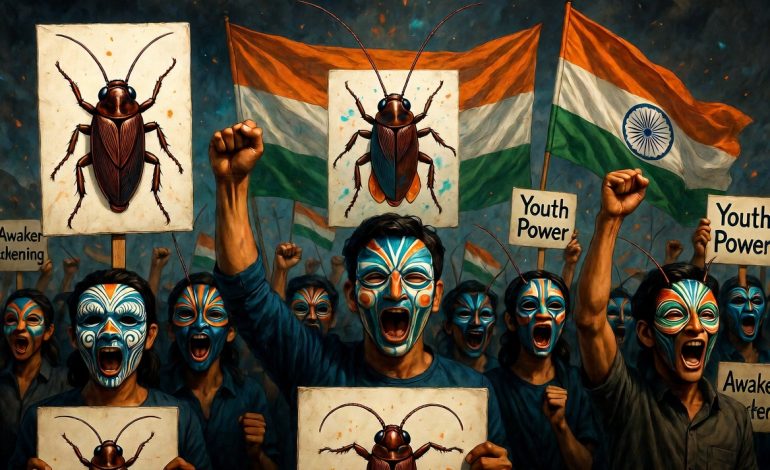

In an era where Indian politics thrives on social media virality, the Cockroach Janta Party (CJP) has emerged as a genuine phenomenon. Born from satirical outrage over a Supreme Court judge’s “cockroach” remark about unemployed youth, the movement, led by Abhijeet Dipke, has amassed over 20-22 million Instagram followers in weeks. Its first physical protest at Jantar Mantar in Delhi on June 6, 2026, drew hundreds (reports suggest thousands) of young supporters demanding accountability on exam leaks, job scarcity, and education minister Dharmendra Pradhan’s resignation.
Yet, for all its meme-fuelled energy and Gen-Z appeal, CJP offers little substantive hope for India’s youth or the nation’s democratic future. History and electoral mathematics suggest it risks becoming another fringe player: securing a handful of seats at best, while fragmenting anti-BJP votes and reinforcing the ruling party’s dominance through divisive, multi-cornered contests.
Youth Disenchantment Meets Electoral Reality
India’s youth bulge is undeniable. Over 210 million voters aged 18-29 were on the rolls for recent elections, with more than 2 crore young electors added recently. Roughly 65% of the population is under 35, making this demographic a powerhouse in theory.
However, turnout and impact tell a different story. In 2024, overall voter turnout dipped slightly to around 66%, with youth registration and participation lagging in key states like Delhi, Bihar, and Uttar Pradesh (under 40% for the youngest cohort in some cases). Despite parties courting young voters with digital campaigns, National Election Study data showed no party fully captured their loyalty in 2024—BJP’s youth support had already shown signs of erosion from its 2014-2019 peaks.
CJP channels real frustrations
NEET paper leaks affecting millions, chronic unemployment, delayed exams, and a sense of systemic betrayal. These are potent issues. But channelling viral anger into sustainable politics requires organization, cadre, alliances, funding, and a clear ideology beyond satire. Past movements—from Anna Hazare’s anti-corruption stir to various regional youth fronts—often fizzled or were absorbed without transforming the national landscape.
The Mathematics of Vote Splitting in India’s First-Past-The-Post System
India’s electoral system punishes fragmentation. BJP has mastered this. In 2024 Lok Sabha polls, BJP secured 240 seats with just 36.56% of the vote (NDA ~43%), while Congress got 99 seats on ~21-22%. Smaller parties and independents took significant vote shares but few seats.
This “efficient” vote distribution has been BJP’s strength since 2014 (when it won 282 seats on ~31% vote in a more fragmented field). Multi-cornered contests in key states amplify this. When opposition votes split among Congress, regional parties, and new entrants, BJP wins pluralities even with minority support. Historical examples abound: in states like Maharashtra or earlier cycles in Rajasthan and others, third parties or splits aided BJP gains by dividing anti-incumbent votes.
A new youth-centric party like CJP, if it formalizes and contests, would likely draw urban, educated, first-time or disaffected voters—precisely those who might otherwise consolidate behind Congress or INDIA bloc allies in anti-BJP seats. Even 2-5% vote share in targeted urban or youth-heavy constituencies could flip marginal seats toward BJP without CJP winning many (if any) itself. Social media phenomena rarely translate to booth-level machinery needed for sustained success in India’s vast, rural-dominated electorate. BJP’s incumbency, organizational depth (via RSS ecosystem), welfare delivery, and Hindutva consolidation provide structural advantages that viral protests cannot easily match. New entrants often end up as “spoilers” rather than challengers, especially without strong regional bases.
Divisive Politics and the Limits of Satire
CJP’s rise highlights genuine youth alienation—jobs, education quality, aspirational gaps—that mainstream parties have failed to address adequately. Its satirical, anti-establishment (often anti-BJP leaning in tone) energy taps into this. Yet, by positioning as a protest vehicle without a viable national alternative, it risks deepening polarization. In competitive politics, such fragmentation benefits the best-organized pole. BJP has repeatedly turned opposition disunity into electoral capital. A CJP that captures imagination but delivers few seats could inadvertently channel youth disenchantment away from building a robust opposition, keeping the polity divided along lines favorable to the incumbent. History is filled with similar flashes: Aam Aadmi Party succeeded regionally through ground mobilization, but many online-driven or single-issue groups faded. Without evolving into a party with alliances, policy depth, and grassroots presence, CJP may entertain and protest effectively but change little structurally.
A Call for Substance Over Spectacle
India’s youth deserve better than recycled frustration. Real hope lies not in another social media party promising disruption but in pressuring existing players toward better governance—employment generation, education reform, skill development—and fostering opposition unity where it matters electorally. The Cockroach Janta Party has brilliantly highlighted problems. Its endurance as a political force, however, remains doubtful. In India’s unforgiving electoral arena, virality is no substitute for votes, and protest energy without strategy often aids the very establishment it mocks. For the country’s sake, one hopes this phenomenon catalyzes deeper change rather than becoming another footnote in BJP’s playbook of managing fragmented dissent.
The cockroaches may be resilient, but India’s democracy needs builders, not just resilient critics.
Team SChandraLiterature


1 Comment
[…] Source: The Cockroach Janta Party: Viral Sensation or BJP’s Unwitting Ally in India’s Fragmented Polity? […]