

The Politics of a Toilet: How Salma Turns Domestic Space into a Feminist Battlefield
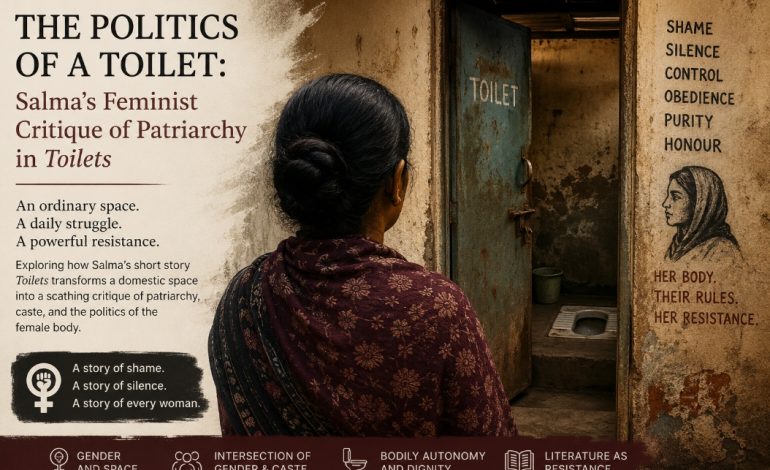

What if the most ordinary corner of a house—the toilet—became the most powerful symbol of oppression? In most literary traditions, bathrooms remain invisible. They are private, mundane spaces that rarely receive narrative attention. Yet in Salma’s Salma remarkable short story Toilets, this neglected domestic space emerges as a deeply political landscape. Through the life of her protagonist, Shamim, Salma transforms the toilet into a metaphor for the silent violence embedded within patriarchal Tamil Muslim society. What appears to be a story about sanitation is, in reality, a profound meditation on gender, bodily autonomy, domestic imprisonment, and social power.
When Space Becomes a Weapon
Feminist criticism has long argued that space is never neutral. Homes, kitchens, bedrooms, and courtyards often reflect social hierarchies as much as physical structures. Salma extends this conversation by drawing attention to a space that literature frequently ignores.
For Shamim, the toilet is never simply a place to relieve herself. It is a space governed by shame, surveillance, fear, and restriction. Every stage of her life is marked by a different toilet, yet each one reproduces the same experience of discomfort and humiliation.
Her frustration repeatedly surfaces in the simple but devastating question:
“Why don’t we knock down the wretched house and build a new one?”
The statement is about far more than architecture. It is a cry against the structures—both physical and ideological—that imprison women.
The Female Body Under Patriarchal Surveillance
One of the greatest strengths of Toilets lies in its refusal to sanitize women’s bodily experiences. Salma writes unapologetically about urination, menstruation, pregnancy, and physical discomfort—subjects often erased from mainstream literature.
The story exposes how women are taught to be ashamed even of their most natural bodily functions.
“When a woman peed, the patter of urine falling must not be heard outside. How can a girl make noise while peeing?”
This single observation captures generations of internalized discipline. Patriarchy controls not only women’s mobility and sexuality but also their most fundamental biological needs. Even the act of using a toilet becomes a carefully regulated performance.
Here, the body itself becomes a political site.
Judith Butler and the Performance of Gender
The story resonates strongly with Judith Butler’s Judith Butler theory that gender is not an innate identity but something continually produced through repeated social performances.
Women in Salma’s narrative learn to regulate their bodies, suppress discomfort, hide pain, and perform modesty because society repeatedly demands these behaviours. The toilet becomes one of the earliest classrooms where femininity is taught—not through freedom, but through discipline.
Shamim does not merely inhabit the space.
The space shapes her.
Claustrophobia Beyond Walls
Reading Toilets often feels emotionally suffocating. The story evokes anxiety, dread, shame, and psychological exhaustion with remarkable subtlety.
In many ways, Shamim’s growing obsession with the toilet recalls the mental confinement experienced by the unnamed narrator in Charlotte Perkins Gilman’s The Yellow Wallpaper The Yellow Wallpaper. Just as the wallpaper becomes a manifestation of patriarchal imprisonment, Salma’s deteriorating toilets symbolize years of accumulated humiliation.
Neither woman is imprisoned merely by walls.
Both are trapped inside systems that normalize female suffering.
The physical space gradually transforms into a psychological prison.
Domestic Space Is Political Space
Salma dismantles the comforting illusion that home is always a sanctuary.
Instead, the household emerges as one of patriarchy’s most efficient institutions.
At her in-laws’ house, Shamim must adjust her bodily rhythms according to the convenience of eighteen family members sharing a single toilet. Her biological needs become secondary to household discipline.
The violence here is subtle.
Nobody strikes her.
Nobody openly imprisons her.
Yet every rule governing when she may eat, sleep, urinate, or defecate quietly erodes her dignity.
This is precisely what makes Salma’s critique so unsettling. Patriarchal violence often operates through routine rather than spectacle.
The Intersection of Gender and Caste
Salma refuses to isolate gender from broader social inequalities.
Her portrayal of manual scavenging reveals another layer of structural violence embedded within Tamil society.
The overflowing toilets depend upon the labour of marginalized communities forced into degrading work.
Shamim watches as workers remove human waste throughout the night, filling drums carried away on bullock carts. Their labour remains invisible, just as women’s suffering remains normalized.
In this way, the toilet becomes an intersection where gender oppression, caste discrimination, poverty, and social exclusion converge.
The story reminds readers that systems of domination rarely exist in isolation.
Writing the Unspeakable
One of Salma’s most radical achievements is her willingness to write about subjects considered culturally inappropriate.
She once observed that a woman’s body is denied not only desire but even comfort. Before culture assigns meanings to it, the body is simply alive.
This philosophy permeates Toilets.
The narrative insists that literature must speak about ordinary bodily experiences because they are precisely where power operates most effectively.
By writing about toilets, menstruation, urination, and domestic discomfort, Salma does not seek to shock.
She seeks to reveal.
Feminist Aesthetics Beyond Protest
What makes Toilets extraordinary is that it avoids becoming a simple political manifesto.
Its feminism is woven into everyday life.
There are no dramatic speeches or revolutionary declarations.
Instead, Salma constructs meaning through ordinary routines, recurring discomforts, and familiar domestic rituals. The toilet becomes both a literal structure and a powerful literary metaphor, demonstrating how ideology inhabits architecture and how violence can exist without visible wounds.
This subtle narrative strategy reflects feminist aesthetics at its finest—transforming the everyday into a site of critical resistance.
Why the Politics of a Toilet Still Matters
Many stories explore patriarchy through spectacular acts of violence. Salma chooses a quieter path.
She shows how oppression often lives inside ordinary routines, household customs, inherited silences, and neglected spaces.
That is precisely why Toilets remains so powerful.
It compels readers to reconsider spaces they have long ignored and to recognize how architecture, culture, religion, gender, and caste together regulate everyday life.
The story ultimately argues that liberation cannot be achieved merely by changing laws or institutions. It also requires reclaiming the body, questioning domestic norms, and reimagining the spaces that quietly shape women’s lives.
By turning the humble toilet into a site of feminist inquiry, Salma demonstrates that literature can uncover extraordinary political truths within the most ordinary corners of everyday existence.
Chandra, S. 2026
References
Butler, Judith. Gender Trouble. Routledge, 2006.
Gilman, Charlotte Perkins. The Yellow Wallpaper. Virago Press, 1981.
Salma, Toilets, “The Curse Stories”, Raman K., Speaking Tiger Books, 2020
Shankar, Shiva, and Kanthi Swaroop. “Manual Scavenging in India: The Banality of an Everyday Crime.” CASTE: A Global Journal on Social Exclusion, vol. 2, no. 1, 2021, pp. 67–76. JSTOR, https://www.jstor.org/stable/48643385. Accessed 25 Nov. 2023.
Tally, Robert T. Spatiality. The New Critical Idiom. London: Routledge
Wrede, Theda. “Introduction to Special Issue ‘Theorizing Space and Gender in the 21st Century.’” Rocky Mountain Review, vol. 69, no. 1, 2015, pp. 10–17. JSTOR, http://www.jstor.org/stable/24372860.