

The schizoid girl; exploring the feminist revisionist mythmaking sensibilities in contemporary Bengali literature.
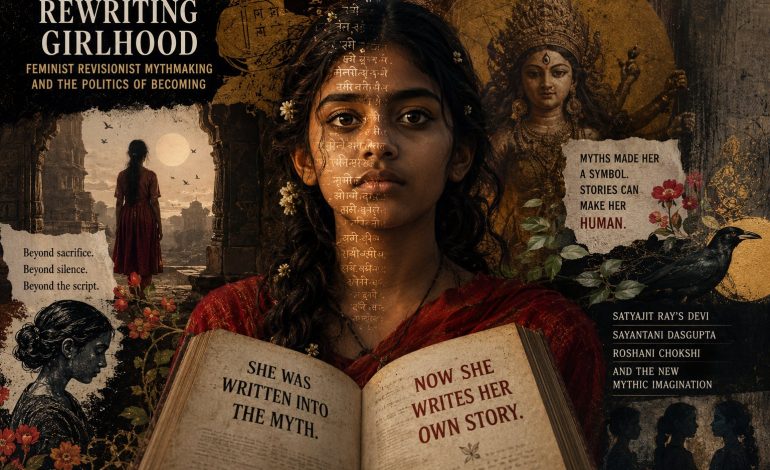

For centuries, myths have functioned as cultural blueprints—stories through which societies explain origins, morality, power, and identity. Yet these narratives have rarely been neutral. Embedded within their symbolic structures are deeply gendered assumptions that have shaped how femininity is imagined and understood. While gods embark on heroic quests and men emerge as agents of history, girls and women often remain confined to the margins: silenced, idealized, sacrificed, or transformed into symbols rather than subjects. This paper navigates feminist revisionist mythmaking with particular focus on concemporary bengali literature.
The emergence of feminist revisionist mythmaking in the 1970s marked a decisive intervention into this inherited narrative order. Influenced by the theoretical frameworks of second-wave feminism, writers and artists began revisiting myths not merely to retell them but to challenge the ideological foundations upon which they rested. Revisionist mythmaking became a powerful social, political, and literary practice aimed at exposing and dismantling patriarchal structures embedded within traditional narratives.
At the heart of this intervention lies a crucial question: what happens when the forgotten girl in mythology is allowed to speak?
Myth has long served as a cultural touchstone, shaping collective understandings of gender and social roles. Feminist scholarship has therefore sought to interrogate the stereotypes sustained through mythological narratives and examine the ways in which phallocentric storytelling has erased, distorted, or altogether excluded the category of the girl. While women have occasionally occupied prominent positions within mythic traditions, narratives of female individuation—stories that trace the formation of a girl’s identity, agency, and consciousness—have remained strikingly rare.
Girlhood occupies a peculiar and often unstable space within mythology. Neither child nor adult, the adolescent girl frequently inhabits a liminal zone where social anxieties surrounding sexuality, autonomy, and power converge. Her identity is perpetually in transition, rendered vulnerable to cultural regulation and symbolic appropriation. In many traditional myths, this transitional stage is either ignored or violently curtailed, reducing the girl’s journey into a prelude for marriage, sacrifice, or motherhood.
Contemporary revisionist narratives seek to recover this lost terrain. By revisiting ancient myths and legends, feminist writers and visual storytellers create alternative imaginative possibilities where girls are no longer passive recipients of destiny but active participants in shaping it. These narratives foreground questions of identity, autonomy, and resistance while challenging the rigid gendered spaces inherited from conservative mythological traditions.
Within the Bengali cultural imagination, such revisionist impulses find compelling expression in the works of filmmaker Satyajit Ray and contemporary feminist writers such as Sayantani DasGupta and Roshani Chokshi. Their narratives illuminate worlds shaped by rigid religious orthodoxy and ritualistic structures that frequently stand opposed to the values of empathy, rationality, and human compassion. Through nuanced storytelling, they expose how cultural and religious institutions often construct girlhood as an unstable category—one suspended between reverence and repression, visibility and erasure.
A haunting example emerges in Satyajit Ray’s film adaptation of Devi. The young Doyamoyee is transformed into a living goddess after her father-in-law becomes convinced that she is an incarnation of the Divine Mother. At first glance, this elevation appears empowering. Yet the ritual worship slowly erases her humanity. She ceases to be a daughter, wife, and individual. She becomes a symbol.
The tragedy of Doyamoyee lies in the paradox of patriarchal reverence. She is worshipped but not heard, exalted but not free. Through this powerful narrative, Ray demonstrates how myth and ritual can collaborate in producing a form of sacred imprisonment, especially for young women suspended between human identity and symbolic expectation.
In Ray’s cinematic universe, the collision between faith, superstition, and human vulnerability often reveals the devastating consequences of patriarchal belief systems. Similarly, DasGupta and Chokshi reimagine mythological frameworks through feminist lenses, restoring complexity and agency to young female protagonists who have traditionally been denied narrative authority. Their works reveal how myths do not merely reflect cultural values but actively participate in producing and regulating them.
What emerges from these revisionist engagements is a profound recognition of the need for mobility within cultural imagination. Girls require narrative spaces through which they can articulate their experiences, negotiate social constraints, and construct meaningful subjectivities. The journey toward selfhood becomes not simply a personal transformation but a political act of reclaiming voice within structures designed to silence it.
Equally significant is the intricate relationship between myth and ritual. Myths often solidify into rituals, and rituals in turn perpetuate the ideological assumptions embedded within myths. Together they create powerful cultural mechanisms that shape perceptions of gender and social belonging. By revisiting and reworking these structures, feminist revisionist narratives expose the ways in which ritualized traditions have historically constrained girlhood while simultaneously opening possibilities for alternative futures.
The significance of feminist revisionist mythmaking, therefore, extends beyond literary experimentation. It represents an act of cultural resistance—a deliberate effort to challenge inherited narratives and imagine new modes of being. Through the recovery of marginalized voices and forgotten subjectivities, revisionist myths transform the girl from an object of representation into a speaking subject, capable of defining her own destiny.
In an era increasingly attentive to questions of identity, power, and representation, these reimagined myths remind us that stories matter. They shape our understanding of who belongs, who speaks, and who is remembered. By reclaiming girlhood from the shadows of patriarchal mythology, feminist revisionist mythmaking and narratives not only rewrite ancient tales but also expand the horizons of what girls can become.
Chandra, S. 2026




1 Comment
[…] Source: The schizoid girl; exploring the feminist revisionist mythmaking sensibilities in contemporary Benga… […]