
The Price of Conviction: When Faith Demands Sacrifice – Episode 2

One of the most unsettling aspects of Silence is that the violence depicted in the film is never gratuitous. Every execution, every torture, and every act of public humiliation serves a specific purpose. The Japanese authorities are not interested merely in killing Christians; they want something far more devastating. They seek to destroy Christianity by compelling believers to renounce it publicly.
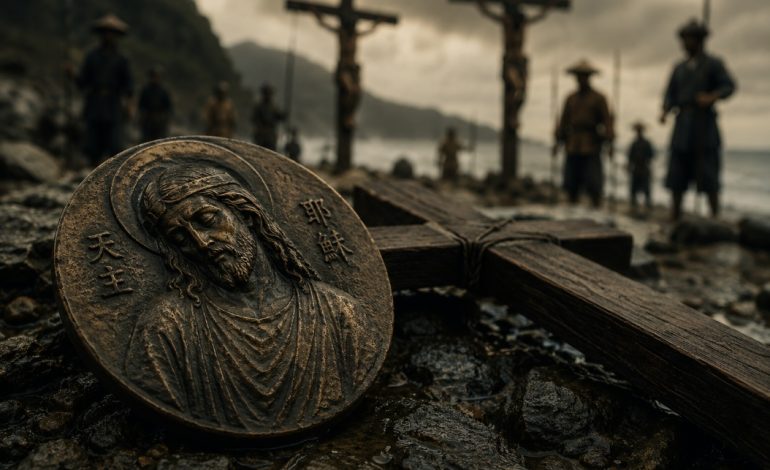
The instrument of this psychological warfare is the fumie—a small bronze image of Christ placed on the ground for suspected Christians to trample upon. To modern audiences, the act might appear almost symbolic. Yet within the world of the film, stepping on the image represents an unbearable spiritual violation. It is not simply an act of political compliance but an apparent betrayal of Christ Himself.
Scorsese repeatedly returns to this image because it crystallizes one of the central philosophical tensions of the narrative. Is faith defined by inward conviction or by outward performance? If one secretly continues to believe after publicly renouncing Christianity, has faith truly been lost? Conversely, if maintaining public fidelity condemns innocent people to horrific deaths, can such steadfastness still be called virtuous?
These questions expose what Derrida describes as the economy of sacrifice.
Unlike traditional theological readings that celebrate sacrifice as the highest expression of devotion, Derrida treats sacrifice with profound suspicion. In Faith and Knowledge, sacrifice is not simply a sacred offering but a structure through which communities attempt to secure moral certainty. Something valuable—a life, a body, an identity, or even one’s humanity—is surrendered in exchange for preserving a supposedly greater truth.
Religious history is filled with such exchanges. Martyrs sacrifice themselves for their faith. Saints renounce worldly pleasures for spiritual fulfilment. Entire communities endure persecution in the hope that suffering will affirm the authenticity of their belief.
But Derrida asks a disturbing question: What if sacrifice ultimately legitimizes violence instead of transcending it?
If every sacred cause requires victims, then violence is no longer an unfortunate consequence of religion—it becomes one of its organizing principles.
This insight transforms our understanding of Rodrigues’ predicament.
Initially, Rodrigues embraces the traditional ideal of martyrdom. Like generations of missionaries before him, he imagines suffering as evidence of spiritual fidelity. The possibility of dying for Christ appears not only acceptable but honourable. His journey to Japan is fuelled by a youthful certainty that authentic faith reveals itself through heroic endurance.
Yet Scorsese slowly dismantles this romantic vision.
Rodrigues soon discovers that the authorities have little interest in killing missionaries themselves. Instead, they torture ordinary Japanese converts while forcing the priests to watch. Men are crucified along the shoreline as waves slowly consume them. Others bleed to death while suspended upside down in pits. Entire villages are subjected to unimaginable suffering simply because they refuse to betray hidden priests.
The brilliance—and cruelty—of this strategy lies in its inversion of traditional martyrdom.
Rodrigues is no longer asked whether he is willing to die for his beliefs.
He is asked whether other people should continue dying for them.
This subtle shift radically alters the ethical landscape.
His refusal to apostatize no longer appears as an act of individual courage. Instead, it begins to resemble an insistence that others bear the consequences of his personal conviction. Every declaration of faith is measured against another human body subjected to unbearable pain.
Scorsese refuses to simplify this dilemma into a choice between courage and cowardice. Instead, he reveals that every available decision carries its own form of violence. To trample the fumie feels like betraying Christ. Yet refusing to do so condemns innocent believers to prolonged torture.
There is no morally uncontaminated position.
This ethical impasse echoes another philosophical influence woven into Derrida’s argument: the work of French thinker René Girard.
Girard famously argued that violence is not an accidental feature of human civilization but one of its foundational mechanisms. Human beings imitate one another’s desires, producing rivalry, conflict, and eventually collective violence. Ancient religions, Girard suggests, developed rituals of sacrifice precisely to contain this destructive cycle. By directing communal aggression toward a single victim—a scapegoat—societies temporarily restored order.
Derrida engages deeply with Girard’s theory while extending it in significant ways. He agrees that religion and violence are profoundly intertwined, but he is equally interested in the paradox that emerges when religions founded on peace become implicated in systems of coercion and sacrifice.
Silence vividly dramatizes this paradox.
The Japanese authorities believe Christianity is a destabilizing foreign ideology threatening social harmony. Their violence is therefore presented as necessary for preserving political order. Meanwhile, the missionaries understand their own suffering as participation in Christ’s passion, transforming persecution into evidence of divine truth.
Both sides justify violence through competing moral narratives.
Neither perceives itself as simply violent.
This mutual certainty is precisely what makes the conflict so tragic.
The film therefore resists the temptation to divide its characters into uncomplicated heroes and villains. While the brutality of the Japanese inquisitors is undeniable, Scorsese also encourages viewers to examine the assumptions underlying missionary zeal. Is evangelization itself free from coercion? Does introducing an exclusive religious truth into another culture inevitably generate conflict? At what point does the desire to save souls become inseparable from the production of suffering?
These questions do not diminish the courage of the persecuted Christians. Rather, they complicate the moral terrain in which their courage exists.
The film suggests that violence does not merely interrupt religious life; it becomes woven into its very structures of meaning. Martyrdom, conversion, persecution, and redemption all derive significance through narratives that continually negotiate the relationship between suffering and salvation.
This is where Derrida introduces one of his most provocative concepts: autoimmunity.
Borrowed from medical science, the term describes a condition in which the body’s immune system mistakenly attacks the very organism it is meant to protect. Derrida argues that religions—and indeed political systems, democracies, and institutions—often behave in precisely this manner.
They destroy themselves in the process of defending themselves.
The more passionately a community seeks to preserve its sacred identity, the greater the risk that it will undermine the ethical values upon which that identity originally depended.
Viewed through this lens, Silence becomes an extraordinary meditation on religious autoimmunity.
The missionaries arrive intending to spread compassion, hope, and salvation. Yet their very presence intensifies the persecution of Japanese Christians. Their mission, however sincere, inadvertently produces the suffering they hope to alleviate. Likewise, the Japanese authorities justify extraordinary cruelty in the name of preserving cultural harmony and political stability. Both sides believe they are protecting something sacred, yet each contributes to an escalating cycle of violence.
Faith, paradoxically, begins to wound itself.
It is this realization that gradually transforms Rodrigues. His struggle is no longer simply between belief and disbelief. Instead, he confronts the terrifying possibility that defending Christianity may require abandoning the very compassion Christianity teaches.
The film’s greatest achievement lies in refusing to resolve this contradiction. Instead, it invites viewers to inhabit the unbearable uncertainty that defines every genuine ethical decision—where every choice simultaneously preserves something precious and destroys something equally irreplaceable.