

The Scarred Violin: How The Mozart Question Turns Trauma into an Inheritance
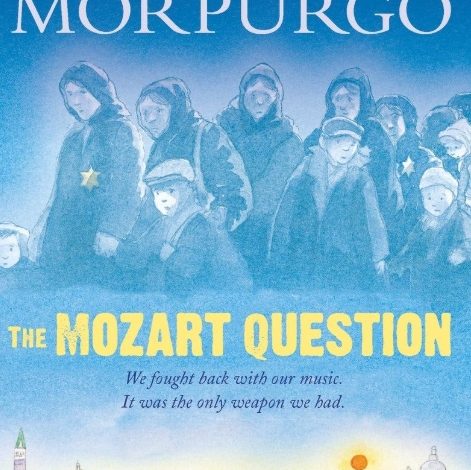

A violin lies hidden in a room in Venice. A boy wants to play it. His father does not want him to touch it. That is where the trouble begins. In Michael Morpurgo’s The Mozart Question, music is never simply music. A violin is not merely an instrument, Mozart is not merely a composer, and memory is not something safely locked in the past. Each carries the residue of another time. Each becomes a way of asking what happens when history enters a family—and when a child inherits a history he never personally lived.
The story begins deceptively gently. There is Venice: canals, gondolas, bread carried home, a boy fascinated by the possibility of music. Michael Foreman’s illustrations reinforce this atmosphere through warm, nostalgic watercolours, before the visual world gradually darkens into the subdued browns and greys of the concentration camp. The contrast is crucial. Morpurgo does not begin with Auschwitz. He begins with beauty.
And then he makes beauty remember.
At the centre of the narrative is Paolo Levi, a celebrated violinist who has spent his career refusing to play Mozart. When a young journalist, Lesley, travels to Venice to interview him, she is told that there is one question she must never ask: the Mozart question. Yet the prohibition itself becomes irresistible. Paolo eventually decides that the time has come to tell the story.
The narrative therefore operates like a piece of music: a theme is introduced, withheld, repeated and finally transformed.
But what exactly is inherited?
The Holocaust arrives as an echo
One of the most compelling features of The Mozart Question is that Paolo is not the primary victim of the historical trauma the story recounts. His parents are Holocaust survivors. As children’s literature scholar Cathy Caruth’s influential formulation of trauma suggests, traumatic experience is often characterised by belatedness: what has happened is not completely possessed in the moment of its occurrence but returns later, through repetition, fragments and testimony.
Paolo’s relationship with the Holocaust is therefore mediated.
He inherits it.
He does not remember the concentration camp because he was not there. Instead, he encounters the past through his parents’ silences, fears, prohibitions and stories. His father’s refusal to play music becomes a kind of memorial. The absence of Mozart becomes more eloquent than the presence of music.
This makes Paolo particularly interesting as a child subject. He is simultaneously inside and outside the traumatic past. He is a spectator to an experience that nevertheless shapes his identity.
Children’s literature has often been treated as a problematic space for representing historical catastrophe. How much can a child reader be told? How much violence can be represented without becoming overwhelming? Can the Holocaust be narrated without either reducing its horror or making it inaccessible to younger readers?
Morpurgo’s answer is neither to conceal trauma nor to reproduce it in exhaustive detail.
Instead, he makes trauma audible through what is withheld.
The question becomes more powerful than the answer.
When music becomes the wound
The most unsettling idea in the story is that music—the very thing we conventionally associate with beauty, culture and transcendence—has been contaminated by violence.
Morpurgo’s inspiration came from the historical existence of concentration-camp orchestras. Prisoners were forced to perform music under Nazi control; the music could accompany camp routines and, in some circumstances, the movement of prisoners toward death. Morpurgo has described being haunted by the question of what it might mean for a musician to love Mozart and yet have been forced to play Mozart in such circumstances.
That paradox becomes the emotional engine of the novel.
For Paolo’s father, Mozart is not Mozart anymore.
He is Auschwitz.
This is where the title becomes more than a narrative gimmick. The “Mozart question” is really a question about whether art can remain innocent after being used within systems of violence.
Can one return to a piece of music after history has changed its meaning?
Can an artwork be separated from the circumstances in which it was heard?
And perhaps most painfully: can a son love what his father can no longer bear?
Paolo’s passion for the violin creates precisely this conflict. The instrument connects him to his parents, but it also threatens to reopen the wound they have spent years trying to contain. His father’s prohibition therefore has a double meaning: it is an attempt to protect Paolo from the past and, at the same time, an attempt to protect himself from remembering it.
The violin becomes an inheritance.
But it is a scarred inheritance.
From memory to second-generation memory
This is where The Mozart Question becomes especially significant for children’s literature and trauma studies.
The story is not simply about Holocaust memory. It is about second-generation memory—the ways in which the descendants of survivors construct relationships with events they did not experience themselves.
Paolo’s memory is assembled from other people’s memories.
He listens.
He imagines.
He reconstructs.
He interprets.
Eventually, he incorporates his parents’ past into his own identity.
This complicates the conventional idea of memory as something possessed by an individual. Paolo’s identity is not an isolated Cartesian “self”; it is relational. His sense of who he is emerges through his parents, Benjamin, music and the stories surrounding the violin.
In this sense, memory travels.
It moves from body to body, from parent to child, from silence to speech, from one generation to another.
And children’s fiction is particularly suited to representing this movement because the child is already a figure of becoming. The child protagonist is not necessarily the owner of historical knowledge. The child is the one who discovers it.
That distinction matters.
Paolo does not inherit a finished history. He inherits fragments and has to decide what to do with them.
The child as witness
There is something radical about placing a child—or a young reader—at the threshold of traumatic history.
The child cannot possess the past in the same way as the survivor.
Nor can the child remain completely outside it.
The result is an ethically complicated position: the child becomes a witness to someone else’s witnessing.
This layered structure is one reason The Mozart Question works so effectively as children’s historical fiction. The Holocaust is not presented simply as a lesson from the past. Instead, the young reader encounters a character who is himself encountering the past.
Lesley performs a similar function.
She arrives in Venice expecting an interview. She leaves having become the recipient of a testimony.
Her curiosity initially resembles the curiosity of the reader: What is the Mozart question? Why won’t Paolo play Mozart?
But curiosity slowly becomes responsibility.
The forbidden question opens the door to a history that cannot be reduced to an answer.
The narrative thus turns reading itself into an ethical act. We, like Lesley, ask to know. But The Mozart Question also makes us confront the consequences of wanting to know.
When the story leaves the page
The story becomes even more interesting when it moves into theatre. Adaptation changes the politics of witnessing because the audience does not merely read about music—it encounters music, voice, silence, space and the physical presence of a performer.
The theatrical adaptation by Simon Reade was performed as a one-person show and later acquired strikingly different theatrical dimensions. At the Hay Festival, the adaptation combined spoken narrative with violin performance and a string ensemble, making the relationship between testimony and music literally audible.
Then came Lata Nobes’s production.
In Nobes’s 2019 Mozart Question, the protagonist’s gender was changed: Paolo became Paola. The production employed projections, sound effects and live music, with Olivia Wormald performing the central role.
This is not simply a theatrical rearrangement.
It demonstrates that inherited trauma is not static.
Every adaptation asks: whose body carries this memory now?
On the page, Paolo’s story is mediated through Morpurgo’s narration and Foreman’s illustrations. On stage, trauma acquires a body, a voice and a temporal presence. The actor must inhabit the memory in front of us. Music can suddenly cease to be an object described by the narrator and become an event experienced by the audience.
The theatre therefore makes visible something the novel already suggests: trauma is transmitted through performance.
A story is performed.
A memory is performed.
Even silence can be performed.
The uncomfortable problem of representation
Yet The Mozart Question should not be praised without reservation.
Its historical imagination has generated criticism. Publishers Weekly, for example, pointed to a significant historical problem in the novel’s representation of men and women being together in concentration-camp orchestras.
This matters enormously.
A children’s book about historical trauma has an ethical obligation to history. If the narrative alters historical realities, even for dramatic purposes, the question is not simply whether the story is moving. The question is what kind of historical knowledge the child reader is receiving.
This tension gives The Mozart Question an unexpected complexity.
It is simultaneously a story about remembering and a story that raises questions about how stories remember.
The book asks us to distrust silence, but it also asks us to distrust narrative simplification.
That contradiction is productive.
It reminds us that historical fiction can never substitute entirely for history. Art can open a door onto the past, but it cannot claim to possess the past.
The violin that changes hands
Perhaps the most moving way to understand the novel is to think of the violin itself as a metaphor for intergenerational memory.
It passes from one generation to another.
But it does not arrive unchanged.
For Paolo’s parents, music is entangled with terror. For Paolo, it gradually becomes a language through which he can approach what his parents could not articulate. The same object therefore carries different emotional meanings for different generations.
This is what makes the story more than a conventional Holocaust narrative.
The central question is not only:
What happened to the survivors?
It is also:
What happens to their children because it happened?
And then:
What will their children do with what they have inherited?
Paolo’s eventual relationship with music suggests that inheritance does not have to mean repetition. The second generation can receive trauma without being condemned to reproduce it unchanged.
Music can become both wound and possibility.
The violin can remember differently.
Beyond the Western “self”
This is perhaps the most radical implication of Morpurgo’s story.
The Western philosophical tradition has often imagined the self as autonomous, coherent and self-contained. The Mozart Question offers something messier.
Paolo is made of relationships.
He is son, musician, student, listener, inheritor and storyteller.
His identity exists in the space between his own desires and the memories handed down to him.
His parents’ past becomes part of his present, but he is not merely a repetition of his parents.
This is precisely where intergenerational trauma unsettles conventional ideas of subjectivity. The self is porous. Memory crosses its borders.
We do not simply remember our own lives.
Sometimes we remember what happened to those who came before us.
Sometimes we carry memories we never personally made.
And sometimes art becomes the vessel in which those memories survive.
So, what is the Mozart question?
Perhaps the most powerful answer is that there is no single Mozart question.
There are several.
Can music survive its history?
Can beauty survive violence?
Can a child inherit a wound without inheriting the silence surrounding it?
Can testimony belong to someone who did not experience the original event?
Can art preserve trauma without turning suffering into spectacle?
And finally, perhaps the question at the heart of Morpurgo’s story:
What do we do with the things our parents could not bear to remember?
That is why the violin matters.
It is scarred, but it is still capable of producing music.
The scar does not disappear.
The music does not erase the past.
Instead, the two exist together.
And perhaps that is what The Mozart Question ultimately teaches its young readers: memory is not a museum in which the past sits untouched behind glass. It is an inheritance continually reinterpreted by those who receive it.
Paolo does not escape his parents’ history.
He learns to play through it.
And somewhere between the silence of a father and the music of a son, trauma becomes testimony, testimony becomes art, and art becomes a way of carrying the past without allowing the past to have the final word.
Chandra, S. 2026
References
Caruth, 1995. Trauma : Explorations in Memory. Baltimore, John Hopkins University Press.
Fackler, Guido. “Cultural Behaviour and the Invention of Traditions: Music and Musical Practices in the Early Concentration Camps, 1933-6/7.” Journal of Contemporary History, vol. 45, no. 3, 2010, pp. 601–27. JSTOR, http://www.jstor.org/stable/20753617.
Morpurgo.M, 2015. The Mozart Question. Walker Books Ltd.



1 Comment
[…] Source: The Scarred Violin: How The Mozart Question Turns Trauma into an Inheritance […]