
Why Rabindranath Tagore’s Nationalism Debate Still Matters ?
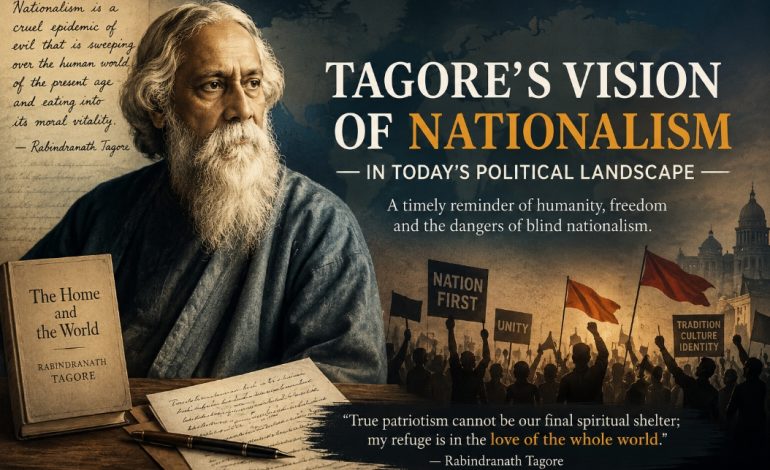

In an age where nationalism dominates political speeches, election campaigns, and social media debates, Tagore’s Nationalism critique deserve renewed attention. More than a century ago, when the world was witnessing imperial expansion and rising national rivalries, Tagore questioned whether nationalism, when elevated above humanity, could become dangerous. Today, his concerns echo across democracies grappling with polarization, identity politics, and shrinking spaces for dissent.
Tagore was never against love for one’s country. What troubled him was the transformation of patriotism into an ideology that demanded unquestioning loyalty while suppressing compassion, critical thought, and individual freedom. His 1916 lectures on nationalism described it as a force capable of replacing moral responsibility with the pursuit of power and material dominance. History would later validate many of his fears.
These philosophical concerns found their most compelling literary expression in The Home and the World. Set during Bengal’s Swadeshi Movement following the 1905 Partition of Bengal, the novel explores a moment when anti-colonial resistance was increasingly intertwined with emotional fervor and political extremism. While the movement began with the noble objective of promoting indigenous industries through the boycott of British goods, it gradually became marked by coercion, communal tensions, and ideological rigidity. Tagore, once a supporter of the movement, became deeply disillusioned by this transformation.
Rather than writing a political manifesto, Tagore created three unforgettable characters who embody competing visions of the nation.
Nikhil represents ethical patriotism. Rational, compassionate, and deeply committed to individual liberty, he believes that no political cause is worthy if it sacrifices human dignity. His nationalism is rooted in justice rather than domination. He refuses to manipulate emotions or justify violence even when doing so appears politically advantageous. In many ways, Nikhil reflects Tagore’s own conviction that true freedom begins with moral integrity.
Standing in sharp contrast is Sandip, a charismatic nationalist whose fiery speeches and emotional appeals captivate those around him. For Sandip, the nation is an object of worship that demands absolute sacrifice. He weaponizes symbols, rhetoric, and collective emotions to achieve political goals, often blurring the line between patriotism and fanaticism. His character serves as a reminder that charismatic leadership, when detached from ethical responsibility, can become profoundly dangerous.
Caught between these opposing visions is Bimala, whose personal journey mirrors the political awakening of a nation. Initially confined within the domestic sphere, she is encouraged by Nikhil to engage with the wider world. Yet her exposure to Sandip’s passionate politics creates an emotional and moral conflict. Her struggle is not merely personal—it reflects India’s own confrontation with competing ideas of modernity, nationalism, and identity.
Tagore also presents a striking commentary on gender. Bimala is more than an individual character; she becomes a symbolic representation of the nation itself. Her body, choices, and loyalties become sites of political contestation. Through her, Tagore exposes how nationalist movements often celebrate women as cultural symbols while limiting their autonomy. This insight remains remarkably relevant in societies where debates about culture, tradition, and national identity frequently revolve around controlling women’s roles and choices.
Perhaps the most remarkable aspect of The Home and the World is its refusal to present politics as a simple contest between heroes and villains. Instead, it asks uncomfortable questions. Can noble ideals survive when fueled by hatred? Can freedom be achieved through coercion? Is national pride meaningful if it erodes empathy and democratic values?
These questions resonate powerfully in today’s political landscape. Around the world, democratic societies are witnessing increasing polarization, aggressive majoritarian narratives, digital misinformation, and growing hostility toward opposing viewpoints. Political identities are often shaped less by shared civic values than by emotional appeals to history, religion, or cultural identity. In such an environment, Tagore’s insistence on universal humanism offers an important counterpoint.
His vision challenges the assumption that nationalism and humanity must exist in conflict. Instead, he argues that genuine patriotism strengthens a nation by protecting its ethical foundations rather than by demanding ideological conformity. For Tagore, the health of a nation depends not on loud declarations of loyalty but on its ability to preserve compassion, intellectual freedom, and respect for difference.
More than one hundred years after its publication, The Home and the World remains remarkably contemporary because it refuses to offer easy political answers. Instead, it reminds readers that the greatest challenge for any democracy is not merely achieving freedom but preserving humanity while pursuing it.
As political discourse becomes increasingly polarized across the globe, Tagore’s message stands as both a warning and a hope: nations may define our borders, but it is our shared humanity that ultimately defines our civilization.
CHANDRA, S. 2026
References
Bellow, Saul. "Where Do We Go From Here: The Future of Fiction." Sau Critics. Ed. Irving Malin. New York: New York University.
Chatterjee, Kalyan. "Lukacs on Tagore: Ideology and Literary Criticism." Indian
literature 313 (1988):153-160.
Chatterjee, Partha. "The Nationalist Resolution of the Woman Question."Sangari and Vaid 233-253
Mitra, Indrani. “‘I WILL MAKE BIMALA ONE WITH MY COUNTRY’: GENDER AND NATIONALISM IN TAGORE’S ‘THE HOME AND THE WORLD.’” Modern Fiction Studies, vol. 41, no. 2, 1995, pp. 243–64. JSTOR, http://www.jstor.org/stable/26285526.
Quayum, Mohammad A. “In Search of a Spiritual Commonwealth : Tagore’s ‘The Home
and the World.’” Journal of South Asian Literature, vol. 31/32, no. 1/2, 1996, pp. 32–45.
JSTOR, http://www.jstor.org/stable/23234182.
Sarkar, Tanika. "Nationalist Iconography: Images of Women in Nineteenth-Century
Bengali Literature." Economic and Political Weekly 21 November 1987:2011-2015.
Tagore Rabindranath. The Home and the World. Trans. Surendranath Tagore. New York:
Macmillan, 1919. Rpt. Macmillan, India, 1985.
-Nationalism. London: Macmillan, 1917.