
A Father’s Unconditional Love: A Heartfelt Story of LGBTQ+ Acceptance and Courage
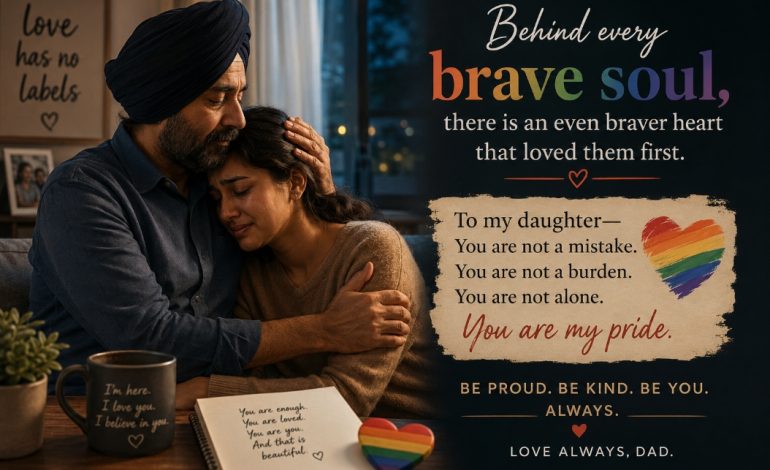

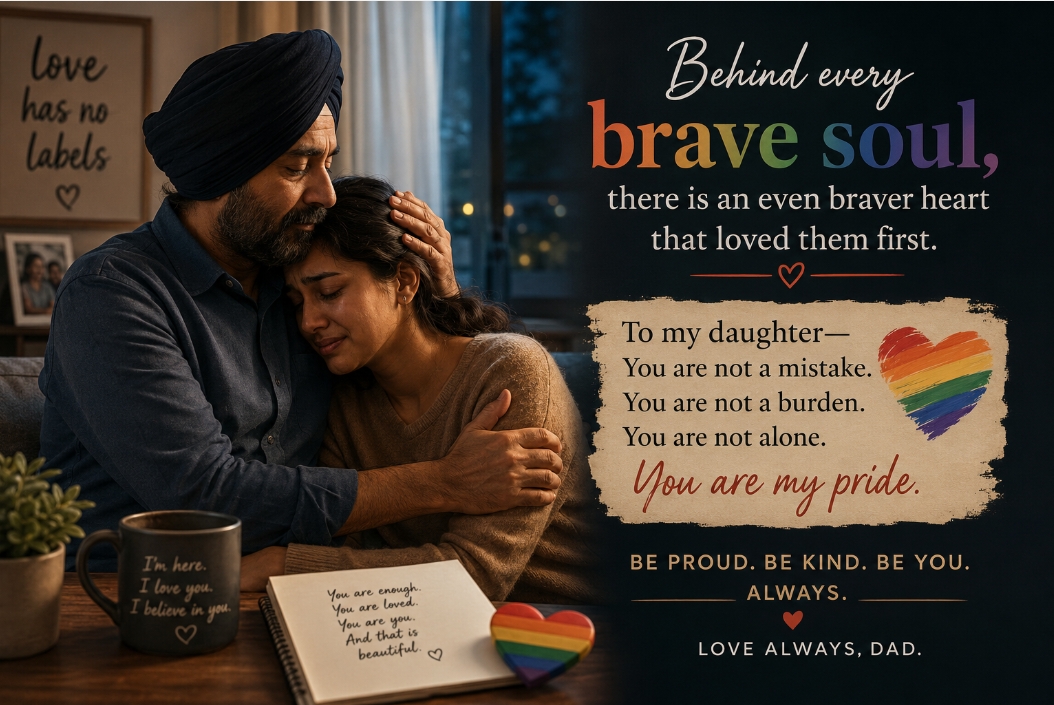
Sometimes the bravest love isn’t romantic. Sometimes it is a father’s quiet voice on the other end of the phone, refusing to let his daughter believe the world’s cruelest lies.
The clock had become Sarabjit’s greatest adversary.
Every passing minute tightened the knot in his chest. Sweat slid down his chin—not merely because the afternoon was unbearably humid, but because anxiety possesses a peculiar warmth of its own. It burns silently, from within.
His fingers hovered over the same contact for what seemed like the hundredth time.
Saihaj.
No answer.
Again.
No answer.
The untouched cup of coffee in his hands had long gone from comfort to torment. Its rising steam scalded his palms much like his thoughts scorched his mind. Was this simply a father’s instinct? Or was it that mysterious connection that exists between people bound not merely by blood, but by love?
Some fears arrive without explanation.
A few days earlier, Saihaj had shared a truth she could no longer hide.
She was in love.
The only problem, according to the world around her, was that the person she loved was another woman.
That single confession transformed her life almost overnight. Family members recoiled in disappointment. Colleagues who once respected her began looking through her rather than at her. Whispers followed her through corridors. Conversations ended when she entered rooms. Every smile seemed rehearsed; every silence carried judgment.
For everyone else, it became a debate.
For Saihaj, it became survival.
Only one person never questioned her.
Her father.
The Weight of Invisible Wounds
Eventually, Sarabjit placed his phone on the coffee table.
He tried convincing himself she was simply busy teaching at the university where she worked as a professor.
But his heart refused logic.
He imagined her walking through corridors lined not with colleagues but with suspicion. Every glance becoming an accusation. Every conversation carrying the sting of prejudice.
Earlier that day, lost in emotional exhaustion, Saihaj had stepped out of the elevator.
She stumbled.
The folder slipped from her hands.
Sheets of paper scattered across the floor like fragments of a life she was desperately trying to hold together.
Some people walked past.
Some stared.
Very few helped.
Sometimes life’s cruelest moments are painfully ordinary.
The Phone Call Every Parent Fears
The vibration of his phone startled him.
For a second he simply stared at the screen.
Saihaj Calling.
A thousand dreadful possibilities dissolved into one overwhelming relief.
He answered immediately, disguising panic beneath the calmness only fathers seem capable of mastering.
“Hello.”
His voice carried the quiet rhythm of reassurance, as though every syllable whispered,
“I’m here.”
A fragile voice responded.
“Dad…”
It trembled.
“I… I’m sorry. I couldn’t answer your calls. I was actually…”
Before she could continue, Sarabjit already knew.
Something had broken.
Not physically.
Emotionally.
“Dad… Am I Shameless?”
He asked gently,
“Saihaj, are you alright? I just wanted to hear your voice…”
The sentence never reached its end.
Instead, he heard sobbing.
Raw.
Uncontrolled.
The kind of crying people reserve for moments when they no longer have the strength to pretend they are okay.
Silence followed.
Not an empty silence.
One crowded with fear.
Then came the question that pierced him more deeply than any accusation ever could.
“Dad… am I shameless? Am I someone people cannot trust? Is loving another woman such a terrible crime? You told me I did nothing wrong. Then why do they treat me as though I’ve lost my dignity?”
Questions born from prejudice are never really questions.
They are wounds searching for permission to heal.
A Father Remembered His Own Battles
As Sarabjit listened, another version of himself emerged from memory.
Twenty-two years old.
A single father.
Holding an adopted daughter in his arms while the world questioned every decision he made.
People had doubted him too.
They had questioned whether a young unmarried man could ever raise a child with compassion, stability, or wisdom.
He remembered feeling inadequate.
Remembered wondering whether love alone could ever be enough.
Today, decades later, those same insecurities echoed in his daughter’s trembling voice.
Different circumstances.
Identical pain.
The struggle was never really about sexuality.
It was about acceptance.
About being told your existence required justification.
“Have I Failed You?”
Then came the question every loving parent hopes never to hear.
“Dad…
They say someone like me cannot be trusted.
Have I failed as a person?
Have I failed you?”
For a brief moment, words abandoned him.
He remembered teaching her confidence.
Teaching her kindness.
Teaching her to speak even when her voice shook.
He had raised her not to seek validation but to become someone capable of offering it to others.
Could the cruelty of strangers erase years of love?
Never.
The Conversation That Saved More Than Confidence
He gathered himself before speaking.
“There are millions of voices in this world,” he said softly.
“But in the end, only one truly determines who you become.
Your own.
Feeling uncertain is human.
Being overwhelmed is human.
But never suffocate your beliefs just because someone else refuses to understand them.
You may not be perfect.
Parts of you may feel broken today.
Yet those imperfections are not flaws—they are proof that you’ve lived honestly.
When you’re different, you’ll often notice only the one person who rejects you, forgetting the countless others who quietly admire your courage.
Don’t spend your life staring at a single crack while ignoring the beauty of the entire mural.
You can travel across the whole universe and still never find another person more deserving of your love than yourself.”
Silence returned.
This time, it was different.
He heard it.
A tiny laugh.
A hesitant chuckle.
Then something far more precious.
Hope.
The Quiet Heroism of Fatherhood
People often imagine heroism as grand gestures.
It rarely is.
Sometimes heroism sounds like answering a phone before the second ring.
Sometimes it means carrying another person’s doubts until they are strong enough to carry themselves again.
Sometimes it means becoming a shelter when the world insists on becoming a storm.
That is what fathers do.
They absorb fears their children cannot yet bear.
They become steady while quietly breaking inside.
They protect not only their children’s bodies but also their confidence, dignity, and sense of self.
Sarabjit did not change society that afternoon.
He did something infinitely more powerful.
He prevented his daughter from believing society’s cruelty.
And perhaps that is where every meaningful revolution begins—not in crowds or slogans, but in a single conversation where love speaks louder than prejudice.
Because at the end of it all, every label faded.
Every argument became irrelevant.
Only one truth remained.
He was a father.
The man who once swung his little girl above his head.
The man who built sandcastles with her and promised they would last forever.
The man who brushed her hair away from her face whenever tears blurred her vision.
The man who reminded her, even when she forgot, that she had always been worthy of love.
And in a world eager to judge, perhaps there is nothing more extraordinary than a parent who chooses acceptance over approval.
Final Thoughts
Love should never require an apology. Yet countless LGBTQ+ individuals continue to face rejection, isolation, and prejudice simply for being honest about who they are. Families often become the first battlefield—but they can also become the first sanctuary.
If there is one lesson from Sarabjit and Saihaj’s story, it is this:
Acceptance doesn’t erase suffering overnight, but it gives someone the strength to survive it.
Sometimes, the most powerful act of love is simply answering the phone and saying,
“I’m here.”