

Dharma in the Mahabharata: Ethics, Duty and Adharma

The Problem of Dharma
Few concepts are as central to the intellectual and ethical world of the Mahabharata as Dharma. Yet Dharma is also among the most difficult concepts to translate or reduce to a single definition. It may encompass duty, righteousness, law, morality, justice, social obligation, religious responsibility and the sustaining order of the cosmos. Its meaning shifts according to the person, circumstance and ethical relationship involved.
This complexity distinguishes the Mahabharata from a straightforward moral narrative. The epic does not simply present Dharma as a fixed collection of rules and Adharma as their violation. Instead, it dramatizes situations in which competing duties collide and in which adherence to one obligation may produce the violation of another.
The fundamental question is therefore not merely “What is Dharma?” but rather:
How does one recognise Dharma when every available choice carries moral consequences?
This question animates the Mahabharata‘s treatment of kingship, warfare, family, gender, political authority and personal responsibility. From Yudhishthira’s decision to participate in the dice game to Draupadi’s interrogation of the Kuru assembly, from Karna’s loyalty to Duryodhana to Krishna’s morally ambiguous strategies, the epic repeatedly demonstrates the instability of ethical certainty.
The Mahabharata is consequently best understood not simply as a conflict between Dharma and Adharma, but as an extended exploration of the conditions under which Dharma becomes difficult, contested and vulnerable to violation.
Understanding Dharma in the Mahabharata
The Sanskrit term Dharma derives from the verbal root dhṛ, conventionally associated with the idea of sustaining, supporting or upholding. In the epic’s ethical universe, Dharma can consequently be understood as that which sustains relationships, social order, political responsibility and, at a broader level, cosmic order.
This meaning is necessarily contextual.
The Dharma of a king is not identical to that of a warrior, parent, wife, teacher or subject. Duties emerge from relationships and social positions, while circumstances may alter how those duties ought to be interpreted.
Thus, Dharma cannot be understood exclusively as law, nor can it be reduced to religion in the modern sense. It operates at the intersection of individual conduct, social responsibility and cosmic order.
Aditya Adarkar’s formulation is particularly useful here: Dharma involves conceiving the universe as part of a unified moral enterprise rather than treating morality, nature and divine order as completely separate domains.
The significance of this formulation becomes clearer in the Mahabharata, where private decisions repeatedly produce public and cosmic consequences.
A king’s personal weakness can destabilise a kingdom.
A family’s rivalry can generate civil war.
A single act of humiliation can become the moral justification for generations of conflict.
Dharma therefore connects the individual to a larger moral structure.
The Mahabharata as a Dramatic Laboratory of Ethics
The ethical universe of the Mahabharata differs significantly from a purely prescriptive text.
The epic contains extensive discussions of Dharma, including teachings associated with kingship, social duty, asceticism, justice and conduct. Yet these principles are repeatedly tested through narrative.
Characters encounter circumstances in which two or more legitimate obligations appear to conflict.
This makes the Mahabharata a kind of dramatic laboratory of Dharma.
Rather than merely stating an ethical principle, the epic asks what happens when that principle is placed under extreme pressure.
The contrast with the Ramayana is instructive, although it should not be overstated. Rama is frequently represented as an exemplary figure whose conduct demonstrates the demanding nature of duty. The Mahabharata, by contrast, is populated by characters whose commitments to Dharma are frequently compromised by competing obligations.
Yudhishthira knows Dharma but gambles.
Bhishma understands duty but remains bound to the Kuru throne.
Karna values loyalty but supports a politically unjust cause.
Dhritarashtra recognises danger but repeatedly fails to restrain his son.
Krishna advocates the restoration of Dharma but does not always rely upon conventional ethical rules to achieve it.
The result is an epic in which moral knowledge and moral action are persistently separated.
This is one reason scholars have treated the Mahabharata as a major site for the literary and philosophical exploration of Dharma. Robert Lingat’s characterization of the epic in relation to Dharma tradition as a Dharma Smriti points toward its significance within the history of Hindu legal and ethical thought, even though the epic itself remains far more internally complex than a conventional legal text.
Dharma and Rajdharma in the Sabha Parva
Yudhishthira and the Ethics of the Dice Game
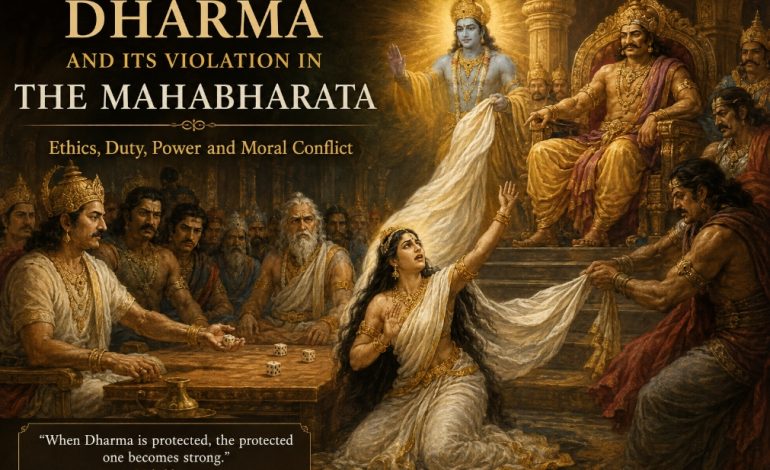
The Sabha Parva provides perhaps the most concentrated representation of the crisis of Dharma.
Yudhishthira is invited to participate in a game of dice at the Kuru court. Vidura warns against the dangers of the invitation, yet Yudhishthira accepts.
His decision is crucial because it reveals the tension between personal judgment and Rajdharma.
Yudhishthira’s conception of royal duty makes withdrawal from a formally issued challenge difficult. He is not simply acting as an individual who enjoys gambling; he is acting as a king operating within a political culture governed by expectations concerning honour, sovereignty and obligation.
Yet the consequences of his decision are catastrophic.
He loses his wealth.
He loses his kingdom.
He stakes his brothers.
He stakes himself.
And finally, Draupadi becomes the object of the wager.
The episode exposes the central paradox of Yudhishthira’s character:
Can strict adherence to an obligation become Adharma when the consequences of that obligation are destructive?
The Mahabharata does not resolve this problem by simply declaring Yudhishthira either righteous or unrighteous. Instead, it makes his conduct an object of ethical scrutiny.
His tragedy lies partly in the possibility that his commitment to formal Dharma becomes detached from the moral consequences of his actions.
Draupadi and the Jurisprudence of Dharma
The humiliation of Draupadi is arguably the defining ethical crisis of the Sabha Parva.
When Draupadi is brought into the assembly, she does not respond merely through emotional protest. She raises a juridical and philosophical question concerning the legitimacy of Yudhishthira’s wager.
Her argument is devastating:
If Yudhishthira had already lost himself, did he retain the legal and moral authority to stake another person?
This question transforms the scene.
The dice game is no longer simply a contest between Pandavas and Kauravas. It becomes a dispute concerning the nature of authority, ownership, personhood and law.
Draupadi effectively places the Kuru court itself on trial.
Her intervention demonstrates that Dharma cannot be reduced to the authority of the person who invokes it. A king may claim legitimacy, but his decisions remain subject to ethical and juridical scrutiny.
Iravati Karve’s interpretation of Draupadi is particularly significant in this context. In Yuganta, Draupadi’s intelligence and awareness of the legal and ethical dimensions of the situation become central to understanding how she challenges the assembly and contributes to the restoration of her husbands’ freedom.
Her role is therefore not passive.
Draupadi becomes an interpreter of Dharma at the precise moment when the male authorities of the court fail to provide a convincing interpretation of it.
The Silence of Bhishma and Drona
The reaction—or lack of decisive reaction—of Bhishma and Drona creates another layer in the epic’s examination of Dharma.
Both are extraordinary warriors and repositories of knowledge.
Yet during Draupadi’s humiliation, neither successfully intervenes to prevent the degradation unfolding before them.
Their hesitation is significant because it demonstrates that moral authority does not automatically translate into moral action.
Bhishma’s uncertainty regarding the legal status of Draupadi reveals a profound conflict between competing conceptions of Dharma. His attachment to the Kuru throne, his vows and his understanding of social order constrain his response.
This does not necessarily make his inaction morally innocent.
Indeed, the power of the episode lies precisely in its ambiguity.
The Mahabharata forces the reader to confront a difficult possibility:
Can ethical uncertainty itself become ethically culpable when injustice is taking place?
The question extends beyond the epic. It concerns the responsibility of individuals who recognise wrongdoing but hesitate to act because institutional rules, competing obligations or uncertainty prevent decisive intervention.
Dhritarashtra and the Failure of Kingship
Dhritarashtra’s conduct reveals another dimension of violated Dharma: the failure of Rajdharma.
As king, Dhritarashtra possesses the authority to prevent the humiliation of Draupadi and to restrain the destructive ambitions of his son.
Instead, he remains largely passive until the consequences become impossible to ignore.
After witnessing the disastrous outcome of the assembly, he attempts to pacify Draupadi by granting her boons. Draupadi uses these opportunities not for personal enrichment but to secure the freedom of Yudhishthira and the other Pandavas, together with their weapons.
Her refusal to exploit the situation for a further personal advantage is significant.
The scene contrasts two forms of power.
Dhritarashtra possesses institutional power but repeatedly fails to exercise it decisively.
Draupadi possesses comparatively little political power in the assembly, yet she exercises moral and intellectual authority.
The distinction is central to the epic’s conception of righteous kingship.
Power without ethical responsibility cannot sustain Dharma.
The Rajsuya Yajna and the Ambiguity of Righteous Power
The crisis of Dharma in the Mahabharata cannot be confined to the dice game. It is already visible in the Pandavas’ rise to imperial power.
Yudhishthira’s Rajsuya Yajna establishes his sovereignty and represents a major political and ritual achievement.
The campaign associated with the Rajsuya requires the defeat of powerful rulers, most notably Jarasandha of Magadha. Krishna plays a decisive role in the Pandavas’ political project.
From one perspective, these actions can be understood as the restoration of legitimate political order.
From another, the episode raises questions about ambition, sovereignty and the relationship between Dharma and power.
The lavishness of Indraprastha and the Pandavas’ increasing political prestige contribute to the atmosphere of rivalry that culminates in the dice game.
This is important because the Mahabharata does not present Dharma as existing outside politics.
Dharma must operate through political institutions, yet political institutions can themselves become sites of Adharma.
The Rajsuya therefore reveals the double nature of power: it can sustain order, but it can also generate pride, rivalry and political violence.
Krishna, Shakuni and the Ethics of Strategy
The parallel between Krishna and Shakuni provides a particularly productive way of examining the ethical ambiguity of the epic.
Shakuni becomes the principal strategist behind the dice game, while Krishna repeatedly assists the Pandavas in navigating political and military crises.
Both operate through intelligence and strategy.
Yet the epic does not treat their strategies as morally equivalent.
The difference lies partly in the ends toward which strategy is directed.
Shakuni’s manipulation contributes to dispossession, humiliation and political destruction.
Krishna’s interventions are framed within the larger project of restoring Dharma.
Yet Krishna himself complicates conventional morality. His strategies during the war sometimes involve deception, unconventional tactics and the deliberate exploitation of vulnerabilities.
This suggests that the Mahabharata does not endorse a simplistic principle according to which Dharma always operates through conventional means.
Instead, it raises the difficult problem of whether morally desirable ends can justify morally ambiguous means.
The question becomes particularly acute in the Bhagavad Gita and the wider war narrative, where the obligation to act must be reconciled with the terrible consequences of action.
Karna and the Conflict Between Loyalty and Dharma
The Udyoga Parva intensifies the epic’s exploration of conflicting obligations through Karna.
Krishna reveals Karna’s birth and offers him the possibility of joining the Pandavas.
Karna refuses.
His decision reflects the extraordinary importance of loyalty in his moral identity. Duryodhana had provided Karna with recognition, political status and friendship at a time when Karna’s social position remained contested.
Karna therefore understands his relationship with Duryodhana as an obligation.
This creates one of the Mahabharata‘s most painful ethical dilemmas:
Is loyalty itself Dharma when the person to whom one is loyal is acting against Dharma?
Karna chooses loyalty.
His decision is morally compelling because it is rooted in gratitude and fidelity.
At the same time, it is tragic because his loyalty binds him to a political cause whose actions increasingly violate the principles he otherwise embodies.
Karna thus demonstrates that virtue in one sphere can become destructive when isolated from the wider moral order.
Dharma and the Problem of Formalism
Yudhishthira’s character offers perhaps the clearest illustration of the dangers of excessive formalism.
He is repeatedly associated with Dharma and is identified with Dharmaraja. Yet his actions demonstrate that knowledge of rules is insufficient for ethical judgment.
The dice game exposes this distinction.
Yudhishthira follows the formal structure of the challenge, but the consequences reveal the inadequacy of treating formal obligation as the entirety of Dharma.
The Mahabharata therefore distinguishes, implicitly or explicitly, between:
- following a rule, and
- understanding the purpose of righteousness.
This distinction is crucial.
Dharma cannot simply mean obedience to whatever rule happens to govern a particular situation. It must also involve consideration of justice, consequence, relationship and the larger moral order.
This is why the epic’s ethical universe is so difficult to reduce to a fixed code.
Dharma and Adharma: Beyond a Simple Good-versus-Evil Binary
It would be tempting to describe the Pandavas as embodiments of Dharma and the Kauravas as embodiments of Adharma.
The narrative certainly creates strong contrasts between the two sides, particularly in its representation of Duryodhana’s jealousy, ambition and hostility toward the Pandavas.
Yet such a binary interpretation does not adequately explain the epic’s ethical complexity.
The Pandavas themselves commit morally questionable acts.
The Kaurava camp contains individuals whose virtues cannot simply be dismissed.
Karna is loyal.
Bhishma is principled.
Drona is devoted to knowledge and martial excellence.
Even Duryodhana’s relationships are marked by genuine forms of loyalty and friendship.
The distinction between Dharma and Adharma therefore does not map perfectly onto two opposing groups.
Rather, Dharma and Adharma operate within individuals, institutions and decisions.
The epic’s characters move between them.
From Sabha to Kurukshetra: The Karma of Political Action
The connection between Dharma and Karma provides the larger philosophical structure through which the epic’s events can be interpreted.
Karma, in this context, is not merely a system of supernatural reward and punishment. It also expresses the principle that actions generate consequences that exceed the immediate moment in which they occur.
The dice game is therefore more than a discrete episode.
Its consequences accumulate.
The Pandavas are dispossessed.
Draupadi is humiliated.
The relationship between the two branches of the Kuru family deteriorates.
Exile follows.
Attempts at reconciliation fail.
Finally, the conflict culminates in Kurukshetra.
The war is therefore not an isolated event.
Kurukshetra is the accumulated consequence of earlier political, familial and ethical failures.
The moral catastrophe of the battlefield has its origins in the moral compromises of the court.
In this sense, the Mahabharata presents history itself as a field of Karma.
Actions become consequences.
Consequences become obligations.
Obligations produce further actions.
And eventually, a conflict that might once have been resolved politically becomes irreversible.
Why the Mahabharata’s Concept of Dharma Still Matters
The enduring significance of Dharma in the Mahabharata lies precisely in its refusal to provide uncomplicated moral certainty.
The epic recognises that individuals occupy multiple moral worlds simultaneously.
A person may be:
- a parent and a ruler;
- a warrior and a teacher;
- a friend and a political actor;
- a subject and a family member;
- an individual and a representative of an institution.
Each identity generates obligations.
The problem arises when those obligations conflict.
The Mahabharata therefore remains relevant because its central ethical dilemmas are not confined to ancient India.
Modern institutions continue to confront similar questions.
Should an employee obey an institution when its decision appears unjust?
Should loyalty to family override impartial justice?
Can political necessity justify morally questionable action?
Does silence in the face of injustice constitute responsibility?
Can obedience become unethical?
These are essentially questions of Dharma, even when the modern world uses different vocabulary.
Conclusion: Dharma Is a Question, Not a Simple Answer
The Mahabharata does not present Dharma as a static moral code that can be mechanically applied to every situation.
Instead, it presents Dharma as an ongoing ethical negotiation among duty, justice, law, power, loyalty, morality and consequence.
The dice game demonstrates how adherence to formal obligation can become destructive.
Draupadi demonstrates how moral and legal reasoning can challenge institutional authority.
Bhishma and Drona demonstrate the danger of ethical paralysis.
Dhritarashtra demonstrates the failure of kingship when personal attachment overwhelms public responsibility.
Karna demonstrates how loyalty can become morally tragic.
Krishna demonstrates the complexity of pursuing Dharma through unconventional political and military strategies.
And Yudhishthira demonstrates perhaps the most important lesson of all: even the person most closely associated with Dharma can misunderstand what Dharma demands.
The road to Kurukshetra therefore begins long before the armies assemble.
It begins in decisions.
In silences.
In loyalties.
In ambitions.
In rationalisations.
And most importantly, in the moments when individuals mistake the preservation of a rule for the preservation of righteousness.
The enduring power of the Mahabharata lies in this ambiguity. It does not simply ask us to choose between Dharma and Adharma.
It asks us to examine our own understanding of Dharma—to question who defines it, whose interests it serves, what consequences it produces, and whether an action that appears righteous in the immediate moment can ultimately sustain the larger moral order.
The greatest tragedy of the Mahabharata is therefore not simply that Dharma is defeated by Adharma. It is that Dharma becomes so difficult to recognise when the people entrusted with upholding it are themselves caught within its contradictions.


1 Comment
[…] हैं। आदित्य आदरकर के शब्दों में, “धर्म को समझना पूरे ब्रह्मांड को एक एकीकृत […]