

The Exam Factory: How Centralized Admissions Are Reshaping Indian Education—and Its Seemingly Not for the Better

When Merit Becomes a Marketplace
India’s centralized entrance examinations—JEE for engineering, NEET for medicine, and CUET for central universities—were introduced with an admirable goal: creating a fair, transparent, and merit-based system of admissions. In a country long plagued by opaque admission processes, donation-based seats, and regional disparities, a single national examination appeared to be a democratic solution.
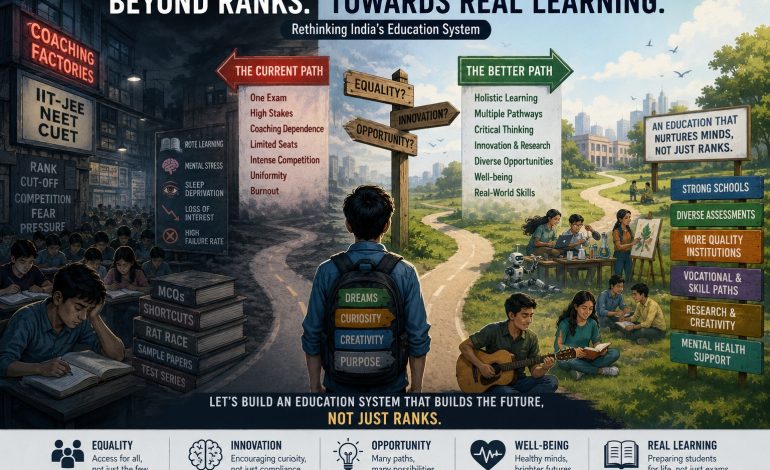
On paper, centralization promised equal opportunity. In reality, it has produced an educational ecosystem increasingly dominated by coaching institutes, private capital, and elite privilege. What was designed as a pathway to merit has gradually evolved into a high-stakes exam industry that often prioritizes rank over learning, speed over understanding, and conformity over creativity.
The Rise of the Examination State
The logic behind centralized testing is straightforward. India has millions of aspirants competing for a limited number of seats in prestigious institutions such as the IITs, AIIMS, NITs, and central universities. A common examination provides a standardized mechanism to compare students from different boards and regions.
However, standardization comes with a hidden cost. Once admission to life-changing opportunities depends on a single examination, the entire education system begins to orient itself around that test. Schools, parents, students, and private institutions adjust their priorities accordingly. Learning becomes secondary; scoring becomes everything.
As a result, examinations no longer assess education—they define it.
Coaching Culture: The Shadow Education System
Perhaps the most visible consequence of centralized admissions is the explosive growth of India’s coaching industry.
Cities such as Kota, Hyderabad, Delhi, and Patna have become synonymous with intensive exam preparation. Thousands of students relocate each year to spend their adolescence immersed in a relentless cycle of mock tests, problem-solving drills, and performance analytics.
The coaching model thrives because centralized examinations are highly predictable. Over time, patterns emerge. Questions repeat in modified forms. Shortcuts replace conceptual understanding. Success becomes less about curiosity and more about mastering an examination strategy.
Students routinely spend eight to twelve hours a day preparing for entrance tests. Many attend “dummy schools” where formal education becomes a mere administrative requirement while coaching takes center stage.
The message is clear: school is optional; coaching is essential.
This parallel education system raises a troubling question. If students need private coaching to succeed in public examinations, what does that say about the effectiveness of mainstream schooling?
Privatization Through the Back Door
Centralized examinations are often portrayed as instruments of equality. Yet they have inadvertently accelerated the privatization of education.
Families with financial resources can afford expensive coaching programs, personalized mentorship, residential training centers, and advanced study materials. Wealthier students gain access to sophisticated preparation ecosystems that significantly improve their chances of success.
Meanwhile, students from rural areas, low-income households, and under-resourced schools often enter the same examination hall carrying vastly unequal advantages.
Technically, everyone takes the same test.
Practically, everyone does not begin from the same starting line.
This phenomenon transforms educational opportunity into a commodity that can be purchased. The result is not merely a coaching culture but a system in which economic capital increasingly converts into educational capital.
The promise of meritocracy becomes difficult to sustain when preparation itself is heavily influenced by income.
How Innovation Gets Squeezed Out
Innovation flourishes in environments that encourage experimentation, collaboration, interdisciplinary thinking, and intellectual risk-taking.
The centralized examination ecosystem rewards almost the opposite.
Students are trained to identify patterns, eliminate options quickly, memorize formulas, and maximize speed. These are valuable skills for competitive examinations, but they are not the same skills required for scientific discovery, entrepreneurship, artistic creation, or original research.
Laboratories, projects, debates, community engagement, and independent inquiry often receive less attention because they contribute little to entrance examination scores.
The consequence is a generation of students who become exceptionally skilled at solving known problems but receive fewer opportunities to explore unknown ones.
In a rapidly changing global economy driven by innovation, creativity, and adaptability, this represents a profound educational contradiction.
The Human Cost of Hyper-Competition
Beyond academic concerns lies a deeper human issue.
The pressure associated with JEE, NEET, and similar examinations begins earlier than ever before. Students often commit themselves to a single career path during their early teenage years, sacrificing extracurricular interests, social experiences, and intellectual exploration.
For many, adolescence becomes less a period of growth and more a prolonged entrance examination.
The emotional consequences are increasingly visible. Anxiety, burnout, depression, and feelings of inadequacy have become recurring features of India’s competitive education landscape. The tragic rise in student suicides within major coaching hubs has intensified concerns about whether the system’s demands have exceeded reasonable limits.
Education should cultivate human potential, not exhaust it.
The Narrow Definition of Success
Another consequence of centralized admissions is the concentration of prestige around a limited set of institutions and professions.
Engineering and medicine continue to dominate the aspirations of millions, not necessarily because they align with students’ interests, but because they are perceived as secure and socially prestigious.
As a result, many talented individuals overlook careers in pure sciences, humanities, social sciences, design, entrepreneurship, public policy, and vocational fields.
A healthy education system encourages diverse forms of excellence. A narrow admission funnel encourages uniformity.
When success is measured primarily by rank, society risks overlooking many other forms of talent.
Why the Problem Is Bigger Than Exams
Centralized examinations did not create all these challenges. They amplified pre-existing structural weaknesses.
India faces a severe shortage of high-quality higher education seats relative to demand. Board examination standards vary widely across states. Employers often place disproportionate value on institutional labels. Alternative pathways such as apprenticeships, vocational education, portfolio-based admissions, and skills certification remain underdeveloped.
In such a context, centralized examinations become the primary mechanism for allocating scarce opportunities.
The real crisis is not merely how students are selected. It is how few quality opportunities exist in the first place.
Reimagining the Future of Admissions
The solution is not necessarily to abolish centralized examinations. They continue to serve important functions related to transparency and standardization.
However, relying on a single examination as the dominant gateway to opportunity is increasingly unsustainable.
Meaningful reform could include:
- Expanding the number and quality of higher education institutions.
- Incorporating project work, portfolios, interviews, and research experience into admissions.
- Strengthening school education so that coaching becomes less necessary.
- Creating robust vocational and professional alternatives.
- Reducing excessive dependence on one-day, high-stakes testing.
- Encouraging universities to experiment with diverse admission models.
- Aligning assessments with creativity, problem-solving, and real-world application rather than rote performance.
Conclusion: From Ranking Students to Nurturing Minds
Centralized examinations were introduced to promote fairness and merit. In many respects, they succeeded. Yet their unintended consequences have transformed education into a competitive marketplace where coaching often matters more than schooling, wealth influences opportunity, and innovation struggles to find space.
India’s challenge is no longer simply identifying talented students. It is creating an education system capable of developing talent in all its forms.
A nation aspiring to become a global innovation leader cannot afford an educational culture that treats young people primarily as ranks, scores, and cut-offs.
The future of education lies not in producing better test-takers, but in nurturing better thinkers.






1 Comment
[…] Source: The Exam Factory: How Centralized Admissions Are Reshaping Indian Education—and Its Seemingly Not … […]