

The Nation, the Outcaste, and the Sacred Order: Inside the Gandhi–Ambedkar Battle over Varna and Democracy
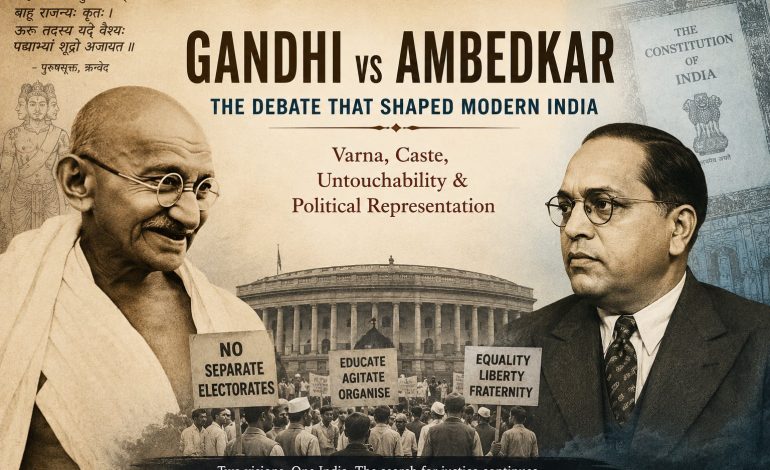

A Nation Being Imagined
India in the late colonial period was not merely fighting for independence. It was wrestling with a far more difficult question: What kind of nation would emerge once the British left?
The struggle against colonial rule often dominates popular memory, but beneath the anti-imperial movement lay fierce debates over representation, citizenship, religion, and social justice. Competing visions of India clashed in legislatures, newspapers, public meetings, and prison cells. Nationalism itself was not a singular idea; it was an arena of contestation.
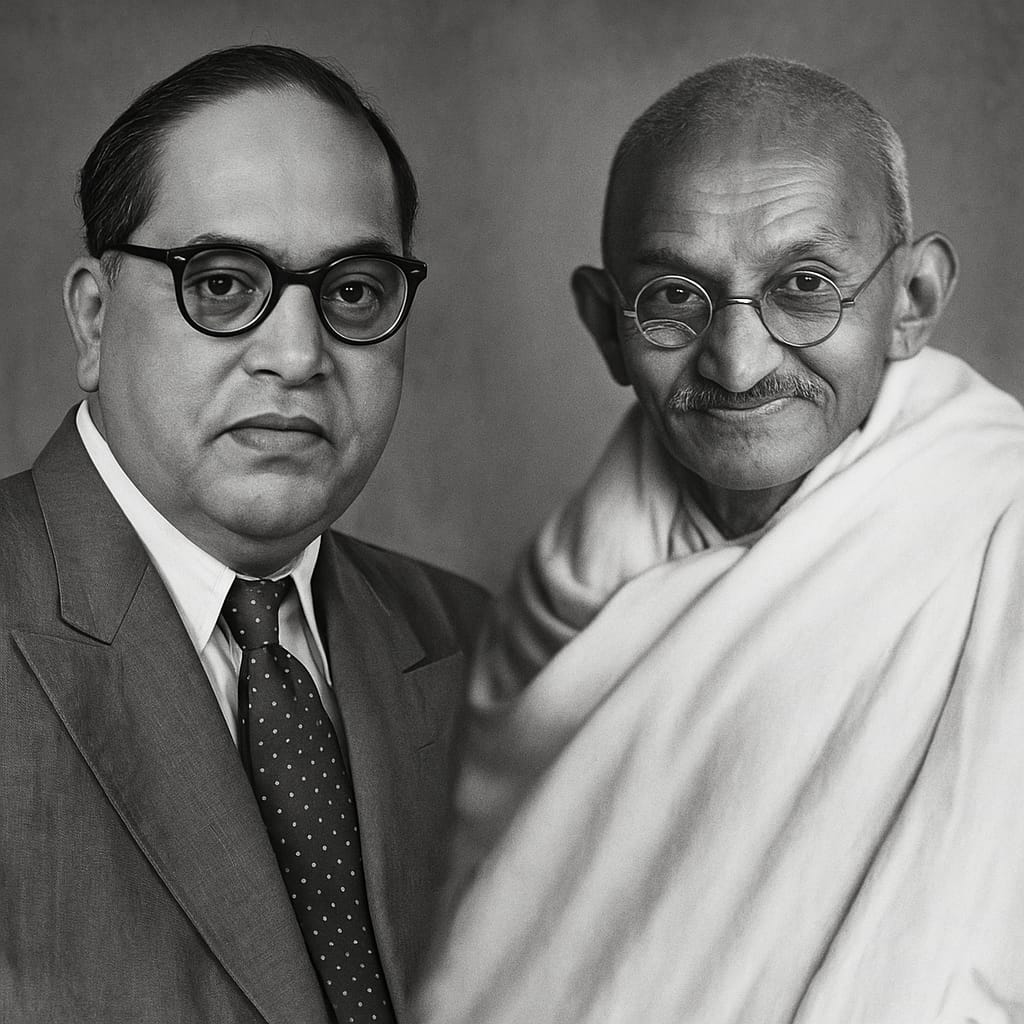
Few confrontations embodied these tensions more profoundly than the debates between Mahatma Gandhi and Dr. B.R. Ambedkar. Their disagreement reached its most dramatic moment in 1932 during the controversy surrounding separate electorates for the Depressed Classes—communities later recognized as Scheduled Castes. Yet the dispute was never merely electoral. Beneath the immediate political conflict lay a much deeper philosophical question:
Could Hindu society reform itself from within, or did justice require the destruction of its foundational social structure?
At the heart of this disagreement stood a single, ancient word: Varna.
The Ancient Body That Became a Social Order
To understand the Gandhi–Ambedkar debate, one must travel back centuries before colonialism, nationalism, or constitutional politics.
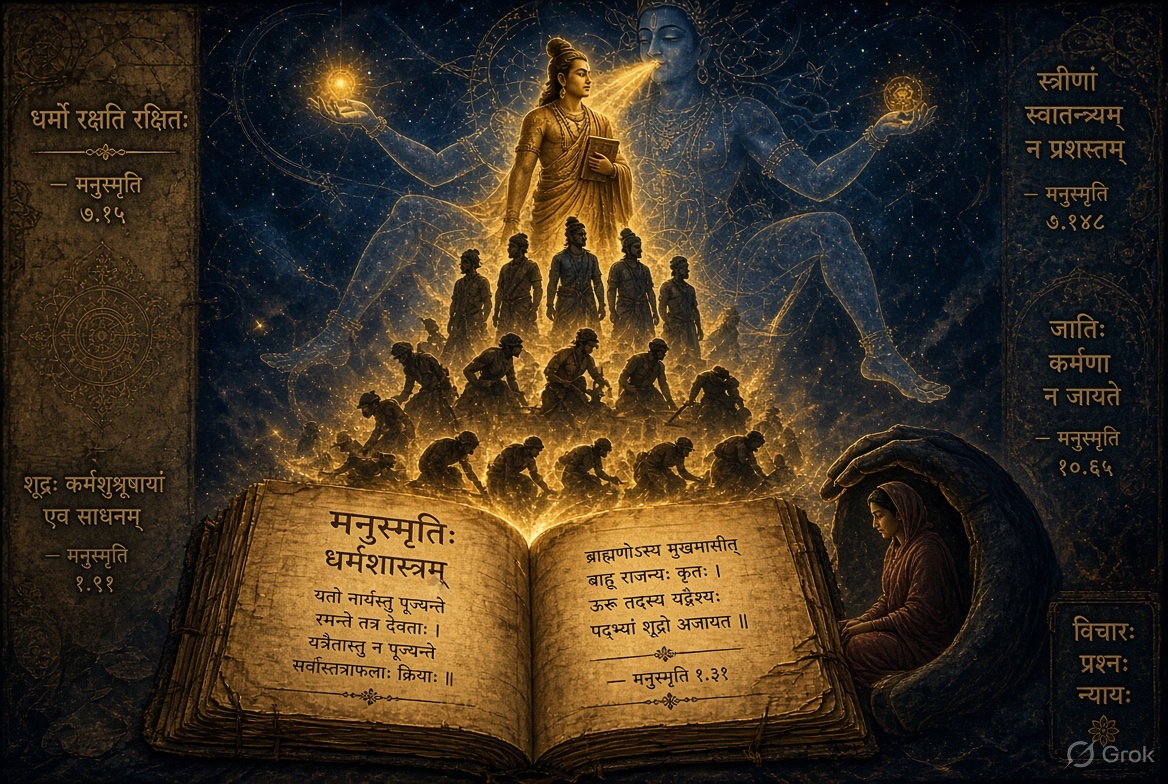
One of the earliest and most influential descriptions of social order appears in the Purusha Sukta of the Rig Veda. The hymn narrates the cosmic sacrifice of Purusha, the primordial being. From his divided body emerged the four varnas:
- From his mouth came the Brahmin.
- From his arms came the Rajanya or Kshatriya.
- From his thighs emerged the Vaishya.
- From his feet arose the Shudra.
For many interpreters, this myth offered a sacred explanation for social organization. Yet it also left behind enduring ambiguities. Did the hymn describe hierarchy or interdependence? Was it a spiritual metaphor or a blueprint for society?
These uncertainties would haunt Indian social thought for centuries.
By the nineteenth century, reformers confronted a society fragmented by thousands of hereditary castes, marked by exclusion, segregation, and untouchability. The question was no longer how the Vedas described society but whether those descriptions could be used to transform it.
The Arya Samaj and the Dream of a Reformed Varna
Among the most influential reform movements was the Arya Samaj, founded in 1875 by Swami Dayanand Saraswati.
Dayanand believed that contemporary caste practices represented a corruption of authentic Vedic principles. His solution was neither the preservation of caste nor its complete abolition. Instead, he proposed a return to what he considered the original four-fold varna system.
In this vision, one’s social position would not be determined by birth. Rather, it would be based on qualities, actions, and disposition—guna, karma, and svabhava. Learned individuals would assess these characteristics and assign social roles accordingly.
The proposal seemed revolutionary. Yet it immediately raised difficult questions.
If human temperament was fixed, then the system would merely recreate hereditary caste under another name. If temperament could change, would an individual’s varna change throughout life? Who would possess the authority to determine these classifications? And could a supposedly flexible system avoid reproducing entrenched inequalities?
These unresolved tensions would later become central to the Gandhi–Ambedkar encounter.
Gandhi’s Search for a Moral Hindu Society
Gandhi inherited many of these reformist concerns.
He unequivocally condemned untouchability, describing it as a moral stain on Hindu civilization. Yet his critique of caste did not extend to a complete rejection of varna. Instead, Gandhi sought to rescue and redefine the concept.
For him, varna represented an ideal of social harmony rather than domination. He envisioned a society composed of interdependent groups whose functions complemented one another without establishing superiority or inferiority. In this reconstructed framework, varna was distinct from caste and entirely separate from untouchability.
Gandhi’s argument rested on a crucial distinction.
Caste was a distortion. Varna was an ideal.
The problem, in his view, was not the principle of differentiated social functions but the hierarchical and oppressive forms it had assumed over time. If stripped of privilege and inequality, varna could become the basis of a cooperative social order.
This idea occupied a central place in Gandhi’s broader understanding of Hinduism. Social reform, for him, required moral regeneration rather than institutional rupture. The task was to purify society, not abandon its foundational categories.
It was an ambitious project.
Ambedkar considered it a dangerous illusion.
Ambedkar’s Refusal of Sacred Hierarchies
For Ambedkar, varna could not be disentangled from history.
Unlike Gandhi, he did not see a distinction between an idealized varna and the lived realities of caste. The vocabulary itself was compromised. It carried the weight of centuries of exclusion, humiliation, and structural violence.
To speak of a purified varna while ignoring caste oppression was, in Ambedkar’s eyes, akin to repairing the façade of a collapsing building while leaving its foundations untouched.
The issue was not merely semantic.
Ambedkar argued that caste was not an accidental corruption of Hindu society. It was one of its organizing principles. The structures of hierarchy were not external distortions imposed upon an otherwise egalitarian system; they were embedded within the very logic of social stratification.
Consequently, any attempt to revive varna—even in a supposedly reformed form—would inevitably reproduce the inequalities it claimed to eliminate.
Where Gandhi saw rehabilitation, Ambedkar saw continuity.
Where Gandhi perceived moral renewal, Ambedkar perceived political evasion.
The Battle Over Social Intimacy
The disagreement became even sharper when the conversation shifted from theory to everyday life.
What would it actually mean to dismantle caste?
For Ambedkar, the answer was straightforward. Caste survived because social groups remained isolated from one another. The barriers separating communities were maintained through strict rules governing marriage and social interaction.
Therefore, inter-caste marriages and inter-dining were not peripheral reforms. They were essential mechanisms for destroying caste consciousness itself.
Without them, caste would simply adapt and endure.
Gandhi’s position evolved over time. Between the 1920s and the 1940s, his views on these questions became more accommodating. Yet he generally maintained that social intimacy could not be imposed as a prerequisite for democratic life.
Marriage, friendship, and dining were matters of personal choice. A just society did not necessarily require everyone to dissolve their communal boundaries.
This difference reveals the deeper divide between the two thinkers.
Gandhi sought harmony among communities.
Ambedkar sought the dismantling of the structures that created those communities in the first place.
1932: When Philosophy Became Politics
The conflict reached a dramatic climax in 1932.
The British government’s Communal Award proposed separate electorates for the Depressed Classes, allowing them to elect their own representatives independently of caste Hindus.
Ambedkar supported the proposal.
His reasoning was rooted in political realism. Communities subjected to systematic exclusion required autonomous political representation. Without institutional safeguards, upper-caste dominance would simply continue under democratic forms.
Gandhi fiercely opposed separate electorates for the Depressed Classes. While he accepted separate representation for certain religious communities, he believed such arrangements would permanently divide Hindu society.
The disagreement culminated in Gandhi’s fast unto death and the subsequent Poona Pact, which replaced separate electorates with reserved seats within a joint electorate system.
The immediate crisis was resolved.
The philosophical conflict was not.
Beyond Heroes and Villains
Contemporary discussions often portray Gandhi and Ambedkar as irreconcilable opposites.
One is cast as the defender of tradition; the other as the architect of radical social justice.
Such portrayals obscure the complexity of their engagement.
Both thinkers sought social transformation. Both recognized the moral catastrophe of untouchability. Both attempted to draw upon ethical and religious resources to reconstruct Indian society.
Yet they diverged fundamentally on the question of whether inherited categories could serve as instruments of liberation.
Gandhi believed they could be reimagined.
Ambedkar believed they had to be discarded.
Their disagreement was not merely about policy. It was a debate about the relationship between history and reform, religion and democracy, identity and justice.
The Unfinished Argument
Nearly a century later, the Gandhi–Ambedkar debate remains unresolved.
Questions of representation, social equality, affirmative action, caste discrimination, religious reform, and constitutional morality continue to shape public life in India. The vocabulary may have changed, but the underlying tensions persist.
Can social structures be morally renovated, or must they be fundamentally dismantled? Can inherited traditions become vehicles of emancipation, or are they inevitably burdened by their histories?
The debate between Gandhi and Ambedkar endures because it confronts these questions with extraordinary clarity. It reminds us that the making of modern India was never only a struggle against colonial rule. It was also a struggle over the meaning of freedom itself.
And at the center of that struggle stood two of the twentieth century’s most formidable political minds, arguing not merely about the future of Hindu society, but about the moral architecture of the nation yet to come.




1 Comment
[…] Source: The Nation, the Outcaste, and the Sacred Order: Inside the Gandhi–Ambedkar Battle over Varna and D… […]