

When Big Ben Strikes: Time, Trauma, and the Search for Authenticity in Mrs. Dalloway
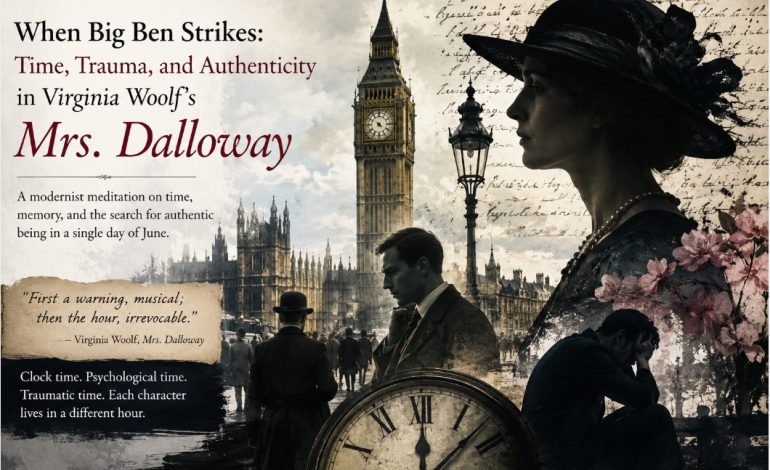

“First a warning, musical; then the hour, irrevocable.”
— Virginia Woolf, Mrs. Dalloway
Few novels make readers feel time as intensely as Virginia Woolf’s Mrs. Dalloway. The novel unfolds over the course of a single June day in London, yet within those ordinary hours witness decades of memory, regret, desire and mortality. Every strike of Big Ben interrupts thought, redirects consciousness, and reminds the characters that time is not simply passing—it is shaping their existence.
Time has served as a significant muse for many modernist writers, but Woolf is not overly engrossed in clocks alone. She explores the invisible rhythms of consciousness, memory and psychological experience. In doing so, Mrs. Dalloway becomes much more than a “single-day novel.” It becomes a philosophical deliberation on what it means to exist within time.
Big Ben: More Than a Clock
Big Ben is often seen as a symbol of chronological time, but in Mrs. Dalloway it decodes something far more unsettling. Every chime interrupts the fluid movement of consciousness with the authority of historical and public time.
When Clarissa Dalloway hears the familiar sound, “First a warning, musical; then the hour, irrevocable,”
the weight falls not on the hour itself but on its irreversibility. The word irrevocable transforms the clock from a neutral instrument into a reminder that every passing moment is permanently lost. The clock does not simply measure time, rather the very clock becomes an instrument of its enforcement.
Interestingly, Woolf constructs Clarissa’s thoughts through long, meandering sentences filled with pauses, repetitions, and digressions. Before Big Ben strikes, language itself appears suspended, as though consciousness resists moving forward. The clock interrupts this resistance. External time repeatedly invades internal time.
This tension between psychological time and clock time becomes one of the defining structures of this novel.
Woolf’s Hidden Conversation with Heidegger
Although Woolf and Martin Heidegger approached existence from different traditions, Mrs. Dalloway remarkably illustrates many of the philosophical concerns articulated in Being and Time. For Heidegger, human existence or Dasein—is fundamentally temporal. We are dynamic beings, as we continuously stive to project ourselves toward future possibilities. Yet our routine life tempts us to forget this condition. We tend to get overly preoccupied in routine, convention, and what Heidegger famously calls das Man—”the They, “the anonymous social world that tells us how to live. Today social media anonymously but significantly influence our choices and lifestyle, for instance.
Wolf argues that authenticity begins only when one confronts mortal questions directly. Heidegger calls this orientation being-towards-death: not an obsession with dying, but an honest acknowledgment that death gives shape and urgency to life itself.
In this backdrop, Wolf asks a philosophical but equally unsettling question: What happens when two people inhabit time in radically different ways?
Clarissa: Living by the Clock
Clarissa Dalloway is deeply connected to the rhythms of ordinary life. She organizes parties, fulfills social obligations, worries about appearances, and moves through London according to public schedules. Her life seemingly preoccupies with insignificant activities such as buying flowers, preparing for parties, walking through London, dressing, greeting people and pondering about people from her past. Yet beneath this carefully crafted and maintained surface resides someone haunted by memory. Wolf transforms her ordinary routine life into profound existential reflection.
Rather than embracing the future, Clarissa repeatedly returns to the past—particularly to Peter Walsh and Sally Seton. Visiting these memory lanes make Clarissa temporally disconnected with present. For Clarissa, memory is an act of habitation, and it is less an act of recollection. Wolf uses Clarissa’s party as form of forward moving structure.
But Clarissa does not merely remember the past, she lives there. The striking of Big Ben repeatedly compels her to go back into chronological reality of time, creating a silent but persistent discord between lived experience and measurable time.
In other words, Clarissa often becomes prisoner of the past not because she intends to return to her youth, but because her identity is continuously shaped as well as interrupted by past experience that no longer can be recovered. Past frequently interrupts her present. She goes to buy flower for her party but any object, sound, person, place or thing can transport her decades backward. As past frequently invades her present, her consciousness does not move chronologically.
Peter Walsh: the emotional centre of Clarissia’s past
Peter Walsh functions as a powerful link between Clarissa’s present and the past she repeatedly revisits. Interestingly, while Clarissa occasionally escapes into memory, Peter seems almost imprisoned by it. His failed relationship with Clarissa becomes the emotional epicentre of his identity, so that his recollections remain deeply attached to regret. Whereas Clarissa’s memories often open onto moments of possibility, Peter’s memories continually return him to what has been lost. He therefore appears suspended in the past, unable to separate his emotional life from an experience that chronological time has supposedly left behind. This tension becomes particularly significant in Woolf’s use of Big Ben. The striking of the clock is presented as almost violent, interrupting Peter’s private reflections with the relentless movement of external, chronological time. Yet this mechanical progression does not heal his emotional wounds; instead, it intensifies his awareness of how little he has changed internally. Through Peter, Woolf therefore exposes a tension between chronological time, which moves inexorably forward, and psychological time, in which the past can remain intensely present.
This is crucial from a Heideggerian perspective, as the past matters because it contains an unrealized possibility of the self.
Septimus Warren Smith: Trauma Outside Ordinary Time
Septimus exists in an altogether different temporal universe. Traumatized by war, he experiences neither the comforting routines of public life nor the nostalgic inhabitation of memory. Past, present, and future collapse into one another. Hallucinations dissolve conventional chronology, making external time almost meaningless.
Paradoxically, this psychological fragmentation allows Septimus to perceive something the socially adjusted characters cannot.
He recognizes that existence is inseparable from mortality.
Unlike Clarissa, whose awareness of death remains muted beneath social performance, Septimus confronts it directly. His final act has often been interpreted solely as psychological collapse. Yet it can also be read philosophically—as a tragic confrontation with finitude that refuses comforting illusions.
This interpretation is undoubtedly disturbing.
Authenticity in Heidegger is not the same as heroism, nor does it romanticize self-destruction. Septimus’s suicide remains a consequence of unbearable trauma and failed care. Yet his relentless awareness of mortality exposes truths that the rest of society continually suppresses.
His tragedy lies not only in his suffering but in the world’s inability to understand it.
Two Ways of Living Time
What makes Mrs. Dalloway extraordinary is that Woolf never simply contrasts sanity with madness or society with isolation. She contrasts temporal experiences.
Clarissa lives according to clocks while longing for lost possibilities. Peter lives inside emotional wounds that refuse to heal. But Septimus inhabits a fractured temporality where death is no longer an abstraction but an immediate presence.
The novel suggests that psychological life cannot be contained within chronological measurement. The hours announced by Big Ben are shared by everyone, yet each character inhabits those hours differently.
The same afternoon. But entirely different worlds.
Why Mrs. Dalloway Still Feels Contemporary
Nearly a century after its publication, Woolf’s novel speaks with surprising urgency.
Modern life has become even more governed by measurable time—deadlines, notifications, calendars, productivity trackers, and digital clocks. Yet our inner lives continue to obey different rhythms. Grief stretches minutes into years. Joy compresses hours into moments. Memory ignores chronology altogether.
Woolf reminds us that the most significant experiences of being human rarely unfold according to the clock. Perhaps this explains why Big Ben continues to echo throughout the novel.
Each chime asks a question that remains profoundly modern: Are we truly living our own time—or merely keeping time with everyone else?
Chandra, S. 2026
References
- Edmondson, Annalee. “Narrativizing Characters in Dalloway.” Journal of Modern Literature, vol. 36, no. 1, 2012, pp. 17–36. JSTOR, https://doi.org/10.2979/jmodelite.36.1.17. Accessed 9 Nov. 2022.
- Heidegger, M. (2007). Being and Time. HarperCollins
- Randall, B. (2016) A day’s time: the one-day novel and the temporality of the everyday. New Literary History, 47(4), pp. 591- 610.(doi:10.1353/nlh.2016.0031)
- Scott, D. The “concept of time” and the “being off the clock”: Bergson, Einstein, Heidegger, and the interrogation of the temporality of modernism. Cont Philos Rev39, 183–213 (2006). https://doi.org/10.1007/s11007-006-9023-4
- Woolf V., (2017), Mrs. Dalloway. Worldview publications






2 Comments
[…] Source: When Big Ben Strikes: Time, Trauma, and the Search for Authenticity in Mrs. Dalloway […]
[…] लोग हैं, गाड़ियाँ हैं, मुलाकातें हैं। Clarissa Dalloway एक पार्टी की तैयारी कर रही है। उसे फूल […]