

When Thought Escapes the Mind: Samuel Beckett’s Not I and the Strange Intelligence of the Mouth
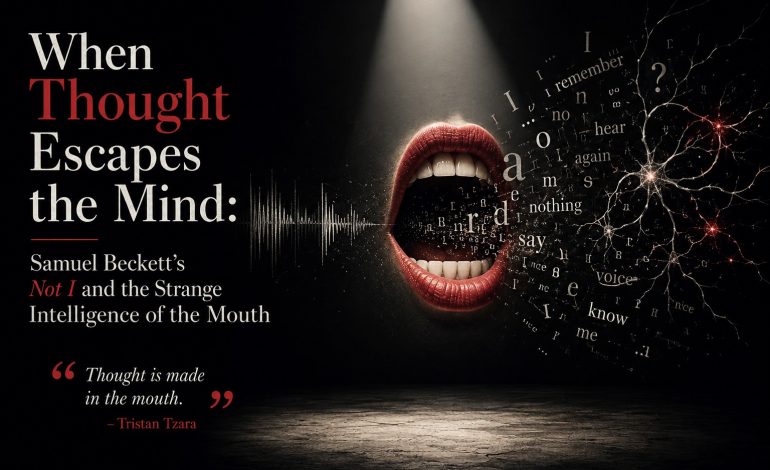

Imagine entering a dark theatre. The stage is swallowed by blackness. There is no scenery, no recognizable human figure, no comforting sense of place. Suddenly, a single mouth appears, suspended in the void, illuminated by a harsh beam of light. It speaks at breakneck speed—fragmented memories, unfinished thoughts, screams, silences, corrections, and repetitions pouring out in a relentless torrent. This is Samuel Beckett’s Not I, one of the most unsettling and revolutionary theatrical experiments of the twentieth century.
At first glance, the play seems almost nonsensical. Yet hidden within its apparent chaos is a profound question: What if thought does not originate in the mind at all? What if, as Dadaist provocateur Tristan Tzara once suggested, “thought is made in the mouth”?
A Mouth Without a Body
Language has traditionally been treated as the supreme instrument of reason. We speak to communicate ideas, construct arguments, and establish meaning. The mouth, in this framework, serves merely as a vehicle for the mind.
Beckett radically overturns this assumption.
In Not I, the human body is dismantled. The audience does not encounter a complete person but only a mouth detached from every familiar marker of identity. Gender becomes uncertain. Personality dissolves. The notion of a coherent self begins to collapse.
The mouth remains.
This theatrical dismemberment recalls the concept of the “Body without Organs,” developed by Antonin Artaud and later expanded by Gilles Deleuze and Félix Guattari. Their argument challenges the idea that a body can ever be neatly organized into stable categories and functions. Human existence, they suggest, exceeds the intellectual systems that attempt to define it.
Beckett’s floating mouth becomes a vivid embodiment of this challenge. It resists wholeness. It refuses classification. It exists as a fragment that somehow speaks more powerfully than a complete body ever could.
When Speech Arrives Before Meaning
Anyone who has spoken in moments of excitement, fear, or grief knows the strange sensation of words arriving before thought fully forms.
Beckett amplifies this phenomenon.
The voice in Not I races forward with such speed that it appears unable to keep up with itself. Memories emerge in fragments. Sentences begin and collapse. Meaning flickers in and out of existence.
The audience is left wondering: does thought produce speech, or does speech produce thought?
This uncertainty lies at the heart of Beckett’s experiment. Rather than presenting language as a clear channel of communication, he reveals it as something unstable, physical, and deeply mysterious. Speech becomes less an expression of reason than an event unfolding through the body.
In this sense, the mouth is no longer simply speaking thoughts—it is generating them.
Kafka’s Singing Mouse and the Power of Nonsense
A surprising parallel emerges in Franz Kafka’s story Josephine the Singer, or the Mouse Folk.
Josephine performs before a community of mice who gather in rapt attention. Yet no one can clearly determine whether she is truly singing. Her sounds often resemble ordinary squeaks. They communicate no obvious message.
And yet they matter profoundly.
Her audience experiences unity, comfort, and belonging through sounds that seem almost devoid of meaning.
This is precisely the territory Beckett explores.
Like Josephine’s song, the voice in Not I suggests that communication may occur beyond conventional language. Emotional exchange does not always depend upon clear statements or logical arguments. Sometimes a cry, a vibration, a rhythm, or a fragmented utterance can create connection more effectively than perfectly structured speech.
What appears to be nonsense may conceal another form of sense altogether.
The Audience Becomes Part of the Performance
One of the most remarkable aspects of Not I is the way it transforms the audience.
Viewers do not simply observe the mouth; they struggle alongside it.
The rapid-fire speech, the fragmented narrative, and the absence of visual context create a form of sensory deprivation. Understanding becomes difficult. Certainty becomes impossible.
Yet this confusion is precisely Beckett’s point.
The audience participates in the disorientation. They become co-creators of meaning, attempting to assemble fragments into something coherent while recognizing that complete coherence may never arrive.
In this process, listening becomes an act of compassion.
The voice may not fully understand itself, but the audience is called upon to hear it nonetheless.
Fragmentation as a New Form of Truth
Modern literature has long been fascinated by fragmentation, but Beckett pushes the idea to its extreme.
The mouth in Not I exists in a state of perpetual rupture. Identity is fragmented. Memory is fragmented. Language itself is fragmented.
Yet these fractures reveal something essential about human experience.
Loss, trauma, confusion, and isolation often resist orderly narration. They cannot always be translated into neat sentences or logical explanations. The broken structure of Beckett’s play mirrors the broken structures of lived reality.
The result is not a failure of communication but a different mode of communication altogether.
Fragmentation becomes its own language.
Why Beckett’s Not I Still Matters
More than half a century after its first performance, Not I remains startlingly contemporary.
In an age saturated with information, Beckett reminds us that communication is not merely the transfer of meaning from one mind to another. Human expression begins in the body—in breath, sound, rhythm, and sensation.
The isolated mouth on Beckett’s stage becomes both a presence and an absence. It occupies a space between language and silence, thought and speech, self and other.
By stripping away everything except the mouth, Beckett exposes the fragile foundations upon which meaning itself rests.
And perhaps that is the enduring lesson of Beckett’s Not I : the most profound forms of thought may emerge not from perfect clarity, but from uncertainty; not from coherence, but from fragmentation; not from the mind alone, but from the strange, embodied mystery of the mouth.
In Beckett’s dark theatrical void, nonsense is never merely nonsense. It is the place where language confronts its limits—and where entirely new possibilities begin.
Chandra, S. 2026
References
Beckett, Samuel. Collected Shorter Plays. New York, Grove Press, 1984.
Catanzaro, Mary. “Recontextualizing the Self: The Voice as Subject in Beckett’s ‘Not I.’” South Central Review, vol. 7, no. 1, 1990, pp. 36–49. JSTOR, https://doi.org/10.2307/3189212.
Deleuze, Gillies. The Logic of Sense. Columbia University Press 1990.
Kafka, Franz, 1883-1924 and Nahum N. 1903-1990. Glatzer, The Complete Stories. New York, Schocken Books, 1988
Schuman, Rebecca. “Kafka’s ‘Verwandlung’, Wittgenstein’s ‘Tractatus’, and the Limits of Metaphorical Language.” Modern Austrian Literature, vol. 44, no. 3/4, 2011, pp. 19–32. JSTOR, http://www.jstor.org/stable/24649857.
Tzara, Tristan. Seven Dada Manifestos and Lampisteries, Barbara Wright, trans, John Calder Ltd, London, 1977, p 35