

“Why Cancel Culture is Destroying Justice AND Forgiveness”
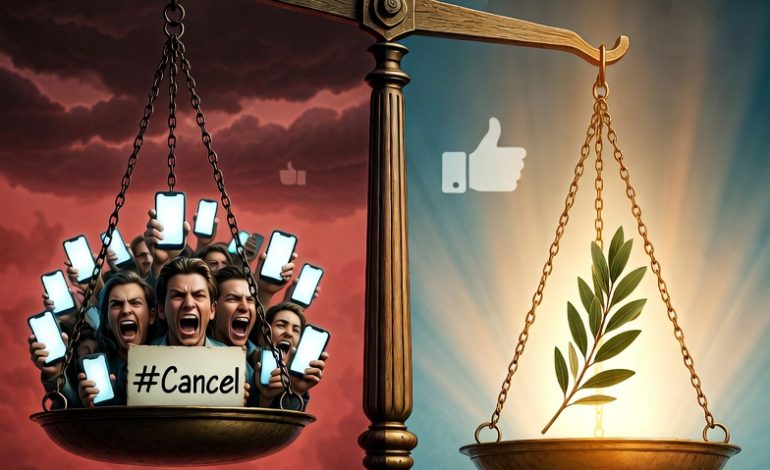

Cancel culture
Cancel culture refers to the widespread practice of publicly calling out, shaming, boycotting, or ostracizing individuals (or organizations) for perceived moral transgressions, often amplified by social media. It raises deep philosophical questions about accountability, punishment, redemption, and the balance between forgiveness and justice.
Philosophical Foundations
Justice has long been central to philosophy. In its retributive form (often associated with “an eye for an eye”), it emphasizes proportional punishment to restore moral balance, as in Kantian deontology where wrongdoers deserve consequences regardless of outcomes. Cancel culture frequently operates in this retributive mode: public exposure and professional/social ruin serve as punishment for offenses ranging from serious harm to past statements or “wrong-think.”
By contrast, restorative justice and transformative justice prioritize repairing harm, addressing root causes, and reintegrating the offender where possible. These approaches draw from indigenous practices, Christian ethics (e.g., Desmond Tutu’s Truth and Reconciliation in South Africa), and modern theorists. They ask: What does the victim need? How can relationships and community be mended? Cancel culture is often critiqued for sidelining this in favor of permanent exclusion, reducing complex people to their worst moments.
Forgiveness, philosophically, is not the absence of justice but a potential complement or alternative. It involves releasing resentment and forgoing (some) punishment, as in Aristotle’s virtue ethics (magnanimity) or Stoicism’s emphasis on mercy and human fallibility alongside reformative justice. Christian traditions (e.g., “turn the other cheek,” grace) strongly champion it, contrasting with cultures of perpetual atonement without redemption. Critics of cancel culture argue it creates an “unsustainable” demand for atonement without paths to forgiveness, fostering hypocrisy and fear rather than moral growth.
A notable German philosopher, Nietzsche, offers a sharp lens via ressentiment (reactive resentment). In On the Genealogy of Morals, he describes how the weak or powerless invert values, creating “slave morality” through imaginary revenge against the strong. Cancel culture can manifest this: collective outrage channels frustration into moral grandstanding, essentializing individuals as irredeemable symbols of evil. This risks sadistic spectacle (like a “21st-century guillotine”) over genuine justice.
Psychological Dimensions
Moral Foundations Theory (Jonathan Haidt) posits six foundations: Care/Harm, Fairness/Cheating, Loyalty/Betrayal, Authority/Subversion, Sanctity/Degradation, and Liberty/Oppression. Cancel culture often activates Care/Harm (protecting victims), Fairness, and Sanctity/Purity (treating certain offenses as moral contamination requiring expulsion). Progressive-leaning groups may weigh individualizing foundations (Care, Fairness) more heavily, while binding ones (Loyalty, Authority, Sanctity) can fuel in-group enforcement on all sides. This explains why offenses often feel existential
Social psychology highlights mob mentality and deindividuation: online anonymity and group dynamics reduce personal responsibility, amplifying outrage into disproportionate punishment. Groupthink suppresses dissent, while social identity theory drives in-group validation through out-group shaming. Attribution theory underscores the fundamental attribution error—viewing others’ actions as dispositional (they are bad) rather than situational—reducing chances for empathy or context.
Forgiveness research (e.g., models by Everett Worthington) shows it reduces personal stress, promotes healing, and requires empathy, apology, and perspective-taking. Shame (global self-attack: “I am bad”) breeds defensiveness and hiding, while guilt (behavior-specific: “I did bad”) encourages repair. Cancel culture often induces shame, hindering redemption and fostering self-censorship or performative allyship.
Impacts include anxiety, mental health strain for targets, and broader societal chilling effects on discourse. Proponents see it as validating for marginalized groups when formal systems fail, providing collective empowerment.
Forgiveness vs. Justice in Tension
Justice without forgiveness risks endless cycles of retribution, eroded trust, and a “Reign of Terror” dynamic where no one is safe from past sins. It can undermine due process, proportionality, and growth (no room for redemption).
Forgiveness without justice risks enabling harm, failing victims, and moral relativism. Not all acts warrant forgiveness (e.g., unrepentant severe abuse), and private forgiveness differs from public accountability.
Balanced view
Many advocate hybrid approaches—consequences proportional to harm (justice), plus pathways for amends, dialogue, and reintegration (restorative elements with forgiveness where earned). Education, perspective-taking, and clear norms for redemption counter punitive excess.
Cancel culture reflects real demands for accountability in an era of weakened traditional institutions, but its philosophy often tilts toward retributive purity over nuanced, humane justice. Drawing on restorative models, moral psychology, and virtues like mercy offers a path toward cultures that condemn acts without permanently condemning persons—fostering both truth and reconciliation. The challenge lies in applying this consistently amid polarized incentives and digital amplification.





1 Comment
[…] Source: “Why Cancel Culture is Destroying Justice AND Forgiveness” […]