
When Gods Chose Sides: Divine Intervention and the Fragile Morality of Mythology
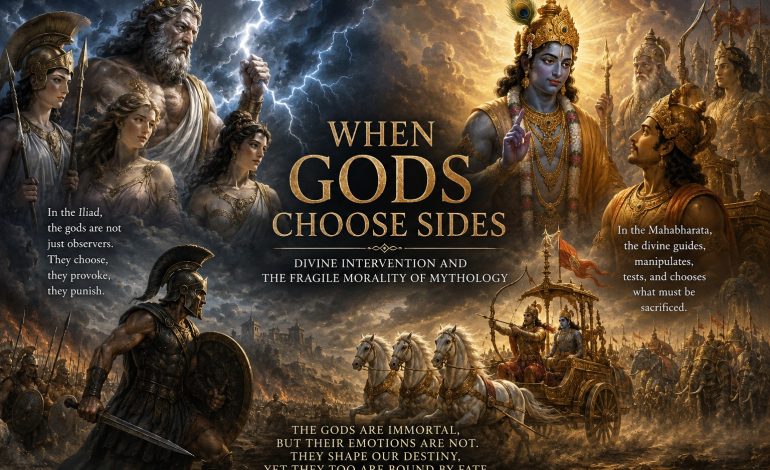

The battlefield was not silent when men died.
Above the burning plains of Troy, gods argued like wounded kings. Athena whispered strategy into mortal ears. Aphrodite rescued Paris not because he deserved saving, but because she loved being worshipped. Hera’s jealousy became a political force. Zeus himself sat suspended between power and helplessness, watching fate unfold even when it threatened those he loved.
Thousands of miles away, on another battlefield imagined centuries later, Krishna stood between two armies at Kurukshetra. A charioteer, a guide, a god. Around him stood brothers prepared to slaughter brothers in the name of righteousness. And there too, divine intervention shaped destiny—not through thunderbolts, but through persuasion, manipulation, and moral ambiguity.
Greek mythology and Hindu mythology may belong to different civilizations, yet both ask the same unsettling question:
What happens when gods interfere in human morality?
The answer is rarely comforting.
In Homer’s Iliad, the gods do not represent perfect justice. They are emotional, partial, and deeply human in their desires. The Trojan War itself continues not merely because of human pride, but because immortals refuse to let go of personal grudges. Athena and Hera despise Troy because Paris once declared Aphrodite the fairest goddess. A war that destroys thousands begins, in part, from divine vanity.
That is what makes Greek mythology strangely modern. The gods are not distant ideals sitting above humanity; they are reflections of humanity’s own flaws magnified to cosmic proportions.
Zeus, the king of the gods, commands thunder and destiny, yet even he is vulnerable to temptation and indecision. In one moment, he appears supreme, and in another he becomes a conflicted father unable to save his own son, Sarpedon, from death because fate has already written the ending.
Power exists, but it has limits.
The same contradiction appears in the Mahabharata. Krishna is often seen as the embodiment of divine wisdom, yet his methods complicate conventional morality. He urges Yudhishthira to speak a half-truth that leads to Dronacharya’s downfall. He encourages Bhima to strike Duryodhana below the waist against the rules of combat. He orchestrates victory, but not always through purity.
And yet Krishna is not portrayed as evil.
That is the brilliance of Hindu mythology. Morality is not treated as rigid or simplistic. The preservation of dharma sometimes demands actions that appear morally uncomfortable. Justice becomes layered, strategic, and painfully human.
This is where mythology becomes more than fantasy.
Both the Iliad and the Mahabharata understand something essential about human civilization: people rarely fight wars believing themselves to be villains. Every side believes it carries righteousness. Every warrior seeks divine approval. And gods, instead of resolving moral confusion, often deepen it.
Achilles fights with unstoppable rage after the death of Patroclus, becoming almost inhuman in his thirst for revenge. Arjuna collapses emotionally before battle, unable to reconcile duty with compassion. One is consumed by anger; the other by conscience. Yet both stand at the center of stories shaped by divine influence.
The gods intervene, but they do not erase suffering. In fact, they intensify it.
There is something haunting about this recurring image across mythologies: immortals shaping the destinies of fragile mortals while remaining trapped within their own desires, rivalries, and cosmic obligations. Greek gods envy, seduce, deceive, and punish. Hindu gods guide, test, and sometimes destroy to restore balance. Neither tradition presents divinity as emotionally detached.
Instead, divinity becomes deeply entangled with human chaos. Perhaps that is why these stories continue to survive centuries after empires collapsed and temples faded. Mythology does not comfort us with perfect morality. It forces us to confront uncertainty. It asks whether justice can ever exist without sacrifice. Whether power inevitably corrupts. Whether destiny leaves any room for free will.
Most importantly, it reminds us that humans created gods who looked remarkably like themselves.
The Olympians sitting on Mount Olympus and the divine figures standing on the fields of Kurukshetra are mirrors reflecting ancient fears and desires. Through them, civilizations explored anger, grief, pride, revenge, duty, and moral conflict.
In both Hindu and Greek Mythology, immortals act as catalyst forces that provide their assistance in fulfilling the plans of destiny. It is imperative to notice that the entire mythological narrative revolves around the central theme ‘will of god’. But the Interplay of divine will and human impulse drives mythology (weather Hindu or Greek Mythology)
And maybe that is the greatest irony hidden within mythology:
Even the gods could not escape the tragedy of being human.
References
- Kullmann, Wolfgang. “Gods and Men in the Iliad and the Odyssey.” Harvard Studies in Classical Philology, vol. 89, 1985, pp. 1–23. JSTOR, jstor.org/stable/311265. Accessed 28 Jan. 2021.
- Jebb R. “the epic poetry” Primer of Greek literature, Part 1, the early literature; to 475 BC.1877, pg14-22.
- Jones, Nathanael (2017) “The Justice of the Gods in Homer and the Early Greek Plays,” Journal of Interdisciplinary Undergraduate, Research: Vol. 9, Article 1.
- The iliad. Trans (in English) E.V.Rieu, London: Penguin Books, 2003